OneNIOS Study Hub
Biology — Class 12 — L19: Reproduction in Plants
Lesson-19.pdf). Content covers sections 19.1–19.8.Overview — Continuing the species
Reproduction is production of one’s own kind for continuity of the species and replacement of dead members. Modes vary: cell division, fragmentation, buds, spores, or elaborate sexual organs (stamens and pistils). All organisms pass hereditary material to offspring. This NIOS Module 3 lesson covers vegetative, asexual and sexual modes; Chlamydomonas and Spirogyra; flowering-plant sexual cycle (flower, pollen, ovule, pollination, double fertilisation, seed, fruit); germination; natural and artificial vegetative propagation; and micropropagation.
After this lesson you should define reproduction; compare the three modes; describe lower-plant and angiosperm sexual paths; draw pollen and embryo sac ideas; state pollination types; explain double fertilisation and seed/fruit; and list vegetative and tissue-culture methods. Notes follow textbook order only. Link to L7: flower parts and placentation. Link to L11: photoperiod and flowering factors.
Section 1: Modes of reproduction (19.1)
Three types: vegetative, asexual, sexual.
Asexual and vegetative (no gamete fusion): single parent; offspring genetically identical (clones); only mitosis needed for growth of the new unit.
- Vegetative: new plantlets from somatic cell, bud or organ (root, stem, leaf, bud detaches and grows). Discussed fully for angiosperms later.
- Fragmentation: filament breaks; each piece with ≥1 cell grows (Spirogyra).
- Fission: parent cell content → 2, 4 or 8 daughters (bacteria, yeasts).
- Budding: outgrowth separates (yeast).
- Asexual by spores: flagellate or not; bryophytes/pteridophytes; higher plants heterosporous — microspores → male gametophyte, megaspores → female after meiosis.
Sexual: fusion of haploid male and female gametes → diploid zygote → new individual. Meiosis at some stage; offspring not exact clones — mixed parental characters.
Apomixis: asexual seed formation without pollination/fertilisation (e.g. dandelions). Diploid somatic cell of ovule becomes embryo; ovule → seed still dispersed like sexual seeds. “Away from act of mixing.” MCQ option: development without fusion of gametes — not darkness or cold alone.
Sexual reproduction is not “better” in every niche: clones preserve a proven genotype in stable habitats; sex pays off when environments change because offspring vary. Exam answers should still list single parent and identical offspring for asexual/vegetative, and fusion plus genetic difference for sexual.
Section 2: Chlamydomonas (19.2.1)
Haploid freshwater unicellular alga; pear-shaped; two flagella; eye spot; cup chloroplast with pyrenoid; central nucleus.
Asexual: with water → zoospores (flagellate, thin wall) by mitosis of protoplast (2–16), parent wall ruptures. Thin film → aplanospores (non-flagellate); colonial-looking Palmella stage; flooding restores flagella. Drought → thick dark hypnospores that later release zoospores.
Sexual: isogamy (morphologically identical gametes, e.g. C. eugametos); anisogamy (larger female, smaller male — C. braunii); oogamy (non-motile egg, motile sperm — C. coccifera, C. ooganum). Zygote thick-walled resting stage; only diploid stage; meiosis → 4 haploid zoospores → adult plants.
Isogamy detail: non-motile parents form 32–64 flagellate gametes by mitosis; fusion of gametes from different mothers → quadriflagellate zygote → resting zygospore. Anisogamy: male side more gametes (32–64), female fewer larger (8–16); larger gamete becomes non-motile and is fertilised by smaller. Oogamy: entire female content is one egg; many male gametes enter but one fertilises. In all cases meiosis is in the zygote — key one-liner for “where does meiosis occur in Chlamydomonas?”
Section 3: Spirogyra (19.2.2)
Filamentous freshwater alga; spiral chloroplasts with pyrenoids; large vacuole; central nucleus on cytoplasmic strands.
Vegetative: fragmentation at septa. Sexual conjugation:
- Scalariform: two filaments ladder-like; conjugation tubes; male content moves into female; zygospore in female cells; male filament empty. Meiosis in zygospore → 4 haploid nuclei, 3 degenerate → one filament.
- Lateral: one filament; male and female cells alternate in pairs; lateral tube across septum.
Body cells form gametes without meiosis → plant is gametophyte (haploid), like Chlamydomonas.
Scalariform sequence for long answers: filaments align septum-to-septum → conjugation tubes → cytoplasm rounds into gametes → male amoeboid transfer → zygospore thickens and darkens for unfavourable period → meiosis on return of favour → three haploid nuclei degenerate → one nucleus forms young filament by mitosis. Lateral conjugation uses one filament only, with alternating male/female pairs and tubes beside septa. After scalariform sex, male filament cells are empty; female cells hold zygospores — exam diagram clue.
Section 4: Angiosperm flowering framework (19.3)
Sexual reproduction by fusion of gametes in the flower — reproductive unit. Annuals complete cycle in one season (pea); biennials vegetative then flower second season (radish); perennials live years (mango). Monocarpic reproduce once then die (bamboo, agave, annuals/biennials); polycarpic flower many times (mango, guava).
Juvenile vs adult shoot: adult responds to flowering stimuli; cereals need minimum leaf number. Factors: vernalisation (cold promotes flowering); photoperiodism (day/night length). Sex of flowers: bisexual or unisexual; hormones can reverse sex (gibberellin → male in Cucumis; auxin/ethylene → female; also Cannabis).
Flower whorls on thalamus: calyx, corolla (accessory); androecium, gynoecium (essential). Absence of stamens or carpels fails sexual reproduction.
Juvenile shoots are soft with few young leaves and do not respond to flower stimuli; adult shoots are branched, leaves change form/size, and can flower. Transition from vegetative apex to floral apex may take years in trees but weeks in annuals. Cereals need a minimum leaf number (textbook: about seven) before flowering. Photoperiodism is response to length of light and dark in sequence; vernalisation is cold pretreatment that speeds flowering in some species. External gibberellin can induce male flowers on genetically female Cucumis; auxin or ethylene can produce functional female flowers on male plants — also seen in Cannabis.
Section 5: Male side — microsporangium and pollen (19.4)
Stamen = anther (4 microsporangia/pollen sacs) + filament. Microspore mother cells (MMC) meiosis → haploid microspore tetrads. Wall layers include epidermis, middle layers, tapetum (nourishes pollen). Mature microspore = pollen grain = male gametophyte precursor.
Pollen wall: durable exine (sporopollenin, germ pores) + thin intine. Nucleus divides → large vegetative cell + small generative cell; released at dehiscence. Pollen itself is not the male gamete — it produces male gametes (sperm). Generative cell divides to two sperms (often by three-celled stage on stigma).
Microsporogenesis sequence: four pollen sacs in anther → sporogenous tissue as MMCs with dense cytoplasm → meiosis yields tetrads of haploid microspores → free pollen grains. Wall layers outer epidermis, thin middle layers, tapetum of large nutritive cells. Exine patterns help identify species under microscope. Germ pores are thin areas where the pollen tube emerges. At dehiscence the stomium splits along a line of weakness — mechanical release of dry pollen into air or onto insect bodies.
Section 6: Female side — ovule and embryo sac
Pistil: stigma, style, ovary with ovules. Ovule: nucellus, integuments, micropyle, funiculus, chalaza. MMC meiosis → 4 megaspores; usually 3 degenerate; functional megaspore → 3 mitoses → 8 haploid nuclei → embryo sac.
Mature embryo sac: 7 cells, 8 nuclei — egg apparatus (egg + 2 synergids) at micropyle; 3 antipodals at chalaza; central cell with 2 polar nuclei (may fuse as secondary nucleus). Synergids guide pollen tube; antipodals degenerate for nutrition; egg + sperm → zygote; secondary nucleus + sperm → primary endosperm nucleus (3n).
Ovule development story: projection on placenta → nucellus covered by integuments leaving micropyle → raised on funiculus. Opposite micropyle is chalaza. Only one hypodermal cell usually becomes MMC. Three successive free nuclear mitoses in the functional megaspore create eight nuclei before walls form around all but the central pair. A fully developed embryo sac with nucellus, integuments and funiculus awaits pollination then fertilisation. Label exam diagrams carefully: micropyle, egg, synergids, polar nuclei, antipodals, integuments, funicle.
Section 7: Pollination (19.4.1)
Transfer of pollen from anther to stigma. Self: same flower or same plant (pea, gram). Cross: another plant of same species (palm, maize). Importance: fertilisation → seed; gene recombination (cross); pollen-tube hormones stimulate fruit.
Agencies: anemophily (wind — small dull flowers, lots of light pollen, large hairy stigma — grasses); entomophily (insects — large showy, nectar — Salvia lever mechanism with bees); hydrophily (water — Hydrilla, Vallisneria); zoophily (birds, squirrels). Artificial hybridisation by humans.
Promote cross: unisexuality; dichogamy (sexes mature at different times); self-sterility. Ensure self: cleistogamy (closed flowers); homogamy (same-time maturity — groundnut).
Dichogamy examples: anther matures before stigma in sweet pea and Salvia; carpel matures before anther in custard apple. Self-sterility: pollen fails on own stigma even if placed carefully (Petunia, apple). Unisexual flowers may be on same plant (maize) or different plants (papaya, palm). Insect flowers may secrete nectar; Salvia shows a special lever mechanism when bees visit. Wind flowers produce huge pollen numbers because most grains never reach a stigma. Water-pollinated pollen floats until it hits female flowers of Hydrilla or Vallisneria. Humans perform artificial pollination deliberately for hybrids — same biological transfer, controlled by breeders.
| Agency | Flower traits |
|---|---|
| Wind | Small, colourless, abundant light pollen, sticky/hairy stigma |
| Insect | Large, coloured, scent/nectar |
| Water | Many floating pollen grains |
Section 8: Fertilisation and post-fertilisation (19.4.2–19.4.5)
On right stigma pollen germinates → pollen tube through style → micropyle → releases 2 sperms. If pollen is not already three-celled, generative division yields two male gametes plus vegetative/tube cell. Tube nucleus leads the tip then degenerates; two sperms occupy the tip. Tube enters via a synergid and bursts. Syngamy: sperm + egg → 2n zygote. Triple fusion: sperm + 2 polar nuclei → 3n primary endosperm nucleus. Together = double fertilisation (unique to angiosperms).
Significance of fertilisation: stimulates ovary→fruit growth; recombines parental genes in the zygote. Endosperm development starts before embryo so food is ready (nuclear type common in maize, wheat, rice — free nuclei then walls; cellular from first division; helobial intermediate). Endosperm may be used up in dicot seeds (pea, bean) or persist massively (cereals, coconut). Embryo: zygote → upper embryonal + lower suspensor cell; suspensor pushes embryo into endosperm; embryo differentiates radicle, plumule, cotyledon(s). Integuments harden as seed coat. Polyembryony: more than one embryo — adventive (synergids/antipodals) or cleavage (zygote splits).
Seed = ripened ovule. Gram (dicot): testa/tegmen, hilum, micropyle, two fleshy cotyledons. Maize (monocot grain): fused coats/pericarp, endosperm + aleurone, scutellum, coleoptile/coleorhiza. Fruit = ripened ovary; protects and disperses seeds. Ripening: starch→sugar, esters for flavour, chlorophyll breakdown. Parthenocarpy: fruit without fertilisation (banana, grapes) — seedless commercial value.
Section 9: Germination (19.4.6)
Dormancy: dry inactive embryo until moisture, temperature, oxygen suitable. Steps: imbibition → swelling → enzymes mobilise food → radicle then plumule emerge. Epigeal: cotyledons above ground (bean, castor). Hypogeal: cotyledons stay below (maize, rice).
Imbibition occurs through micropyle and seed coat; seed swells as hydrated; reserve starch, protein and fat convert to soluble glucose, amino acids and fatty acids for the growing axis. Radicle emerges first as root, then plumule as shoot. Epigeal growth of hypocotyl lifts cotyledons to form first leaves (castor, neem, bean); hypogeal weak hypocotyl leaves cotyledons buried while plumule pushes up (maize, rice). Dormancy is adaptive: avoids germination in drought or cold and times seedling establishment to favourable windows.
Section 10: Vegetative reproduction (19.5–19.7)
New plants from vegetative parts; clones of parent.
Natural: underground stems — rhizome (ginger), tuber (potato), bulb (onion), corm (zamikand); subaerial — offset (Pistia), sucker (Chrysanthemum); tuberous roots (sweet potato); leaf buds (Bryophyllum); bulbils (Agave, Oxalis).
Artificial: cuttings (rose, sugarcane); layering (jasmine — bent branch soil-covered); gootee/aerial layering; grafting (stock + scion — mango, rose; dicots mainly). Grafting: scion of desired variety on disease-resistant stock; vascular union.
Advantages: rapid; true-to-type; stores food for survival; cheap multiplication of improved varieties. Disadvantages: overcrowding; no new genetic varieties (except mutation); diseases spread fast.
| Method | Example |
|---|---|
| Rhizome / tuber / bulb | Ginger / potato / onion |
| Cutting / layering / grafting | Rose / jasmine / mango |
| Leaf buds | Bryophyllum |
Section 11: Micropropagation (19.8)
Tissue culture: small sterile explant on nutrient medium → callus (unorganised mass) → hormones induce plantlets → harden into soil. Advantages: unlimited identical plants from tiny parent tissue. Used in orchids, carnations, Chrysanthemum, Asparagus in India.
Graft question: Dasehri scion on desi stock → grafted branch bears Dasehri type; other stock branches remain desi — scion genotype decides fruit of that shoot.
Section 12: Exam map and closed-book drill
Define reproduction; asexual vs sexual; apomixis; Chlamy zoospore/isogamy/meiosis in zygote; Spirogyra fragmentation/scalariform; annual/biennial/perennial; flower essential whorls; tapetum; pollen exine/intine; embryo sac structure; self/cross pollination; anemophily vs entomophily; double fertilisation; seed vs fruit; parthenocarpy; epigeal/hypogeal; vegetative organs; cutting/layering/grafting; pros/cons vegetative; callus/micropropagation.
One-line keys: pollen = male gametophyte; embryo sac = female gametophyte; syngamy + triple fusion; 7 cells 8 nuclei; cleistogamy closed selfing; dichogamy different maturity times; scion = graft shoot; stock = rooted base.
Use Formula Sheet; drill 10 MCQs and 20 flashcards. Prioritise double fertilisation diagram, embryo-sac labels, pollination tables, and vegetative method examples.
Section 13: Extra depth for full coverage
Why sexual reproduction matters: meiosis and fertilisation reshuffle genes — raw material for selection and variety. Vegetative keeps elite fruit genotypes true (mango varieties) because no recombination. Apomixis is a natural “seed clone” path plant breeders study for hybrid seed fixation.
Double fertilisation efficiency: endosperm forms only if fertilisation succeeds, matching food store to embryo need. Nuclear endosperm in cereals becomes the bulk of grain food for humans. Persistent endosperm vs non-endospermic dicot seeds (pea stores food in cotyledons) is a standard comparison.
Pollination ecology: wind is wasteful but works for open grasslands; insect mutualism trades nectar for precision transfer. Devices against selfing promote outbreeding and heterozygosity. Cleistogamy guarantees seed set when pollinators fail.
Grafting compatibility is mostly among dicots with cambium for vascular union. Scion determines aerial traits (fruit quality); stock can influence vigour and disease resistance of the root system — board answers should name both roles.
Germination needs water, oxygen and suitable temperature; dormancy is an evolutionary pause. Epigeal cotyledons become first photosynthetic leaves; hypogeal keep reserves underground protected.
Micropropagation equals industrial vegetative cloning: disease-free starts, rare orchids multiplied, year-round production. Callus is undifferentiated — hormone ratios decide root vs shoot induction (exam need only “hormones induce differentiation”).
Closed-book drill: (1) three modes + apomixis; (2) Chlamy asexual + sexual types; (3) Spirogyra conjugations; (4) annual/biennial/perennial + mono/polycarpic; (5) flower whorls; (6) microsporogenesis outline; (7) embryo sac cells; (8) pollination types + two agencies; (9) double fertilisation equations; (10) dicot vs monocot seed; (11) fruit vs parthenocarpy; (12) epigeal vs hypogeal; (13) five natural vegetative examples; (14) three artificial methods; (15) vegetative pros/cons; (16) micropropagation steps. Completing these covers Lesson 19 terminals.
Section 14: Seed, fruit and vegetative detail bank
Seed importance: contains embryo; coat protects against drying and damage; storable and transportable for dispersal. Gram seed: pod enclosure, conical shape, hilum attachment, testa fused with tegmen, micropyle pore, two fleshy cotyledons around axis. Maize grain: broader; seed coats fused with pericarp; massive endosperm with protein-rich aleurone; one cotyledon scutellum; coleoptile protects plumule, coleorhiza protects radicle. Fruit significance: seed protection, soil enrichment on decay, dispersal. Ripening chemistry: starch to sugar; esters for aroma; chlorophyll loss changes colour.
Parthenocarpy commercial points: seedless eating quality; abortive seeds that will not grow; high growth hormones in tissue. Adventive polyembryony = embryo from non-egg cell of embryo sac; cleavage polyembryony = multiple embryos from one zygote.
Natural vegetative table memory: Asparagus/sweet potato roots; runner grass; sucker mint; bulb onion; tuber potato; rhizome ginger; Bryophyllum leaf notches; bulbil pineapple/oxalis. Artificial: rose/money plant cuttings; jasmine layering; citrus/mango grafting; orchids/chrysanthemum tissue culture. Layering rings bark before soil burial so roots form above the ring; gootee uses moss and polythene on high woody branches. Graft: wedge scion into slit stock, tape until vascular continuity.
Vegetative advantages expanded: speed, genetic fidelity for horticulture, perennation organs store food through bad seasons, low cost. Disadvantages: overcrowding competition, no breeding progress except mutation, monoculture disease risk. Micropropagation steps: explant → sterile medium → callus multiplication → hormone medium → plantlets → gradual soil transfer. Advantage: unlimited identical plants from tiny tissue.
Quick formula strip: zoospore/aplanospore/hypnospore; scalariform vs lateral; double fertilisation 2n+3n; 7-cell embryo sac; anemophily vs entomophily; seed=ovule fruit=ovary; epigeal/hypogeal; stock/scion; callus. Say each with one example plant. Module 3 continues into animal reproduction and genetics — keep meiosis and gamete vocabulary sharp.
Terminal-style memory: if Dasehri mango scion is grafted on desi stock, the grafted branch fruits Dasehri while other branches of the stock tree remain desi — scion genotype rules that shoot. Define corm, scion, callus, micropropagation and vegetative reproduction in one line each before the paper. List wind- and water-pollinated traits side by side. Sketch mature ovule and mature pollen from memory with five labels each. That closes the sexual and vegetative halves of Lesson 19. You are exam-ready when double fertilisation, embryo-sac labels, and three vegetative methods each with an example all come without opening the notes again on the day of the full Module 3 NIOS biology examination paper for this academic year of senior secondary biology study workbook notes.
MCQ Quiz — L19 Reproduction in Plants
Flashcards — L19
Golden Rules — L19 Reproduction in Plants
Most exam-important points from this chapter:
Three modes + lower plants
Vegetative/asexual = clones; sexual = gametes + meiosis somewhere. Chlamy: zoospores; isogamy/anisogamy/oogamy; meiosis in zygote. Spirogyra: fragmentation; scalariform/lateral conjugation.
Flower to gametophytes
Accessory calyx/corolla; essential stamens/carpels. MMC→pollen (♂ gametophyte). Megaspore→embryo sac 7 cells/8 nuclei (♀ gametophyte). Tapetum feeds pollen.
Pollination & double fertilisation
Self vs cross; wind/insect/water/animal. Double fertilisation: sperm+egg=zygote; sperm+2 polar=3n endosperm. Angiosperm hallmark.
Seed, fruit, germination
Seed=ovule; fruit=ovary. Dicot vs monocot seed structure. Parthenocarpy seedless. Epigeal vs hypogeal. Dormancy until water, O₂, temperature OK.
Vegetative & tissue culture
Natural organs (rhizome, tuber, bulb, Bryophyllum). Artificial cut/layer/graft. Pros: fast true-to-type; cons: no variety, disease spread. Micropropagation: callus→plantlets, mass clones.
Past Year Questions — L19 Reproduction in Plants
PE-only questions for this chapter only. 13 item(s). No overlap with other lessons. Tap Show answer after you try each question.
Q1. When both male and female flowers are present on the same plant, the plant is said to be
Why it clicks: Both male and female flowers on same plant = monoecious. Dioecious = sexes on different plants.
Q2. The edible part of the coconut is
Why it clicks: Coconut water and white kernel are endosperm (food tissue of seed).
Q3. The example of hypanthodium is
Why it clicks: Hypanthodium = fig-type closed receptacle; example peepal/fig.
Q4. Identify the type of inflorescence of the diagram given below:
Why it clicks: Without the figure, name the type your paper diagram shows using NIOS inflorescence list.
Q5. What do you understand by the term 'double fertilization'? Briefly explain the process and the end products formed. 3 "Xmoham
Why it clicks: Two fusions, two products—unique to flowering plants.
Q6. Name the following: 2 (i) Excretory organs of earthworm (ii) Naked seeds are the characteristic feature of this group of plants 9 ]
Why it clicks: Annelid excretion + gymnosperm key character.
Q7. Supply the technical term for the following: 2 (a) Division of other cells in embryo sac like synergids or antipodal cel ls to give rise to additional embryos. (b) The process in which the zygote may divide to give rise to two or more cell s each of which develops into a separate embryo
Why it clicks: Extra embryos without normal single zygote path = polyembryony types.
Q8. (b) What is the function of Endosperm in the flowering plants? Write th e names of any 2 types of endosperms
Why it clicks: Endosperm = baby plants lunch box; classified by how free nuclei/walls form.
Q9. (II) Which one of the following helps in maintaining posture and balance of the human body? A. medulla B. cerebellum C. cerebrum D. Pons 4 (I) A pollen grain in its external view is drawn here. The substance which is the chief component of its external layer A. cellulose B. pectin C. protein D. sporo-pollonin
Why it clicks: Cerebellum = balance; sporopollenin = tough pollen coat.
Q10. (II) Developing pollen grains in an anther are nourished by A. Epidermal cells/ outermost layer B. Middle layer C. Inner most layer, tapetum D. Micro spore mother cells
Why it clicks: Tapetum nourishes developing pollen grains inside anther.
Q11. (II) The mode of reproduction in Chlamydomonas where the gametes are morphologically identical but differ physiologically or chemically: A. Oogamy; B. Ani sogamy C. Syngamy D. Isogamy 9 (I) Leydig cells in the human testes secrete produce A. Seminal fluid B. Testosterone C. Sperms D. a white, vis cons, alkaline secretion
Why it clicks: For morphologically identical gametes pick Isogamy; Leydig = testosterone.
Q12. "Angiosperms are either Monocots or Dicots". State any four differences between them
Why it clicks: Classic monocot–dicot comparison table.
Q13. With the help of a neat labelled diagram explain Hypanthodium inflorescence, Give an example of it
This question needs a diagram — open the answer to view the HD model figure.
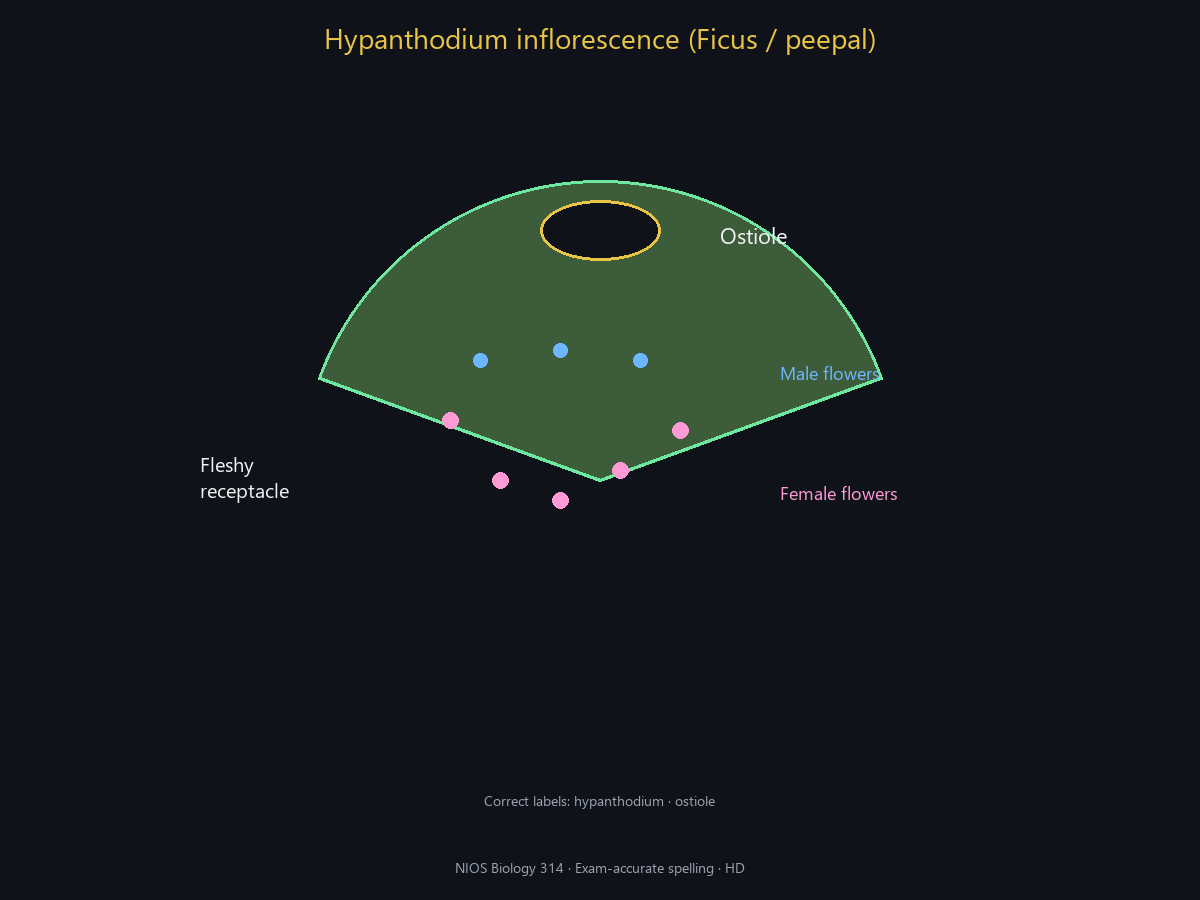
Why it clicks: Closed urn with a door = hypanthodium.
Problem Solving — L19 Reproduction in Plants
Six problems spanning this chapter’s NIOS Biology (314) syllabus. Every question is built from the notes and formula sheet: solve with definitions and equations first, then read the formal textbook-style write-up, the easy explanation, and the topic in depth (key relations, meaning, exam tips). If the question says draw, a labelled pencil sketch is provided. Explanations open by default.
Name the male and female essential whorls of a flower. Label anther, filament, stigma, style, ovary on a sketch.
Pencil sketch (labelled)
Solution — step by step
- Male: androecium (stamens).
- Female: gynoecium (carpels/pistil).
- Sketch labels as asked.
Final answer: Androecium & gynoecium; labelled parts
Key relations / definitions
Textbook formal language
Flower is the reproductive shoot of angiosperms.
Key relations: Androecium = stamens; Gynoecium = carpels. State the definition or law first (NIOS style), use correct biological terms, and end with a clear boxed conclusion.
Easy language (same idea, plain words)
Stamens make pollen; pistil has stigma–style–ovary.
Read the question once for the idea, once for the details. Write the definition or equation, then apply it. Check labels and units if any numbers appear.
Topic in depth — Essential whorls
Calyx and corolla are accessory whorls; androecium and gynoecium are essential.
Linked to chapter notes (L19). Remember: Androecium = stamens; Gynoecium = carpels. Most exam errors mix up similar terms, reverse cause and effect, or skip labelled diagrams.
Exam tip
Open with a one-line definition, then use: Androecium = stamens; Gynoecium = carpels. For diagram questions, label every part asked and keep lines neat.
Common mistakes
- Confusing prokaryote with eukaryote (or plant with animal tissues).
- Mixing up similar pathways (e.g. photosynthesis vs respiration; mitosis vs meiosis).
- Writing vague answers without key technical terms from NIOS notes.
- Forgetting to label diagrams or state units where numbers are used.
Define cross-pollination and state one advantage over self-pollination.
Solution — step by step
- Transfer of pollen to stigma of a flower on a different plant (of same species).
- Advantage: genetic variation / hybrid vigour / reduces inbreeding depression.
Final answer: Pollen to another plant; more variation
Key relations / definitions
Textbook formal language
Pollination precedes fertilisation; agents and floral traits coevolve.
Key relations: Self: same flower/plant; Cross: different plant; Agents: wind, insect, water. State the definition or law first (NIOS style), use correct biological terms, and end with a clear boxed conclusion.
Easy language (same idea, plain words)
Cross means new genetic mix from another plant—healthier diversity.
Read the question once for the idea, once for the details. Write the definition or equation, then apply it. Check labels and units if any numbers appear.
Topic in depth — Self vs cross
Cleistogamy forces self-pollination—special case.
Linked to chapter notes (L19). Remember: Self: same flower/plant; Cross: different plant; Agents: wind, insect, water. Most exam errors mix up similar terms, reverse cause and effect, or skip labelled diagrams.
Exam tip
Open with a one-line definition, then use: Self: same flower/plant; Cross: different plant; Agents: wind, insect, water. For diagram questions, label every part asked and keep lines neat.
Common mistakes
- Confusing prokaryote with eukaryote (or plant with animal tissues).
- Mixing up similar pathways (e.g. photosynthesis vs respiration; mitosis vs meiosis).
- Writing vague answers without key technical terms from NIOS notes.
- Forgetting to label diagrams or state units where numbers are used.
What is double fertilisation in angiosperms?
Solution — step by step
- One male gamete + egg → zygote (2n).
- Other male gamete + two polar nuclei → primary endosperm nucleus (3n).
Final answer: Zygote (2n) + endosperm (3n)
Key relations / definitions
Textbook formal language
Double fertilisation characterises flowering plants.
Key relations: Syngamy: 2n zygote; Triple fusion: 3n endosperm; Unique to angiosperms. State the definition or law first (NIOS style), use correct biological terms, and end with a clear boxed conclusion.
Easy language (same idea, plain words)
Two fusions: baby and food tissue start together.
Read the question once for the idea, once for the details. Write the definition or equation, then apply it. Check labels and units if any numbers appear.
Topic in depth — Double fertilisation
Gymnosperms lack this classic double fertilisation.
Linked to chapter notes (L19). Remember: Syngamy: 2n zygote; Triple fusion: 3n endosperm; Unique to angiosperms. Most exam errors mix up similar terms, reverse cause and effect, or skip labelled diagrams.
Exam tip
Open with a one-line definition, then use: Syngamy: 2n zygote; Triple fusion: 3n endosperm; Unique to angiosperms. For diagram questions, label every part asked and keep lines neat.
Common mistakes
- Confusing prokaryote with eukaryote (or plant with animal tissues).
- Mixing up similar pathways (e.g. photosynthesis vs respiration; mitosis vs meiosis).
- Writing vague answers without key technical terms from NIOS notes.
- Forgetting to label diagrams or state units where numbers are used.
After fertilisation, what do ovule and ovary develop into?
Pencil sketch (labelled)
Solution — step by step
- Ovule → seed.
- Ovary → fruit.
Final answer: Ovule→seed; ovary→fruit
Key relations / definitions
Textbook formal language
Post-fertilisation changes package embryo with food and dispersal units.
Key relations: Ovule → seed; Ovary → fruit. State the definition or law first (NIOS style), use correct biological terms, and end with a clear boxed conclusion.
Easy language (same idea, plain words)
Ovule becomes seed; ovary becomes fruit around it.
Read the question once for the idea, once for the details. Write the definition or equation, then apply it. Check labels and units if any numbers appear.
Topic in depth — Seed and fruit
False fruits involve other floral parts (apple)—advanced point.
Linked to chapter notes (L19). Remember: Ovule → seed; Ovary → fruit. Most exam errors mix up similar terms, reverse cause and effect, or skip labelled diagrams.
Exam tip
Open with a one-line definition, then use: Ovule → seed; Ovary → fruit. For diagram questions, label every part asked and keep lines neat.
Common mistakes
- Confusing prokaryote with eukaryote (or plant with animal tissues).
- Mixing up similar pathways (e.g. photosynthesis vs respiration; mitosis vs meiosis).
- Writing vague answers without key technical terms from NIOS notes.
- Forgetting to label diagrams or state units where numbers are used.
Give two natural and one artificial method of vegetative propagation.
Solution — step by step
- Natural: runner (grass), tuber (potato), bulb (onion), rhizome (ginger).
- Artificial: cutting, layering, grafting, tissue culture.
Final answer: e.g. tuber/runner + cutting/grafting
Key relations / definitions
Textbook formal language
Vegetative propagation produces clones—uniform but low variation.
Key relations: Runners, tubers, bulbs, cuttings, grafting. State the definition or law first (NIOS style), use correct biological terms, and end with a clear boxed conclusion.
Easy language (same idea, plain words)
Plants clone themselves by stems/roots; farmers also cut and graft.
Read the question once for the idea, once for the details. Write the definition or equation, then apply it. Check labels and units if any numbers appear.
Topic in depth — Vegetative propagation
No seeds/meiosis in pure vegetative path.
Linked to chapter notes (L19). Remember: Runners, tubers, bulbs, cuttings, grafting. Most exam errors mix up similar terms, reverse cause and effect, or skip labelled diagrams.
Exam tip
Open with a one-line definition, then use: Runners, tubers, bulbs, cuttings, grafting. For diagram questions, label every part asked and keep lines neat.
Common mistakes
- Confusing prokaryote with eukaryote (or plant with animal tissues).
- Mixing up similar pathways (e.g. photosynthesis vs respiration; mitosis vs meiosis).
- Writing vague answers without key technical terms from NIOS notes.
- Forgetting to label diagrams or state units where numbers are used.
In angiosperms, which generation is dominant—sporophyte or gametophyte? Give one example of each stage.
Solution — step by step
- Sporophyte dominant (the leafy plant).
- Gametophytes highly reduced: pollen (male), embryo sac (female).
Final answer: Sporophyte dominant; pollen & embryo sac gametophytes
Key relations / definitions
Textbook formal language
Alternation of generations is modified in seed plants.
Key relations: Sporophyte (2n) ↔ gametophyte (n). State the definition or law first (NIOS style), use correct biological terms, and end with a clear boxed conclusion.
Easy language (same idea, plain words)
The big plant is diploid; pollen and embryo sac are tiny haploid stages.
Read the question once for the idea, once for the details. Write the definition or equation, then apply it. Check labels and units if any numbers appear.
Topic in depth — Life cycle idea
Moss reverses dominance—gametophyte main body.
Linked to chapter notes (L19). Remember: Sporophyte (2n) ↔ gametophyte (n). Most exam errors mix up similar terms, reverse cause and effect, or skip labelled diagrams.
Exam tip
Open with a one-line definition, then use: Sporophyte (2n) ↔ gametophyte (n). For diagram questions, label every part asked and keep lines neat.
Common mistakes
- Confusing prokaryote with eukaryote (or plant with animal tissues).
- Mixing up similar pathways (e.g. photosynthesis vs respiration; mitosis vs meiosis).
- Writing vague answers without key technical terms from NIOS notes.
- Forgetting to label diagrams or state units where numbers are used.