OneNIOS Study Hub
Biology — Class 12 — L21: Reproduction and Population Control
Lesson-21.pdf). Content covers sections 21.1–21.4.Overview — From gemmules to family planning
Reproduction is production of one’s own kind, transmitting genetic material so species and parental traits continue. Organisms reproduce asexually (no gametes/fusion) or sexually (gametes fuse → zygote). This NIOS Module 3 lesson covers gemmules in sponges, cockroach reproductive organs, human male and female systems, menstrual cycle, fertilisation to birth, placenta and lactation, twins, assisted reproduction, and human population growth with contraception.
After this lesson you should define asexual vs sexual reproduction; describe gemmules and cockroach organs; list human organ functions; outline gametes → pregnancy → birth; explain placenta, lactation and twins; define demographic terms; list causes and problems of population rise in India; and name contraception methods. Notes follow textbook order only. Link to L17: hormones (FSH, LH, oestrogen, progesterone, prolactin, oxytocin, testosterone). Link to L15: placenta and HIV transfer caution.
Section 1: Asexual example — gemmule (21.1a)
In sponges (Porifera), gemmules are asexual reproductive bodies (Greek gemma = bud). A gemmule is a hard ball of undifferentiated archaeocytes inside a resistant chitin covering (often with spicules) and a small micropyle outlet. When ponds dry or freeze, adults die but gemmules survive; on return of favour archaeocytes emerge via micropyle and form a new sponge (e.g. Spongilla). Gemmules are thus a survival strategy as much as a reproductive strategy — the textbook stresses viable drought- or cold-proof stages when the adult body cannot endure. Label micropyle, covering, and archaeocytes on diagrams.
Section 2: Puberty and cockroach (21.1–21.2a)
Puberty: sex organs mature; secondary sex characters appear (males ~13–14 y; females ~11–13 y). Adolescence (WHO 10–19) is physical, psychological and social change. Male secondary characters: deeper voice, wider shoulders, beard/moustache, axillary/pubic hair, genital growth. Female: axillary/pubic hair, wider pelvis/hips, breast growth, start of menstrual cycle. Hygiene of reproductive organs is important.
Cockroach (sexes separate): some insects parthenogenetic (aphids — all female generations).
- Male: pair of testes → vasa deferentia → median ejaculatory duct → genital pouch/pore; gonapophyses aid copulation; seminal vesicles store sperms; mushroom and phallic glands accessory.
- Female: pair of ovaries (ovarioles) → lateral oviducts → median oviduct/vagina → genital pouch; spermatheca receives sperms; gonapophyses for copulation, egg-laying, oötheca; colleterial glands secrete oötheca (egg case).
Cockroach function map for intext: seminal vesicles store sperms; spermatheca receives sperms in female; testes generate sperms; ovaries produce eggs. Gonapophyses assist copulation in both sexes; in females they also help lay eggs and shape the oötheca. Different insects vary from this basic plan, but Periplaneta is the exam type specimen.
Section 3: Human male reproductive system (21.2b)
Organs: testes, epididymis, vasa deferentia, urethra, penis, accessory glands.
Testes (~4–5 cm, ~12 g) outside abdomen in scrotum — thermoregulator keeping temperature ~2–3°C below body temperature for sperm development. Tunica albuginea capsule; seminiferous tubules produce sperms; Leydig (interstitial) cells secrete testosterone (primary and secondary male characters).
Epididymis — long coiled tube on testis; stores viable but immotile sperms. Vas deferens → abdomen → joins seminal vesicle duct → ejaculatory duct → urethra. Urethra (~15–20 cm): prostatic, membranous, penile parts — common path for urine and semen. Penis — spongy vascular copulatory organ; glans covered by prepuce.
Accessory glands: seminal vesicles (nourishing viscous fluid, large fraction of semen); prostate (alkaline fluid, sperm motility/survival); Cowper’s/bulbourethral (lubricating alkaline mucus).
Sperm: spermatogenesis in tubules; head (nucleus + acrosome enzymes for penetration), midpiece (mitochondria), tail (flagellum). Epididymis storage immotile; gland secretions activate motility. One ejaculation ~2×10⁸ sperms; speed ~2 mm/min in female tract. Path: seminiferous → vasa efferentia network → epididymis → vas deferens → urethra.
Function table memory: seminiferous — produce sperms; epididymis — store viable immobile; vas deferens — contract to pass sperms at ejaculation; seminal vesicles and prostate — activate and nourish; urethra — expel semen (and urine); penis — copulatory organ with erectile tissue. Seminal fluid is ~40–80% of ejaculate; prostate ~5–30%. Cowper’s fluid is lubricant mucus. Acrosome enzymes enable egg penetration — match acrosome with spermatozoa in column questions.
Section 4: Human female system and menstrual cycle (21.2.2–21.2.3)
Organs: ovaries, fallopian tubes (oviducts), uterus, vagina, external genitalia.
Ovaries — oogenesis; hormones oestrogen and progesterone. Primary follicle → Graafian follicle (ovum + surrounding cells + antrum) → ovulation leaves corpus luteum.
Fallopian tubes (~10–15 cm): infundibulum with fimbriae near ovary; site of fertilisation; transfer of zygote/embryo to uterus.
Uterus — pear-shaped; endometrium (vascular inner lining), myometrium (muscle), perimetrium; receives, protects, nourishes embryo; expels baby. Cervix mucus lubricates and aids sperm swimming. Vagina — receives penis, birth canal, menstrual outflow; separate urethral opening; hymen may partially close virgin opening. Clitoris — sensory organ homologous to penis.
Menstrual cycle (~28 days) from menarche (~11–13) to menopause (~45–50). Fertility between these. Day 1–4: menstrual flow (endometrium shed with blood). Day 5–13: Graafian follicle grows; oestrogen thickens uterus. Day ~13–14: ovulation. Corpus luteum secretes progesterone. Ovum viable ~48–72 h; if unfertilised, degenerates and lining sheds by day 28. If fertilised, progesterone continues (corpus luteum then placenta); menses and ovulation stop in pregnancy. Irregular cycles common at start; hygiene: bath, change pads, clean cloths dried in sun, rest and moderate exercise.
Female function table: ovary manufactures eggs; oviduct fertilisation and transfer; uterus receives/protects/nourishes embryo and expels baby; cervix mucus lubricates and helps sperm swim; vagina receives penis and is birth passage. Graafian follicle is mature pre-ovulation stage; empty follicle becomes corpus luteum. Days 13–16 favour conception if sperm are present. Illness and stress can shift cycle timing — early irregularity is common but prolonged absence needs medical care. FSH and LH from the pituitary drive follicle growth and ovulation; ovarian oestrogen builds the lining; progesterone maintains it for possible implant.
Section 5: Fertilisation, pregnancy, placenta, birth (21.2)
Sperms viable 24–72 h in female tract. Fertilisation in fallopian tube most likely ~13–14 days after menses onset. Zygote divides → morula (~day 4) → blastocyst (~day 5) → implantation in endometrium (~day 6–7) = pregnancy. Embryo pea-sized ~4 weeks; foetus with limbs ~6 weeks; birth ~40 weeks.
Placenta — maternal–foetal tissue association for exchange. Umbilical cord vascular link. Amnion + amniotic fluid cushion embryo. Placenta: O₂ and food mother → foetus; CO₂ and wastes foetus → mother; antibodies can pass; germs generally blocked but HIV can transfer if mother infected. Placenta produces progesterone. Oxytocin (posterior pituitary) drives labour contractions.
Childbirth: labour contractions; amnion bursts; baby expelled; first breath; cord tied/cut; placenta delivered; milk production begins.
Lactation: milk synthesis. First milk = colostrum (nutrients, fats, proteins, IgA passive immunity). Prolactin (anterior pituitary) synthesises milk; oxytocin ejects milk from glands.
Placenta permeability: respiratory gases, nutrients and antibodies can cross; germs generally blocked — except HIV from infected mother can reach the embryo. False T/F traps: fertilisation is not in vagina; oxygen/nutrients do not diffuse via amnion but via placenta villi; pregnancy is not prevented by vasectomy in the woman — vasectomy is male sterilisation. Umbilical cord is the vascular connection; amnion is the fluid-filled sac around the foetus.
Section 6: Twins and assisted reproduction (21.2.5–21.3)
Fraternal twins: two eggs + two sperms; may differ in sex. Identical twins: one fertilised egg splits; same sex, same genetics. Siamese twins: incomplete separation; may be surgically separable depending on join (historic Siamese case joined at thorax, lived to age 65).
Test-tube / IVF: for blocked oviducts — ripe ova sucked from ovaries with a special syringe, placed with partner sperms in a dish under optimum conditions for hours, fertilised embryo inserted into uterus for implant chance. Artificial insemination: human semen frozen in liquid nitrogen and stored in sperm banks for years without losing fertility; thawed and introduced by syringe at ovulation. Fertility drugs: FSH injections (from animal sources in textbook description) artificially stimulate Graafian follicle production when sterile women fail to mature ova.
Section 7: Population — terms, India, problems (21.4)
Terms: human population = total people; demography = statistical study of growth, composition, distribution; density = individuals/km²; birth rate = live births/1000/year; death rate = deaths/1000/year; growth rate = birth − death; census = official count.
India second most populous after China; >15% world population. Steady rise last century (textbook 1901 ~23.8 crore → 2001 ~102.7 crore) — population explosion concern.
Factors (India): better agriculture (less starvation); medicine (longer life, more reach reproductive age); religious/social customs resisting family planning; industrialisation (food storage, jobs); illiteracy about reproduction; children as income; desire for male child leading to many births.
Family problems: mother’s health from frequent pregnancy; poor housing; economic pressure; malnutrition/poor health; education unaffordable.
National/environment: urbanisation and slums; transport pollution; education load; agricultural pressure (deforestation, fertiliser/pesticide pollution); food demand; water scarcity; mineral and fossil-fuel depletion. Uncontrolled growth lowers per capita resources and living standards.
Inter-relationship of population, environment and development: more people need more food, jobs, housing and transport; without planning, cities swell with informal settlements, forests fall for farms, water and minerals run short, and pollution rises — quality of life and environment both fall. Textbook India census figures show century-scale climb (about 24 crore in 1901 to over 100 crore by 2001 in the table) to underline why “population explosion” is a policy topic, not only a biology term.
Education as control: most effective long-term tool — people learn small-family benefits and how contraception works. Government family planning and welfare programmes support clinical methods. Knowledge of the reproductive process itself is presented as a means to reduce unwanted growth: informed choices about fertility timing.
Section 8: Population control and contraception (21.4.5)
Need: educate small-family norms; family planning and welfare services.
- Rhythm / safe period — avoid fertile days; not very reliable.
- Barrier: condom (male), diaphragm (female) — block sperm–egg meeting.
- IUD (e.g. copper T) — prevents implantation; needs medical fitting.
- Oral contraceptive pills — interfere with ovulation; medical advice required.
- Vasectomy — ligate/cut vas deferens (may be reversible if only tied; permanent if cut and ligatured).
- Tubectomy — cut and ligate fallopian tubes so egg cannot meet sperm.
If prevention fails or foetus defective: MTP/abortion removes unwanted foetus — only with professional medical care. Common false statements to correct: fertilisation is in oviduct not vagina; exchange is via placenta not amnion; vasectomy is male (not pregnancy prevention in women alone); tubectomy is female tubes not vas deferens.
| Method | Action |
|---|---|
| Condom/diaphragm | Barrier to sperm |
| IUD | Hinders implantation |
| Pill | Stops/alters ovulation |
| Vasectomy | Blocks sperm path |
| Tubectomy | Blocks egg path |
Section 9: Exam map and closed-book drill
Define reproduction; asexual vs sexual; gemmule; cockroach male/female organs; puberty ages and secondary characters; male path and glands; scrotum role; female organs and menstrual timeline; fertilisation site and implantation; placenta functions; birth steps; colostrum/prolactin/oxytocin; fraternal vs identical twins; IVF/AI/FSH drugs; demography terms; India factors; family and national problems; contraception list; vasectomy vs tubectomy.
One-line keys: seminiferous produce sperms; Leydig testosterone; fertilisation fallopian tube; implantation uterine wall; amniotic fluid cushion; placenta O₂/food in CO₂/waste out; prolactin milk make oxytocin milk out + labour; birth rate per 1000; copper T is IUD.
Use Formula Sheet; drill 10 MCQs and 20 flashcards. Prioritise organ function tables, menstrual timing, placenta, and contraception definitions for true/false traps.
Section 10: Extra depth for full coverage
Why scrotum matters: spermatogenesis is temperature-sensitive; abdominal heat reduces viable sperm — classic short-answer. Epididymis stores “ready but not swimming” sperm; activation by alkaline nourishing fluids explains accessory gland importance. Large sperm number compensates for journey loss.
Menstrual hormones: FSH/LH (from pituitary) drive follicle and ovulation; ovarian oestrogen builds endometrium; progesterone from corpus luteum maintains it for possible implant. Pregnancy maintains progesterone so lining is not shed. Menopause is permanent stop of ovulation/menses with organ shrinkage.
Development sequence for essays: sperm deposit → egg from ovary → union in tube → zygote day 1 → morula day 4 → blastocyst day 5 → implant day 6–7 → embryo/foetus weeks → birth ~40 weeks. Amnion is the sac; fluid absorbs shocks; umbilical cord is blood bridge not the exchange surface itself — villi of placenta do exchange.
Population ethics in textbook frame: education is most effective long-term control; medical methods are tools. Desire for male child and child labour economics are social drivers, not only biology. Environment chain: more people → more urban migration → slums and pollution → more food demand → forest loss and chemical farming → water and mineral stress.
Contraception classification: temporary (barrier, pill, IUD, rhythm) vs permanent (sterilisation). Reversible vs permanent depends on surgical technique. MTP is not a routine “contraceptive” but emergency medical option — textbook stresses professional help.
Closed-book drill: (1) asexual vs sexual + gemmule; (2) cockroach male & female organs; (3) puberty ages; (4) male organs + path of sperm; (5) three accessory glands; (6) female organs + functions; (7) menstrual phases; (8) fertilisation & implantation definitions; (9) placenta roles; (10) birth events; (11) lactation hormones & colostrum; (12) twin types; (13) three ART methods; (14) five demography terms; (15) four India explosion factors; (16) family vs national problems; (17) six contraception methods; (18) vasectomy vs tubectomy. Completing these covers Lesson 21 terminals.
Section 11: Matching bank and quick formula strip
Match practice: acrosome–spermatozoa; ovulation–LH (and mid-cycle); villi–placenta; fertilisation–fallopian tube; progesterone–pregnancy maintenance. Odd-one-out: ureter does not belong with ovary/tube/uterus; uterus does not belong with epididymis/urethra/vas; Leydig is male interstitial not ovarian follicle; corpus luteum is ovarian not foetal membrane set.
Sequence for essays: seminiferous production → epididymis store → vas → urethra → female tract → meet egg in oviduct → zygote → morula → blastocyst → implant → placenta grows → labour (oxytocin) → birth → colostrum then milk (prolactin/oxytocin). Parallel female sequence: follicle → ovulation → capture by fimbriae → tube → if no sperm, menses; if sperm, pregnancy path above.
Contraception reliability ranking (qualitative textbook sense): surgical sterilisation most permanent; hormonal pills and properly used barriers more reliable than rhythm; rhythm least reliable. IUD needs clinic placement. MTP is not first-line planning. Desire for male child and child labour economics show population control is social as well as medical.
Quick formula strip: gemmule archaeocytes; scrotum −2–3°C; sperm path five steps; ovulation day 14; implant day 7; placenta exchange; colostrum IgA; fraternal vs identical; IVF/AI/FSH; birth rate per 1000; condom/IUD/pill/vasectomy/tubectomy. Say each aloud with one diagram label. Module 3 next lessons move into genetics — keep meiosis and gamete terms sharp from this chapter.
Section 12: Essay outlines and definition bank
Define demography, vasectomy, IUD in one line each. Differentiate implantation (attachment of embryo) from pregnancy (state of carrying embryo after implant); Graafian follicle (pre-ovulation) from corpus luteum (post-ovulation hormone body); identical from fraternal twins; birth rate from death rate; vasectomy from tubectomy. Name organs: foetus develops in uterus; male gamete is sperm; fluid around embryo is amniotic fluid; stop of menses/ovulation with age is menopause; female surgical sterilisation is tubectomy.
Lactation note: synthesis stimulated by prolactin; ejection by oxytocin; colostrum first; rich in nutrients and IgA for passive immunity of the newborn. Childbirth sequence: occasional then vigorous uterine contractions; amnion bursts; baby expelled; lungs start; cord cut; placenta delivered; breasts produce milk.
Population factors list for four-mark answers: (1) agricultural food security, (2) medical longevity, (3) social/religious resistance to planning, (4) industrialisation and prosperity, (5) illiteracy about reproduction, (6) children as wage earners, (7) preference for a male child. Family problems: maternal health, housing, money, nutrition, schooling. Country problems: urban slums, pollution, education load, farm chemicals and forest loss, water and mineral shortage, energy depletion.
Contraception expanded: rhythm uses “safe period” before ovulation but is unreliable; condoms and diaphragms are barriers; copper T is intrauterine device preventing implant; pills need medical guidance and block ovulation; surgical methods may be temporary if only ligated or permanent if cut and tied. MTP removes unwanted or defective foetus under medical supervision only — not a casual substitute for contraception.
You are exam-ready when organ function tables, the 28-day cycle, placenta roles, and contraception true/false items all come without notes. That closes Lesson 21 for Module 3 public exam study.
Secondary sexual characters review: males — deeper voice, wider shoulders, muscular body, beard and moustache, axillary and pubic hair, enlarged external genitals. Females — axillary and pubic hair, wider pelvis and hips, breast enlargement, initiation of menstrual cycle. Adolescence (WHO 10–19 years) covers these physical changes plus psychological and social growth into adult participation. Sexual maturation is a significant life stage requiring health and hygiene of reproductive organs. Testosterone maintains male primary and secondary characters; ovarian oestrogen and progesterone shape female cycles and pregnancy readiness. Sperms number in millions because many never reach the egg; about two hundred million may leave in one ejaculation according to the full textbook numerical figure given.
MCQ Quiz — L21 Reproduction and Population Control
Flashcards — L21
Golden Rules — L21 Reproduction and Population Control
Most exam-important points from this chapter:
Asexual & insect frame
Gemmule: archaeocytes in hard coat, micropyle, sponge survival. Cockroach: testes→vas→ejaculatory; ovaries→oviduct→spermatheca; oötheca from colleterial glands.
Human organs
Male: scrotum cool, seminiferous sperms, Leydig testosterone, glands make semen. Female: ovary eggs/hormones, tube fertilisation, uterus implant and birth, vagina canal.
Cycle to birth
~28-day cycle; ovulation mid-cycle. Fertilised in tube; implant in uterus. Placenta exchanges; amnion cushions. Oxytocin labour; prolactin/oxytocin lactation; colostrum immunity.
Twins & ART
Fraternal two zygotes; identical one splits. IVF for blocked tubes; AI frozen semen; FSH for follicles. Siamese = incomplete separation.
Population & contraception
Demography rates; India growth from food, health, customs, illiteracy, male-child preference. Control by education + barriers, IUD, pill, sterilisation. Know vasectomy≠tubectomy.
Past Year Questions — L21 Reproduction and Population Control
PE-only questions for this chapter only. 11 item(s). No overlap with other lessons. Tap Show answer after you try each question.
Q1. Name of the technique used for detecting genetic disorders in a foetus is
Why it clicks: Amniotic fluid sampling detects foetal chromosomal/genetic disorders.
Q2. Match the statement given in Column-I with the right option in Column-II: 2 Column-I Column-II (i) Copper-T (a) Interfere with the ovulation process and prevent fertilization (ii) Condoms (b) Prevent sperms from meeting the ovulated egg (c) Implantation is not possible (d) Permanently prevent fertilization
Why it clicks: Barrier vs IUD vs hormonal vs permanent—match mode of action.
Q3. Write the name of one contraception carried on in human females. Describe the procedure adopted for it. m ('mZd 'mXm)
Why it clicks: Tubectomy = female sterilisation; demography = population statistics.
Q4. Write three effects of uncontrolled population growth on a nation
Why it clicks: Social/economic strain from rapid growth is the L21 focus.
Q5. Complete the following flow chart from A-D (Attempt any two parts from (A-D)) Sperms are deposited into the female reproductive tract and eggs released from "A" → union of sperm and ovum in "B" →to form a zygote. →zygote divides rapidly to form a spherical mass →"C" →Early embryonic stage called blastocyst get implanted into D
This question needs a diagram — open the answer to view the HD model figure.
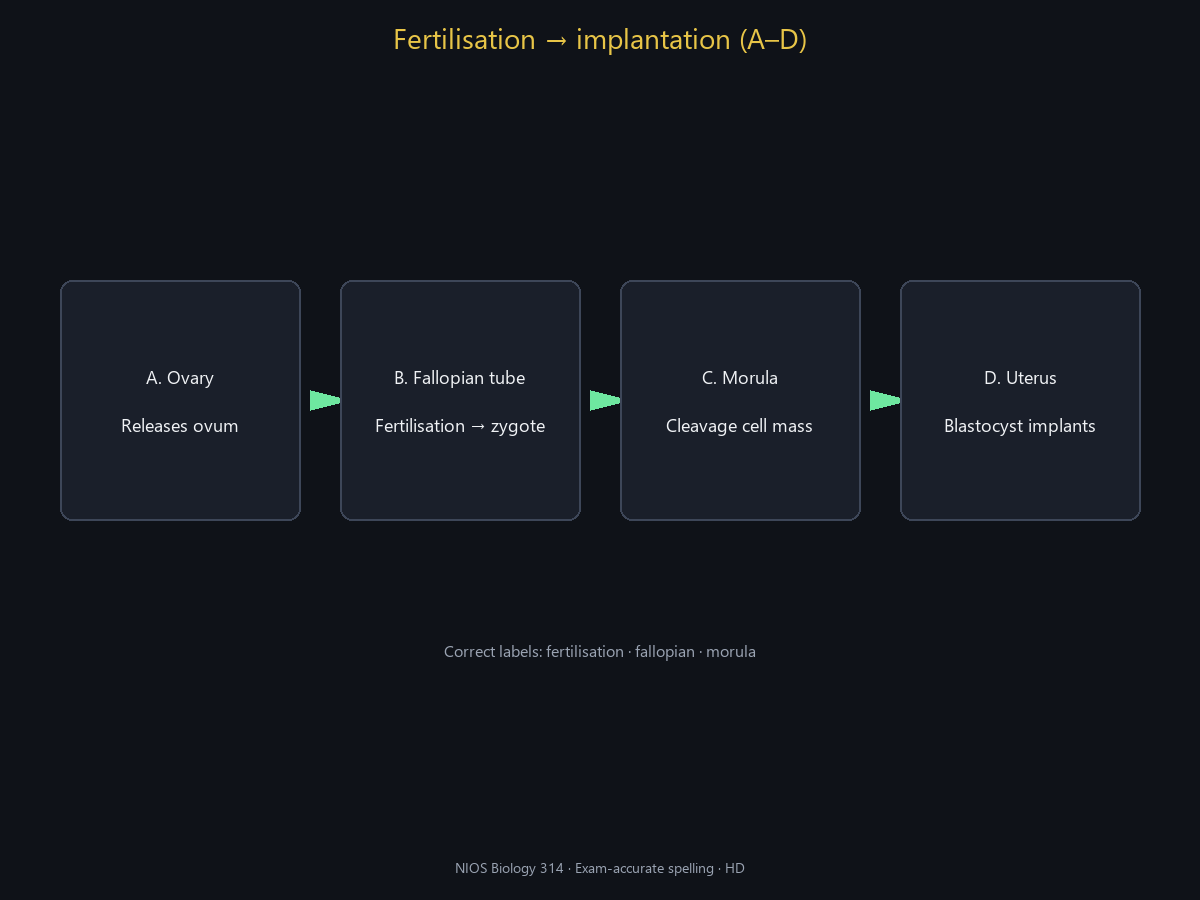
Why it clicks: Egg from ovary → meet sperm in tube → morula → implant in uterus.
Q6. Label the Given below structure of a human sperm and i. Mitochondria ii. Acrosome
This question needs a diagram — open the answer to view the HD model figure.
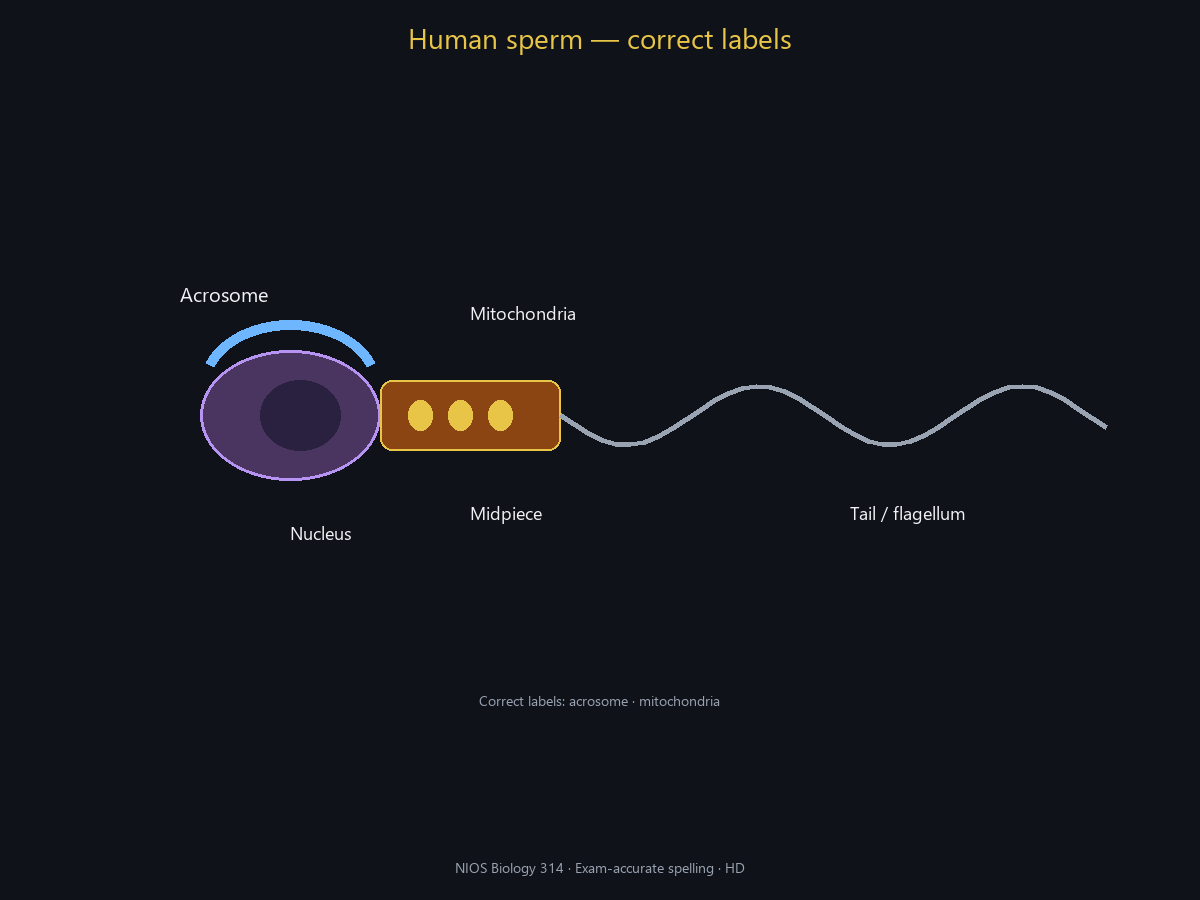
Why it clicks: Drill, fuel tank, propeller.
Q7. Which are the two factors according to you that justify the need for family planning in our country?
Why it clicks: Family planning = health + resources + informed choice.
Q8. Under what conditions do populations become J shaped and S Shaped
Why it clicks: Plenty → J; limited → S.
Q9. (I)State non surgical method of contraception. Mention the name of the procedures
Why it clicks: Non-surgical = reversible methods without cutting tubes.
Q10. (I) Indian population is about to reach a stage of explosion. State any three reasons which may have contributed to such a situation
Why it clicks: Births high + deaths low → explosion risk.
Q11. 36 Populations become J shaped when food is available in plenty, Populations become S Shaped when food becomes limited 37 (I) Vestibule
Why it clicks: Same rule as above—marking key.
Problem Solving — L21 Reproduction and Population Control
Six problems spanning this chapter’s NIOS Biology (314) syllabus. Every question is built from the notes and formula sheet: solve with definitions and equations first, then read the formal textbook-style write-up, the easy explanation, and the topic in depth (key relations, meaning, exam tips). If the question says draw, a labelled pencil sketch is provided. Explanations open by default.
Where are sperms produced and where do they mature/store?
Solution — step by step
- Produced in seminiferous tubules of testis.
- Mature and store mainly in epididymis.
Final answer: Seminiferous tubules; epididymis
Key relations / definitions
Textbook formal language
Male gametogenesis is continuous after puberty under hormonal control.
Key relations: Testis seminiferous tubules → sperm; Epididymis maturation/storage. State the definition or law first (NIOS style), use correct biological terms, and end with a clear boxed conclusion.
Easy language (same idea, plain words)
Factory is testis tubes; warehouse is epididymis.
Read the question once for the idea, once for the details. Write the definition or equation, then apply it. Check labels and units if any numbers appear.
Topic in depth — Spermatogenesis site
Vas deferens carries sperm during ejaculation path.
Linked to chapter notes (L21). Remember: Testis seminiferous tubules → sperm; Epididymis maturation/storage. Most exam errors mix up similar terms, reverse cause and effect, or skip labelled diagrams.
Exam tip
Open with a one-line definition, then use: Testis seminiferous tubules → sperm; Epididymis maturation/storage. For diagram questions, label every part asked and keep lines neat.
Common mistakes
- Confusing prokaryote with eukaryote (or plant with animal tissues).
- Mixing up similar pathways (e.g. photosynthesis vs respiration; mitosis vs meiosis).
- Writing vague answers without key technical terms from NIOS notes.
- Forgetting to label diagrams or state units where numbers are used.
State one gamete function and one endocrine function of ovary. Where does implantation normally occur?
Pencil sketch (labelled)
Solution — step by step
- Gamete: release ovum; endocrine: oestrogen/progesterone.
- Implantation: endometrium of uterus.
Final answer: Ovum + hormones; uterus lining
Key relations / definitions
Textbook formal language
Female tract coordinates ovulation, fertilisation and pregnancy.
Key relations: Ovary: ova + hormones; Uterus: implantation & gestation. State the definition or law first (NIOS style), use correct biological terms, and end with a clear boxed conclusion.
Easy language (same idea, plain words)
Ovary makes egg and hormones; baby implants in uterus wall.
Read the question once for the idea, once for the details. Write the definition or equation, then apply it. Check labels and units if any numbers appear.
Topic in depth — Ovary and uterus
Fertilisation usually in fallopian tube—not uterus.
Linked to chapter notes (L21). Remember: Ovary: ova + hormones; Uterus: implantation & gestation. Most exam errors mix up similar terms, reverse cause and effect, or skip labelled diagrams.
Exam tip
Open with a one-line definition, then use: Ovary: ova + hormones; Uterus: implantation & gestation. For diagram questions, label every part asked and keep lines neat.
Common mistakes
- Confusing prokaryote with eukaryote (or plant with animal tissues).
- Mixing up similar pathways (e.g. photosynthesis vs respiration; mitosis vs meiosis).
- Writing vague answers without key technical terms from NIOS notes.
- Forgetting to label diagrams or state units where numbers are used.
On a 28-day cycle, when does ovulation typically occur? Which hormone surge triggers it?
Solution — step by step
- Around day 14.
- LH surge (with FSH roles) triggers ovulation.
Final answer: ~Day 14; LH surge
Key relations / definitions
Textbook formal language
Menstrual cycle prepares uterus and releases ovum cyclically.
Key relations: ~28 days; FSH/LH/oestrogen/progesterone; Ovulation ~ day 14. State the definition or law first (NIOS style), use correct biological terms, and end with a clear boxed conclusion.
Easy language (same idea, plain words)
Mid-cycle LH spike pops the egg out.
Read the question once for the idea, once for the details. Write the definition or equation, then apply it. Check labels and units if any numbers appear.
Topic in depth — Cycle outline
Progesterone maintains uterus after ovulation.
Linked to chapter notes (L21). Remember: ~28 days; FSH/LH/oestrogen/progesterone; Ovulation ~ day 14. Most exam errors mix up similar terms, reverse cause and effect, or skip labelled diagrams.
Exam tip
Open with a one-line definition, then use: ~28 days; FSH/LH/oestrogen/progesterone; Ovulation ~ day 14. For diagram questions, label every part asked and keep lines neat.
Common mistakes
- Confusing prokaryote with eukaryote (or plant with animal tissues).
- Mixing up similar pathways (e.g. photosynthesis vs respiration; mitosis vs meiosis).
- Writing vague answers without key technical terms from NIOS notes.
- Forgetting to label diagrams or state units where numbers are used.
Where does fertilisation normally occur in humans?
Solution — step by step
- In the fallopian tube (ampullary region).
Final answer: Fallopian tube (ampulla)
Key relations / definitions
Textbook formal language
Early embryonic stages travel to uterus for implantation.
Key relations: Fertilisation in ampulla; Cleavage → morula → blastocyst → implant. State the definition or law first (NIOS style), use correct biological terms, and end with a clear boxed conclusion.
Easy language (same idea, plain words)
Sperm meets egg in the tube, not in the uterus first.
Read the question once for the idea, once for the details. Write the definition or equation, then apply it. Check labels and units if any numbers appear.
Topic in depth — Zygote to blastocyst
Ectopic pregnancy is implantation outside uterus—pathology.
Linked to chapter notes (L21). Remember: Fertilisation in ampulla; Cleavage → morula → blastocyst → implant. Most exam errors mix up similar terms, reverse cause and effect, or skip labelled diagrams.
Exam tip
Open with a one-line definition, then use: Fertilisation in ampulla; Cleavage → morula → blastocyst → implant. For diagram questions, label every part asked and keep lines neat.
Common mistakes
- Confusing prokaryote with eukaryote (or plant with animal tissues).
- Mixing up similar pathways (e.g. photosynthesis vs respiration; mitosis vs meiosis).
- Writing vague answers without key technical terms from NIOS notes.
- Forgetting to label diagrams or state units where numbers are used.
Classify: condom, oral pill, copper-T, vasectomy — as barrier / hormonal / IUD / surgical.
Solution — step by step
- Condom — barrier.
- Oral contraceptive pill — hormonal.
- Copper-T — IUD.
- Vasectomy — surgical (male sterilisation).
Final answer: Barrier; hormonal; IUD; surgical
Key relations / definitions
Textbook formal language
Contraception prevents conception by different mechanisms.
Key relations: Barrier, hormonal, IUD, surgical, natural. State the definition or law first (NIOS style), use correct biological terms, and end with a clear boxed conclusion.
Easy language (same idea, plain words)
Condom blocks, pill hormones, copper-T device, vasectomy surgery.
Read the question once for the idea, once for the details. Write the definition or equation, then apply it. Check labels and units if any numbers appear.
Topic in depth — Family planning methods
None replace STI protection except barriers (especially condom).
Linked to chapter notes (L21). Remember: Barrier, hormonal, IUD, surgical, natural. Most exam errors mix up similar terms, reverse cause and effect, or skip labelled diagrams.
Exam tip
Open with a one-line definition, then use: Barrier, hormonal, IUD, surgical, natural. For diagram questions, label every part asked and keep lines neat.
Common mistakes
- Confusing prokaryote with eukaryote (or plant with animal tissues).
- Mixing up similar pathways (e.g. photosynthesis vs respiration; mitosis vs meiosis).
- Writing vague answers without key technical terms from NIOS notes.
- Forgetting to label diagrams or state units where numbers are used.
Name two STIs and two preventive measures.
Solution — step by step
- Examples: HIV/AIDS, gonorrhoea, syphilis, genital warts/herpes (any two).
- Prevention: barrier protection, fidelity/tested partners, education, avoid shared needles (HIV).
Final answer: e.g. HIV & gonorrhoea; condoms + awareness
Key relations / definitions
Textbook formal language
Reproductive health includes safe sex and infection control.
Key relations: HIV, gonorrhoea, syphilis etc.; Prevention: safe sex, awareness. State the definition or law first (NIOS style), use correct biological terms, and end with a clear boxed conclusion.
Easy language (same idea, plain words)
Some infections spread sexually; protection and knowledge reduce risk.
Read the question once for the idea, once for the details. Write the definition or equation, then apply it. Check labels and units if any numbers appear.
Topic in depth — Reproductive health
Not all STIs are curable—HIV managed, not simply “cured”.
Linked to chapter notes (L21). Remember: HIV, gonorrhoea, syphilis etc.; Prevention: safe sex, awareness. Most exam errors mix up similar terms, reverse cause and effect, or skip labelled diagrams.
Exam tip
Open with a one-line definition, then use: HIV, gonorrhoea, syphilis etc.; Prevention: safe sex, awareness. For diagram questions, label every part asked and keep lines neat.
Common mistakes
- Confusing prokaryote with eukaryote (or plant with animal tissues).
- Mixing up similar pathways (e.g. photosynthesis vs respiration; mitosis vs meiosis).
- Writing vague answers without key technical terms from NIOS notes.
- Forgetting to label diagrams or state units where numbers are used.