OneNIOS Study Hub
Biology — Class 12 — L17: Coordination and Control – The Nervous and Endocrine Systems
Lesson-17.pdf). Content covers sections 17.1–17.12.Overview — Two systems of coordination
Every organism moves and performs many timed tasks. Inside the body, actions must be coordinated. Two organ systems achieve this: the nervous system (fast electrical signals) and the endocrine system (slower chemical hormones in blood). This NIOS lesson covers nervous functions and terms; cockroach and human CNS/PNS/ANS; brain and spinal cord; neuron, impulse and synapse; reflexes; sense organs (eye, ear, nose, tongue, skin); endocrine glands and major hormones; feedback; hormone vs nerve control; and pheromones.
After this lesson you should list nervous subdivisions and brain parts; describe cockroach nerves; explain impulse conduction and reflex arcs; outline sense organs; distinguish exocrine/endocrine; name major hormones and disorders; and explain feedback. Notes follow textbook order only. Link to L5: neurons and neuroglia as nervous tissue. Link to L15: ANS effects on heart rate and vessels; adrenaline from adrenals ties to emergency circulation.
Section 1: Nervous functions and basic terms (17.1)
Functions: inform about the outside world via sense organs; enable memory, thinking, reasoning; control voluntary muscle (run, speak); regulate involuntary acts (breathing, heart beat, gut movement). Overall: body works as one coordinated unit.
Terms: stimulus — change that alters activity; impulse — wave of electrical disturbance along a neuron; response — change in activity; receptors — cells sending impulses to CNS; effectors — muscles or glands; nerve — bundle of axons; sensory (afferent) toward CNS; motor (efferent) toward muscle/gland.
Section 2: Cockroach nervous system (17.1.1)
Same basic plan as other animals: CNS + PNS (+ visceral/sympathetic).
- CNS: brain = supra-oesophageal ganglion above oesophagus; sub-oesophageal ganglion below; pair of circumoesophageal connectives join them; double ventral nerve cord with 3 thoracic + 6 abdominal ganglia (comparable in role to spinal cord though ventral, not dorsal).
- PNS: nerves from ganglia to all body parts.
- Sympathetic/visceral: frontal and visceral ganglia with nerves.
Section 3: Human CNS — brain and spinal cord (17.4)
CNS = brain + spinal cord; PNS = nerves entering/leaving them.
Brain protected by skull and three meninges: tough outer duramater, web-like arachnoid, vascular piamater; spaces and cavities hold cerebrospinal fluid (CSF).
Forebrain: cerebrum + diencephalon. Midbrain: small tubular. Hindbrain: cerebellum, pons, medulla oblongata.
- Cerebrum — largest; two hemispheres; convoluted surface; outer gray matter (cell bodies), inner white matter (axons); corpus callosum connects hemispheres; left controls right body and vice versa. Cortex: voluntary muscle; sensory processing; thinking, planning, memory.
- Thalamus — sensory relay (pain, pleasure) to cerebrum.
- Hypothalamus — motivated behaviour (eat, drink, sex); controls pituitary; temperature and fluid homeostasis.
- Cerebellum — balance and muscular coordination.
- Medulla oblongata — breathing, coughing, swallowing; heart beat; gut movement; many involuntary actions. Connects to spinal cord. 12 pairs of cranial nerves leave the brain.
Spinal cord: from medulla down the backbone; same three meninges + CSF; white matter outside, gray inside (reverse of brain). Functions: reflexes below neck; sensory impulses skin/muscles → brain; motor commands brain → trunk/limbs.
Memorise one-function lines: cerebrum — intelligence/thinking; cerebellum — balance/muscular coordination; medulla — involuntary centres (breathing, heart); hypothalamus — homeostasis and pituitary control. Gray matter is cell bodies; white matter is myelinated axon tracts. Fluid in brain cavities and meningeal spaces is CSF. Cranial nerves: twelve pairs, sensory, motor or mixed.
Crossed control: left cerebral hemisphere largely controls the right side of the body and vice versa — classic fact for short answers. Corpus callosum is the sheet of fibres allowing the two hemispheres to share information. Pons lies in hindbrain with cerebellum and medulla; midbrain is the small tubular link between fore and hind regions.
Section 4: Peripheral and autonomic systems (17.4–17.5)
PNS = all nerves from brain and cord: afferent (sensory) and efferent (motor). Sensory may be pure cranial (eye, ear, nose) or mixed (e.g. facial). Efferent: somatic (voluntary muscle) and autonomic (ANS) (involuntary muscle and glands) — chains of ganglia beside backbone.
Sympathetic prepares for emergency (“fight or flight”). Parasympathetic restores normal after emergency (“rest and digest”). Influenced by emotions.
| Organ | Sympathetic | Parasympathetic |
|---|---|---|
| Pupil | Dilated | Constricted |
| Heart | Faster | Slower |
| Bronchioles | Dilated | Constricted |
| Saliva | Decreased | Increased |
| Gut peristalsis | Decreased | Increased |
| Adrenal | ↑ adrenaline | No effect |
Full ANS contrast list for exams also includes: skin vessels constrict (sympathetic) vs dilate (parasympathetic); muscle vessels dilate under sympathetic; bladder muscle relaxes with sphincter contracted (sympathetic, less urge) vs muscle contracts and sphincter relaxes (parasympathetic, urge to urinate); sweat increased by sympathetic; blood sugar raised by sympathetic; tear glands activated by sympathetic, slowed by parasympathetic; erecter pili raise hair under sympathetic; gut gland secretion decreased by sympathetic, increased by parasympathetic. Why “peripheral”? Because it connects the periphery (body surface and organs) to the CNS. Afferent = sensory; efferent = motor.
Section 5: Neuron, impulse, synapse (17.5–17.6)
Neuron: cell body (nucleus, organelles); dendrites receive; long axon carries impulse to endings on another neuron or muscle/gland; synapse is the communication point. Myelin sheath → myelinated/medullated fibre; nodes of Ranvier.
Along fibre — electrical: resting membrane polarised (outside + from high Na⁺ via Na⁺/K⁺ pump + ATP). Stimulus → Na⁺ enters → depolarization (local charge flip) → spreads as self-propagating wave → previous region repolarizes by pumping Na⁺ out. Impulse = wave of depolarization and repolarization.
The sodium–potassium pump is a carrier protein on the plasma membrane that moves ions using ATP; normally ions would diffuse down concentration gradients, but the pump maintains the resting gradient. When a stimulus arrives, local membrane permeability to Na⁺ rises, Na⁺ rushes in, and that spot becomes the stimulus for the next patch of membrane — hence self-propagating. Meanwhile the previous spot is restored so it can fire again. This is electrochemical signalling, not simple electron flow through a metal wire.
Across synapse — chemical: axon ending releases acetylcholine → stimulates next neuron → acetylcholine broken down quickly for next signal. If axon endings branch to many dendrites, the impulse can diverge to multiple pathways. All-or-none: if threshold met, full impulse at fixed speed; stronger stimulus does not speed the impulse — only more fibres or higher frequency of firing can code intensity.
Section 6: Reflex action (17.7)
Automatic, quick, involuntary response to a stimulus — e.g. withdraw hand from hot plate; salivation on smelling favourite food.
- Simple reflex — inborn (knee jerk, pupil narrow in bright light, cough if food in windpipe, eyelid close on approaching object).
- Conditioned reflex — learned (brakes when someone steps out, shoe laces while talking, stand when teacher enters).
Reflex arc parts: stimulus → receptor → sensory (afferent) fibre via dorsal root into cord → (often interneuron) → motor neuron via ventral root → effector (muscle/gland). Cerebral reflexes use brain (e.g. eyelid); spinal reflexes use cord.
Classify examples quickly: knee jerk — simple; salivation on seeing favourite dish — conditioned; tying shoelaces while talking — conditioned; closing eyelids in strong light — simple; mistaking rope for snake in dark — conditioned (experience-shaped). Intermediate (association) neurons inside the cord are common between sensory and motor neurons in the textbook figure of a simple spinal reflex.
Section 7: Sense organs (17.8)
7.1 Eye
Wall layers: sclera (tough white → transparent cornea); choroid (blood vessels, dark prevents reflection); retina — rods (dim light), cones (bright light and colour). Yellow spot — best vision, many cones. Blind spot — optic nerve exit, no receptors. Chambers: aqueous humour (front), vitreous humour (back, shape + protect retina). Biconvex lens held by suspensory ligaments and ciliary body. Iris controls pupil size (circular + radial muscles).
Seeing: light through cornea/humour/lens → inverted real image on retina → chemical change → optic nerve → brain interprets upright. Accommodation: distant — lens flat; near — ciliary contracts, lens thickens. Myopia (near sight) — image in front of retina → concave lens. Hypermetropia — image behind retina → convex lens. Cataract — opaque lens, surgical replacement. Binocular vision gives depth.
Function checklist: iris contracts/dilates pupil; ciliary helps near vision by thickening lens; pupil controls light entry; vitreous maintains shape and protects retina; retina produces nerve impulses into optic nerve. Aqueous humour keeps lens moist and cushions shocks. Suspensory ligaments hold the lens; tension changes shape. Normal eyes constantly accommodate while walking or looking around. Primates have forward-facing eyes so images overlap in the brain for stereoscopic depth.
7.2 Ear — hearing and balance
External: pinna, auditory canal, eardrum. Middle: air-filled cavity; malleus–incus–stapes; eustachian tube to pharynx equalises pressure. Internal: cochlea (organ of Corti — hearing); vestibule — semicircular canals + utriculus/sacculus (balance). Sound: eardrum → ossicles → oval window → fluid → Corti → auditory nerve. Static balance: fluid in semicircular canals; dynamic: otoliths in utriculus/sacculus.
7.3 Nose, tongue, skin
Chemical senses: taste by direct contact on taste buds; smell by airborne molecules on nasal epithelium. Skin free nerve endings: touch, pressure, heat, cold, pain. Hunger (stomach receptors); thirst; fatigue (muscles).
Section 8: Endocrine system (17.9)
Hormones — secretions from endocrine (ductless) glands poured into blood to target organs. Nature: regulate physiology; tiny amounts, highly active; excess or deficiency disorders; proteins/peptides/amines or steroids; not stored long — excreted. Exclusively endocrine: pituitary, thyroid, parathyroid, thymus, adrenals. Partially: pancreas, gut lining, gonads, placenta.
8.1 Pituitary (master gland)
Pea-sized, hangs from mid-brain; stalk to hypothalamus. Anterior: GH/STH (dwarfism if low in child; gigantism if high in child; acromegaly in adult); TSH → thyroid; ACTH → adrenal cortex; FSH (gametes); LH (ovulation, corpus luteum, testosterone); prolactin (milk). Posterior: ADH/vasopressin (water reabsorption; deficiency → diabetes insipidus); oxytocin (uterine contraction in birth).
8.2 Thyroid and parathyroid
Thyroid in neck: thyroxine — basal metabolism, growth, temperature, mental development. Hypo: simple goitre (I deficiency), cretinism (child growth + mental lag), myxoedema (face/hand swelling, sluggish). Hyper: exophthalmic goitre (high metabolism, rapid heart, protruding eyes). Calcitonin lowers blood Ca by depositing in bone. Parathyroids: parathormone raises blood Ca from bone.
8.3 Thymus, adrenals, pancreas, gonads
Thymus: T-lymphocyte maturation; atrophies after puberty. Adrenal medulla: adrenaline — ↑HR, BP, muscle blood, blood glucose (emergency). Cortex: glucocorticoids (stress, glucose from liver); mineralocorticoids e.g. aldosterone (Na⁺/Cl⁻ retention). Excess cortex: early puberty or sex character shifts. Pancreas islets: insulin (use glucose, store glycogen — deficiency diabetes mellitus: high blood sugar, sugar urine, thirst, weight loss); glucagon raises sugar; somatostatin inhibits both. Testes: testosterone (male secondary characters). Ovary: estrogen (female characters, uterus prep); progesterone (pregnancy maintenance). Placenta: HCG maintains corpus luteum. Gut: gastrin, secretin, cholecystokinin.
Section 9: Feedback, comparison, pheromones (17.10–17.12)
Feedback: hormone amount matches need. Example: hypothalamus TSH-RH → anterior pituitary TSH → thyroid thyroxine; high thyroxine stops TSH; low thyroxine restarts thyroid output — negative feedback loop.
| Hormonal | Nervous | |
|---|---|---|
| Signal | Chemical | Electrical (+ chemical at synapse) |
| Speed | Slow | Rapid (0.7–120 m/s) |
| Effect | General, many targets | Localised |
| Growth | Can affect growth | Does not |
| Learning | Not modified by learning | Can be modified |
| Duration | Short or long | Short-lived |
Pheromones — chemicals released to the environment that affect other members of the same species (ant trail, bee alarm, moth sex scent, mouse urine effects). Differ from hormones (internal, blood-borne, own body targets).
Feedback mechanism restated: the product of the target tissue “talks back” to the controlling gland — secrete more, or slow/stop. For thyroid, high circulating thyroxine is the “stop TSH” signal; low thyroxine is the “restart” signal. Pituitary and hypothalamus form a hierarchy so the body does not flood or starve tissues of hormone without check.
Intext hormone map: thyroid near larynx/trachea; oversecretion of thyroxine → exophthalmic goitre (hyperthyroidism features); adrenaline faces danger; glucose in urine → diabetes mellitus; ADH from posterior pituitary. Pheromone definition: secretion from one individual into the environment that elicits a response in other members of the same species.
Section 10: Exam map and closed-book drill
CNS/PNS/ANS; brain parts one function each; gray/white; CSF; cockroach ganglia; afferent/efferent; sympathetic vs parasympathetic table; neuron parts; depolarization + ACh; reflex arc five parts; simple vs conditioned; eye structure and defects; ear hearing vs balance; hormone properties; pituitary table; thyroid disorders; insulin vs glucagon; adrenaline; feedback thyroxine; hormone vs nerve; pheromones.
One-line keys: acetylcholine at synapse; cerebellum balance; medulla vital; yellow spot best vision; blind spot no vision; eustachian pressure; diabetes mellitus insulin; diabetes insipidus ADH; goitre iodine; adrenaline danger hormone; pituitary master; hypothalamus homeostasis.
Use Formula Sheet lock boxes; drill 10 MCQs and 20 flashcards. This is a large dual-system chapter — prioritise tables (ANS, pituitary, hormone vs nerve, eye defects) and the reflex arc path.
Section 11: Extra revision depth
Why two systems? Nerve impulses reach one muscle in milliseconds for escape or speech; hormones set longer states (growth, metabolism, stress readiness, reproduction). Hypothalamus is the bridge: neural tissue that also releases controlling hormones to the pituitary. Learn that bridge for “link nervous–endocrine” questions.
Depolarization is not electron flow like a copper wire — it is a membrane ion event that must be regenerated along the axon; myelin speeds saltatory conduction between nodes (advanced detail beyond NIOS core, but “wave of depolarization” is exam language). All-or-none prevents half-strength messages: either threshold is reached or not.
Reflexes free the brain from routine: spinal cord can withdraw a limb before you “think.” Conditioned reflexes show learning layered on the same arc hardware — Pavlov-style memory for board examples (salivation on food cue).
Eye accommodation is continuous outdoor walking; ciliary fatigue after long near work is everyday physiology. Cataract is opacity not “weak power” — do not confuse with myopia/hypermetropia lens prescriptions.
Diabetes mellitus vs insipidus: sugar urine and thirst from insulin failure versus large dilute urine from ADH failure — different glands (pancreas vs posterior pituitary). Exophthalmic goitre is hyperthyroidism; simple goitre is often iodine-deficient hypo production with gland enlargement.
Closed-book drill: (1) four nervous functions; (2) cockroach CNS parts; (3) meninges and CSF; (4) cerebrum/cerebellum/medulla/hypothalamus; (5) ANS dual table three organs; (6) neuron + synapse chemistry; (7) reflex arc; (8) rods/cones/yellow/blind; (9) myopia vs hypermetropia lenses; (10) ear three parts + cochlea/vestibule; (11) hormone properties; (12) GH disorders; (13) thyroid disorders; (14) insulin tasks + diabetes mellitus; (15) feedback loop; (16) pheromone definition. Completing these covers terminal questions for Lesson 17.
Section 12: Integrated walkthrough and formula strip
A pinprick on the foot starts a simple spinal reflex: sensory neurons fire, the cord routes a motor command, the leg jerks — often before conscious pain fully registers in the cerebrum. Meanwhile sympathetic tone may raise heart rate if you are frightened. Hours later, thyroid and insulin keep metabolism and blood sugar steady via feedback. At night ADH helps conserve water. In a crowd, a bee’s alarm pheromone is a social chemical outside bodies — not a blood hormone. That story spans both halves of Lesson 17.
Hearing walkthrough: pinna collects sound → canal → tympanum vibrates → malleus–incus–stapes → oval window → cochlear fluid moves organ of Corti → auditory nerve → brain. Balance walkthrough: head tilt moves endolymph in semicircular canals or presses otoliths in utriculus/sacculus → sensory hairs → nerve. Gymnastics rely on vestibule; music relies on cochlea — classic matching pair.
Pituitary quick list for revision: anterior GH, TSH, ACTH, FSH, LH, prolactin; posterior ADH, oxytocin. Tropic hormones stimulate other endocrine glands — that is why pituitary is the “master.” Gonadotropins FSH and LH drive gamete and sex-hormone production; prolactin is milk; oxytocin is birth contraction; ADH is water retention.
Pancreas dual nature: exocrine digestive enzymes via ducts; endocrine islets without ducts. Alpha glucagon, beta insulin, gamma somatostatin. Insulin promotes glucose use and glycogen storage; glucagon breaks glycogen to glucose — opposites. Non-secretion of insulin: high blood sugar, sugar in urine, thirst from polyuria, weight loss, possible vision loss. Oversecretion: hypoglycemia; brain may enter coma if sugar too low.
Adrenal cortex excess stories: premature sexual maturity in children; virilisation of females; feminisation signs in males — exam “overgrowth of cortex” effects. Mineralocorticoid aldosterone retains Na⁺ and water, raising blood volume/pressure (links to Lesson 14 excretory/osmoregulation context in the book).
Quick formula strip: CNS/PNS/ANS; cerebrum/cerebellum/medulla; Na⁺ depolarize / ACh synapse; reflex five parts; rods/cones; myopia concave; cochlea/SCC; GH dwarf/giant/acromegaly; thyroxine goitre/cretin/myxoedema/exophthalmic; insulin vs glucagon; adrenaline emergency; TSH feedback; pheromone same species. Say sites aloud (brain parts, neck thyroid, kidney caps adrenals, pancreas islets).
Endocrine vs exocrine one line: endocrine ductless into blood; exocrine use ducts to surfaces or cavities (e.g. sweat, salivary, pancreatic digestive juice). Hormones work at tiny concentrations — adrenaline active even at about one part in three hundred million — so excess and deficiency both cause serious clinical pictures. Extra hormone is not stored indefinitely; it is excreted. That completes the textbook “nature of hormones” list for short notes. You are ready for the paper when brain functions, the reflex arc, the ANS table, and the pituitary–thyroid–pancreas hormone set all come without looking back at these full study pages.
MCQ Quiz — L17 Coordination and Control – The Nervous and Endocrine Systems
Flashcards — L17
Golden Rules — L17 Coordination and Control – The Nervous and Endocrine Systems
Most exam-important points from this chapter:
Nervous map
CNS processes; PNS carries sensory/motor traffic; ANS has sympathetic emergency and parasympathetic recovery. Brain: cerebrum mind, cerebellum balance, medulla vitals, hypothalamus–pituitary link.
Impulse & reflex
Along axon electrical (Na⁺ depolarization); at synapse chemical (ACh). All-or-none. Reflex arc five parts; simple inborn, conditioned learned.
Sense organs
Eye: rods/cones, accommodation, myopia/hypermetropia, cataract. Ear: cochlea hearing, canals balance, eustachian pressure. Skin multi-receptors; tongue/nose chemical.
Endocrine core
Ductless glands → blood → targets. Pituitary master (GH, tropins, ADH, oxytocin). Thyroid BMR; pancreas insulin/glucagon; adrenal emergency/stress. Excess and deficit both disease.
Feedback & pheromones
Thyroxine loop via TSH is classic negative feedback. Hormones internal; pheromones external same-species signals. Nerve = fast local; hormone = slower widespread.
Past Year Questions — L17 Coordination and Control – The Nervous and Endocrine Systems
PE-only questions for this chapter only. 9 item(s). No overlap with other lessons. Tap Show answer after you try each question.
Q1. The condition caused due to oversecretion of thyroxine is
Why it clicks: Excess thyroxine = hyperthyroidism. Cretinism/myxoedema = underactivity patterns.
Q2. Complete the flowchart with the basic components of the nervous system (attempt any two from A to D): 2V
This question needs a diagram — open the answer to view the HD model figure.
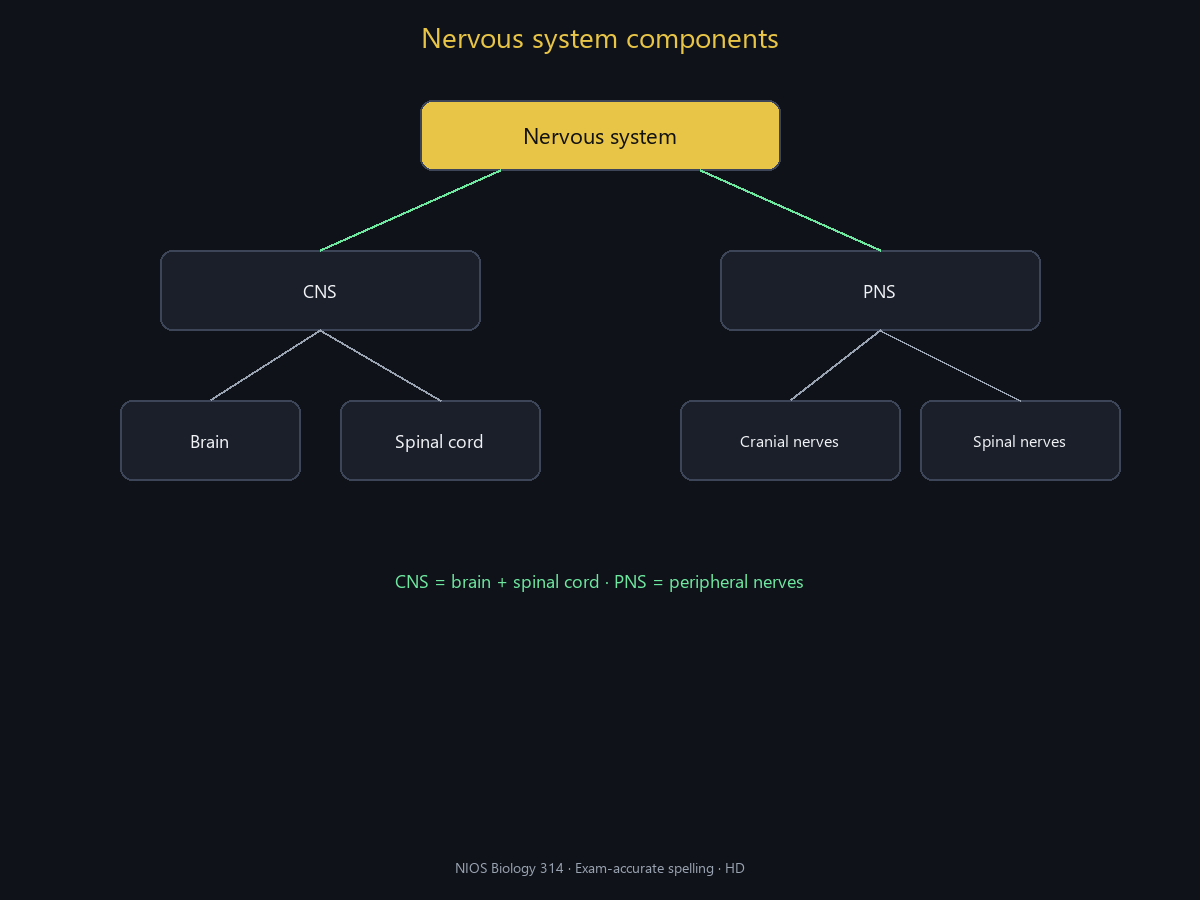
Why it clicks: Fill any two blanks with CNS/PNS or brain/spinal cord/nerves as per flowchart.
Q3. Which one of the following is not produced due to under secretion of thyroxine?
Why it clicks: Hypo → cretinism/myxoedema; goitre often iodine deficiency story.
Q4. Identify the type of neuron given in the diagram and state the function of axon: 2 15 ]
This question needs a diagram — open the answer to view the HD model figure.
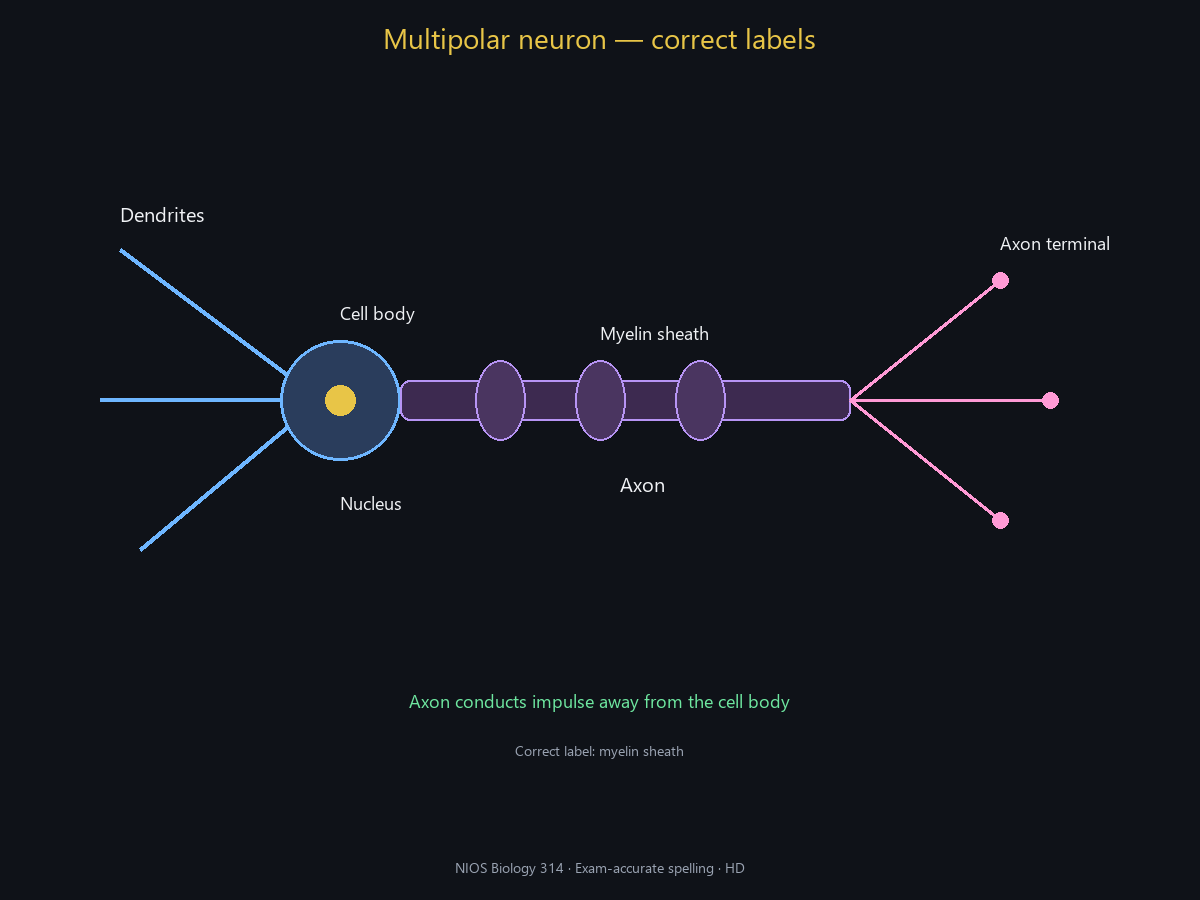
Why it clicks: Dendrites receive; axon sends out.
Q5. (I) The faulty functioning of an endocrine gland can make a person very short or very tall. This gland is: A. pituitary B. adrenal C. pineal D. thyroid
Why it clicks: Growth hormone (STH/GH) from anterior pituitary: excess → tall/gigantism; deficit → short/dwarfism.
Q6. Match the hormones in column I with their functions given in column II. (i) Column I Column II (i) Testosterone (ii) Insulin (a) Causes breasts to develop in females (b) Regulates the amount of sugar is blood (c) Causes males to start producing sperms (d) Prepares body for as emergency 20 In the flow chart given below write down the basic components of the nervous system in the empty spaces, a, b, c, and d.(attempt any two a
Why it clicks: Match hormone to textbook action.
Q7. (b) Suppose you are stuck in traffic and have the feeling of urination. Which part of the nervous system do you think is responsible for this? Mention the role of that part
Why it clicks: Not skeletal (somatic) control alone—visceral ANS pathway.
Q8. Following is the list of hormones produced in our body. Write their expanded forms and write the names of the endocrine glands that produce them: (a) STH (b) TSH (c) FSH (e) ADH Marking Scheme (.no MCQs Marks
Why it clicks: Tropic hormones of anterior pituitary vs ADH from posterior pituitary.
Q9. ADH (Antidiuretic hormone) is released by the posterior pituitary gland and is a non- tropic hormone. TSH (thyroid-stimulating hormone), and FSH(follicle-stimulating hormone) are released by the anterior pituitary gland and are tropic hormones. STH: Somatotropic Hormone LH: Luteinizing Hormone
Why it clicks: Marking-scheme style facts already in stem—use as model answer.
Problem Solving — L17 Nervous and Endocrine Systems
Six problems spanning this chapter’s NIOS Biology (314) syllabus. Every question is built from the notes and formula sheet: solve with definitions and equations first, then read the formal textbook-style write-up, the easy explanation, and the topic in depth (key relations, meaning, exam tips). If the question says draw, a labelled pencil sketch is provided. Explanations open by default.
Draw a motor neuron and label dendrite, cell body, axon and synaptic terminal. State direction of impulse.
Pencil sketch (labelled)
Solution — step by step
- Labels as asked.
- Impulse: dendrites/cell body → axon → terminal (usually).
Final answer: Impulse dendrite→axon→terminal; labelled sketch
Key relations / definitions
Textbook formal language
Neuron is the structural and functional unit of nervous system.
Key relations: Dendrite → cell body → axon → terminal; Synapse chemical transmission. State the definition or law first (NIOS style), use correct biological terms, and end with a clear boxed conclusion.
Easy language (same idea, plain words)
Message enters bushy dendrites, through cell body, out long axon to the end.
Read the question once for the idea, once for the details. Write the definition or equation, then apply it. Check labels and units if any numbers appear.
Topic in depth — Neuron structure
Myelin speeds conduction in many vertebrate axons (school-level note).
Linked to chapter notes (L17). Remember: Dendrite → cell body → axon → terminal; Synapse chemical transmission. Most exam errors mix up similar terms, reverse cause and effect, or skip labelled diagrams.
Exam tip
Open with a one-line definition, then use: Dendrite → cell body → axon → terminal; Synapse chemical transmission. For diagram questions, label every part asked and keep lines neat.
Common mistakes
- Confusing prokaryote with eukaryote (or plant with animal tissues).
- Mixing up similar pathways (e.g. photosynthesis vs respiration; mitosis vs meiosis).
- Writing vague answers without key technical terms from NIOS notes.
- Forgetting to label diagrams or state units where numbers are used.
How does a nerve impulse cross a chemical synapse?
Solution — step by step
- Action potential opens Ca²⁺ channels at terminal → vesicles release neurotransmitter.
- Transmitter diffuses across cleft, binds receptors on postsynaptic membrane → new potential.
Final answer: Neurotransmitter release and receptor binding
Key relations / definitions
Textbook formal language
Synapses allow one-way, modulatable transmission between neurons or neuron–muscle.
Key relations: Neurotransmitter across synaptic cleft; e.g. acetylcholine at many NMJ. State the definition or law first (NIOS style), use correct biological terms, and end with a clear boxed conclusion.
Easy language (same idea, plain words)
Electric signal becomes chemical splash, then electric again next cell.
Read the question once for the idea, once for the details. Write the definition or equation, then apply it. Check labels and units if any numbers appear.
Topic in depth — Chemical synapse
Drugs can block or mimic transmitters—exam link.
Linked to chapter notes (L17). Remember: Neurotransmitter across synaptic cleft; e.g. acetylcholine at many NMJ. Most exam errors mix up similar terms, reverse cause and effect, or skip labelled diagrams.
Exam tip
Open with a one-line definition, then use: Neurotransmitter across synaptic cleft; e.g. acetylcholine at many NMJ. For diagram questions, label every part asked and keep lines neat.
Common mistakes
- Confusing prokaryote with eukaryote (or plant with animal tissues).
- Mixing up similar pathways (e.g. photosynthesis vs respiration; mitosis vs meiosis).
- Writing vague answers without key technical terms from NIOS notes.
- Forgetting to label diagrams or state units where numbers are used.
Match: cerebellum, medulla oblongata, cerebrum to primary roles.
Solution — step by step
- Cerebrum — higher functions, sensory perception, voluntary motor.
- Cerebellum — posture, balance, coordination of movement.
- Medulla — vital centres (breathing, heart rate, etc.).
Final answer: Cerebrum higher; cerebellum balance; medulla vitals
Key relations / definitions
Textbook formal language
Brain regions specialise yet integrate via tracts.
Key relations: Cerebrum: intelligence/senses/motor; Cerebellum: balance/coordination; Medulla: vital reflexes. State the definition or law first (NIOS style), use correct biological terms, and end with a clear boxed conclusion.
Easy language (same idea, plain words)
Thinking cap, balance box, life-support switchboard.
Read the question once for the idea, once for the details. Write the definition or equation, then apply it. Check labels and units if any numbers appear.
Topic in depth — Brain parts
Spinal cord also has reflex arcs independent of brain awareness.
Linked to chapter notes (L17). Remember: Cerebrum: intelligence/senses/motor; Cerebellum: balance/coordination; Medulla: vital reflexes. Most exam errors mix up similar terms, reverse cause and effect, or skip labelled diagrams.
Exam tip
Open with a one-line definition, then use: Cerebrum: intelligence/senses/motor; Cerebellum: balance/coordination; Medulla: vital reflexes. For diagram questions, label every part asked and keep lines neat.
Common mistakes
- Confusing prokaryote with eukaryote (or plant with animal tissues).
- Mixing up similar pathways (e.g. photosynthesis vs respiration; mitosis vs meiosis).
- Writing vague answers without key technical terms from NIOS notes.
- Forgetting to label diagrams or state units where numbers are used.
List the five components of a simple reflex arc in order.
Solution — step by step
- Receptor.
- Sensory (afferent) neuron.
- Interneuron in CNS (sometimes direct synapse).
- Motor (efferent) neuron.
- Effector (muscle/gland).
Final answer: Receptor–sensory–interneuron–motor–effector
Key relations / definitions
Textbook formal language
Reflexes are rapid involuntary responses protecting the body.
Key relations: Receptor → sensory neuron → interneuron → motor neuron → effector. State the definition or law first (NIOS style), use correct biological terms, and end with a clear boxed conclusion.
Easy language (same idea, plain words)
Sensor → wire in → middle neuron → wire out → muscle jump.
Read the question once for the idea, once for the details. Write the definition or equation, then apply it. Check labels and units if any numbers appear.
Topic in depth — Reflex arc
Knee-jerk is classic spinal reflex example.
Linked to chapter notes (L17). Remember: Receptor → sensory neuron → interneuron → motor neuron → effector. Most exam errors mix up similar terms, reverse cause and effect, or skip labelled diagrams.
Exam tip
Open with a one-line definition, then use: Receptor → sensory neuron → interneuron → motor neuron → effector. For diagram questions, label every part asked and keep lines neat.
Common mistakes
- Confusing prokaryote with eukaryote (or plant with animal tissues).
- Mixing up similar pathways (e.g. photosynthesis vs respiration; mitosis vs meiosis).
- Writing vague answers without key technical terms from NIOS notes.
- Forgetting to label diagrams or state units where numbers are used.
Give two differences between nervous and endocrine control.
Pencil sketch (labelled)
Solution — step by step
- Nervous: rapid, localised, short-lived electrical/chemical synapses.
- Endocrine: slower onset, widespread via blood hormones, longer lasting.
Final answer: Fast local nerves vs slower blood hormones
Key relations / definitions
Textbook formal language
Both maintain homeostasis; differ in speed and mode.
Key relations: Hormone: chemical, blood-borne, slower, longer; Nerve: electrical/chemical, fast, short. State the definition or law first (NIOS style), use correct biological terms, and end with a clear boxed conclusion.
Easy language (same idea, plain words)
Nerves are text messages; hormones are radio broadcasts in the blood.
Read the question once for the idea, once for the details. Write the definition or equation, then apply it. Check labels and units if any numbers appear.
Topic in depth — Endocrine vs nervous
Some systems interact (neuroendocrine).
Linked to chapter notes (L17). Remember: Hormone: chemical, blood-borne, slower, longer; Nerve: electrical/chemical, fast, short. Most exam errors mix up similar terms, reverse cause and effect, or skip labelled diagrams.
Exam tip
Open with a one-line definition, then use: Hormone: chemical, blood-borne, slower, longer; Nerve: electrical/chemical, fast, short. For diagram questions, label every part asked and keep lines neat.
Common mistakes
- Confusing prokaryote with eukaryote (or plant with animal tissues).
- Mixing up similar pathways (e.g. photosynthesis vs respiration; mitosis vs meiosis).
- Writing vague answers without key technical terms from NIOS notes.
- Forgetting to label diagrams or state units where numbers are used.
Name the hormone that lowers blood glucose and its gland. What disease if deficient?
Pencil sketch (labelled)
Solution — step by step
- Insulin from pancreatic β-cells (islets of Langerhans).
- Deficiency/ineffectiveness → diabetes mellitus.
Final answer: Insulin (pancreas); diabetes mellitus
Key relations / definitions
Textbook formal language
Hormone specificity depends on target receptors.
Key relations: Insulin ↓ blood glucose; Adrenaline fight/flight; Thyroxine metabolism; GH growth. State the definition or law first (NIOS style), use correct biological terms, and end with a clear boxed conclusion.
Easy language (same idea, plain words)
Insulin is the sugar-lowering key from pancreas; without it, diabetes.
Read the question once for the idea, once for the details. Write the definition or equation, then apply it. Check labels and units if any numbers appear.
Topic in depth — Key hormones
Glucagon raises blood glucose—opposite partner.
Linked to chapter notes (L17). Remember: Insulin ↓ blood glucose; Adrenaline fight/flight; Thyroxine metabolism; GH growth. Most exam errors mix up similar terms, reverse cause and effect, or skip labelled diagrams.
Exam tip
Open with a one-line definition, then use: Insulin ↓ blood glucose; Adrenaline fight/flight; Thyroxine metabolism; GH growth. For diagram questions, label every part asked and keep lines neat.
Common mistakes
- Confusing prokaryote with eukaryote (or plant with animal tissues).
- Mixing up similar pathways (e.g. photosynthesis vs respiration; mitosis vs meiosis).
- Writing vague answers without key technical terms from NIOS notes.
- Forgetting to label diagrams or state units where numbers are used.