OneNIOS Study Hub
Biology — Class 12 — L12: Respiration in Plants
Lesson-12.pdf). Content covers sections 12.1–12.6.Overview — Making food energy usable
Life needs continuous materials for growth and energy for all processes. Photosynthesis stores light energy in bonds of glucose and starch (“food”). Respiration releases that stored energy by oxidation of organic molecules and makes it available to cells as ATP (adenosine triphosphate) — the energy currency of the cell. Oxygen for aerobic respiration comes from the atmosphere. This NIOS lesson covers external and cellular respiration, aerobic vs anaerobic paths, glycolysis, fermentation and industry, Krebs cycle, electron transport chain and the 38-ATP budget, RQ and factors, photorespiration, and the pentose phosphate pathway (PPP).
After this lesson you should define respiration, fermentation, photorespiration and RQ; write anaerobic equations; compare aerobic and anaerobic respiration; outline Krebs and ATP accounting; list factors affecting rate; and understand PPP in microbes and active tissues. Notes follow textbook order only. Link to L11: photosynthesis builds the food that respiration oxidises; photorespiration is the wasteful oxygenation of RuBP under high light/O₂. Link to L10: acetyl CoA and Krebs intermediates also feed amino-acid carbon skeletons after nitrogen assimilation — energy and building blocks travel the same highways.
Section 1: What is respiration? (12.1)
Respiration is the stepwise oxidation of complex organic molecules with release of energy as ATP for cellular metabolic activities. It involves gas exchange with the environment: plants take O₂ and return CO₂ and water vapour.
- External respiration (breathing in animals) — mere physical exchange of gases.
- Cellular respiration — biochemical oxidation of food inside cells, catalysed by enzymes.
Aerobic respiration uses oxygen; anaerobic does not. Anaerobic incomplete breakdown in cytosol yields little ATP. Aerobic continues with an O₂-requiring phase that yields much more ATP — in mitochondria (eukaryotes) or folded plasma membrane/mesosome (prokaryotes).
Shared features of both: oxidation reactions; coenzymes NAD and FAD as hydrogen carriers (reduction of coenzyme, oxidation of substrate); later reoxidation of carriers for ATP synthesis; use of high-energy phosphates like ATP for transfer. Coenzymes are non-protein molecules temporarily bound to enzymes, linking pathways.
| Aerobic | Anaerobic | |
|---|---|---|
| Oxygen | Required | Absent |
| Oxidation | Complete | Incomplete |
| Typical equation | C₆H₁₂O₆+6O₂→6CO₂+6H₂O+~38ATP | → 2 ethanol+2CO₂+2ATP (yeast) or 2 lactate+2ATP (muscle) |
| Site | Cytosol + mitochondria | Cytosol only |
| Organisms | Higher plants & animals | Microbes; muscle under O₂ debt |
Plants and other organisms obtain energy for growth by oxidising photosynthetic products and capturing energy as ATP. Two differences aero/anaero: complete vs incomplete oxidation; much more ATP vs only 2 ATP.
Section 2: External respiration / gaseous exchange (12.2)
In plants, air moves by simple diffusion through: (a) general body surface (stems, roots, fruits, seeds); (b) lenticels in bark; (c) stomata in leaves and young green stems. No blood O₂ carrier is needed: O₂ requirement is lower than in animals and large leaf surface allows enough diffusion.
As O₂ is used, more diffuses in. CO₂ builds up in tissues and diffuses out when not used in photosynthesis. Why plants give out O₂ by day: photosynthesis releases O₂ faster than respiration uses it, so net O₂ is liberated; at night only respiration continues and CO₂ is released. Animals release CO₂ always.
Why no special respiratory organs: large surface area for exchange; relatively low O₂ demand compared with animals.
Section 3: Cellular respiration map (12.3)
O₂ oxidises nutrients (glucose, amino acids, fatty acids) to CO₂, water and energy inside cells. First stage in all paths is glycolysis. Then: with O₂ → mitochondria (aerobic); without → fermentation.
3.1 Glycolysis (EMP pathway)
Always initially anaerobic; common to aero and anaero. Glucose (6C) → two pyruvic acid (3C) by enzyme-controlled steps in cytosol. Three major phases:
- Phosphorylation / activation — glucose → fructose-1,6-bisphosphate; 2 ATP used.
- Splitting — into two interconvertible 3C sugar phosphates (origin of name “glycolysis”).
- Oxidation by dehydrogenation — each 3C compound oxidised; NADH formed; ATP made (ancient energy-capture reactions).
Balanced idea: glucose + 4ADP + 4Pi + 2NAD → 2 pyruvic acid + 4ATP + 2NADH. Net ATP = 4 − 2 = 2 ATP; also 2 NADH. Only a small fraction of glucose energy is released by end of glycolysis. ATP hydrolysis: ATP → ADP + Pi + ~30.6 kJ.
Why memorise three phases? Terminal exercises ask them by name. Activation invests ATP so the sugar is trapped and primed; splitting explains the word glycolysis; oxidation is the ancient capture of energy that virtually all living cells still share. Substrate for glycolysis is glucose from photosynthesis (plants) or digestion (animals). End product is always pyruvate — the fork in the road for oxygen status.
3.2 Fermentation
Further oxidation of pyruvate needs O₂ for mitochondria. Under anaerobic conditions: fermentation — pyruvate reduced to ethyl alcohol + CO₂ (yeast) or lactic acid (animal muscle); NADH oxidised back to NAD⁺ so glycolysis can continue making 2 ATP. No additional ATP in the fermentation steps themselves.
Equations: C₆H₁₂O₆ → 2C₂H₅OH + 2CO₂ + 2ATP (alcohol); or → 2 lactic acid + 2ATP. Muscle pain in prolonged exercise: lactic acid accumulation under O₂ debt.
Industrial significance: bakeries (bread, cakes); breweries (wine, alcohol); vinegar, leather tanning/curing; ethanol for gasohol (Brazil); everyday leavening of idli, dosa, bhatura, dhokla — CO₂ makes dough spongy; fermentation flavours foods.
3.3 Aerobic fate of pyruvic acid
With O₂, pyruvate enters mitochondria: decarboxylation + dehydrogenation → acetyl CoA — link between glycolysis and Krebs. Acetyl CoA also from fats (β-oxidation) and proteins (after deamination).
3.4 Krebs’ cycle (citric acid / TCA cycle)
In mitochondrial matrix; worked out by Hans Krebs (1930s). Acetyl (2C) + oxaloacetate (4C) → citrate (6C). Two decarboxylations release CO₂; dehydrogenations load 3 NADH and 1 FADH₂ per turn; 1 ATP made directly per turn. Two acetyls per glucose → two turns. Oxaloacetate regenerated. Per glucose summary idea: 2 pyruvate → 6CO₂ + 8NADH + 2FADH₂ + 2ATP (book equation form for this phase). NAD and FAD from vitamin B-complex coenzymes.
Hydrogen carriers then feed the respiratory chain / ETC.
3.5 Electron transport chain / oxidative phosphorylation
Inner mitochondrial membrane (cristae increase area). H from carriers oxidised stepwise with molecular O₂; energy in small steps makes ATP from ADP + Pi — oxidative phosphorylation. Carriers pass e⁻/H downhill to O₂, final acceptor, reduced to H₂O. Cytochrome oxidase hands electrons to oxygen. Each NADH ≈ 3 ATP; each FADH₂ ≈ 2 ATP (FADH₂ enters at lower energy). CO and H₂S poison the H-transfer system and stop ATP generation.
| Stage | CO₂ | ATP (substrate) | NADH | FADH₂ |
|---|---|---|---|---|
| Glycolysis | — | 2 | 2 | — |
| Pyruvate → acetyl CoA | 2 | — | 2 | — |
| Krebs (2 turns) | 4 | 2 | 6 | 2 |
| Total | 6 | 4 | 10 | 2 |
10 NADH × 3 = 30 ATP; 2 FADH₂ × 2 = 4 ATP; + 4 substrate-level = 38 ATP per glucose (textbook total). Note: some biologists count 36 in eukaryotes because shuttling 2 cytosolic NADH into mitochondria costs 2 ATP; prokaryotes without mitochondria still get 38. Two Krebs turns per glucose because two pyruvates form in glycolysis.
Book phase equation for aerobic after glycolysis: 2 pyruvic acid + 6O₂ → 6CO₂ + 6H₂O + 30 ATP, plus 8 ATP counted from glycolysis-related accounting in some summaries — keep the stage table clear so you do not double-count. End products of the ETC itself are water (and the ATP made along the way). Poisons like carbon monoxide and hydrogen sulphide block hydrogen transfer and stop ATP generation — a classic applied fact.
Significance of stepwise oxidation instead of one explosive step: energy is released in controlled packets that cells can store as ATP; a single-step burn would waste most energy as heat and damage the cell. That is why the pathway is long and enzyme-regulated.
3.6 Significance of Krebs and acetyl CoA; amphibolic pathway
Krebs: major controlled release of reduced coenzymes and energy; common path for carbs, fatty acids (β-oxidation → acetyl CoA), amino acids (after deamination); intermediates for amino acids, nucleotides, chlorophyll, fats. Respiration is catabolic; photosynthesis anabolic; together they form an amphibolic pathway (amphi = two). Compensation point (from L11 context): light intensity where photosynthetic CO₂ use equals respiratory CO₂ production — net gas exchange zero for CO₂.
Sites summary: glycolysis — cytosol; Krebs — mitochondrial matrix; ETC/ATP by oxidative phosphorylation — inner membrane. O₂ role: terminal acceptor of electrons and H from glucose, reduced to water. Why fermentation of pyruvate when no O₂: regenerates NAD⁺ for glycolysis. Why less energy anaerobic: partial oxidation; energy remains in alcohol or lactate.
Section 4: Rate of respiration and factors (12.4)
Rate measured as CO₂ released per unit time; varies by organ and age (young parts higher). Internal factors: minerals, organ structure, enzyme activity, substrate type. External: O₂, water, temperature, CO₂.
Respiratory Quotient (RQ) = volume CO₂ evolved / volume O₂ consumed. Indicates substrate: carbohydrate RQ = 1 (stems, roots); protein RQ < 1 (pulses); fats/oils discussed for oil seeds (textbook also notes energy density of fat). Significance: idea of kind of food being respired.
- Temperature: most suitable ~30–35°C (enzyme optimum); reduced above ~50°C and at 0–10°C.
- Oxygen: rate rises as O₂ rises from zero, then increase slows beyond a limit.
- CO₂: accumulation around tissue decreases respiration rate.
- Water: dry mature seeds respire very slowly; water hydration of enzymes starts respiration immediately — limiting factor in dry seeds is water.
RQ practice: if volumes of CO₂ and O₂ are equal, substrate is likely carbohydrate. If CO₂/O₂ is less than one, protein is likely. Oil seeds store fat; textbook uses RQ to identify substrate class in different organs (stem/root vs pulse vs mustard-type seeds). High O₂ concentration: rate rises then the rate of increase falls beyond a limit — do not claim infinite increase. CO₂ accumulation around tissue slows respiration — opposite of the usual “CO₂ fertilises photosynthesis” story from L11, so keep the processes separate.
Section 5: Photorespiration (12.5)
In dark reaction of photosynthesis, Rubisco carboxylates RuBP → 2 PGA → Calvin. Rubisco also has high affinity for O₂ and can oxygenate RuBP. Respiration initiated in chloroplast under light, high O₂, low CO₂ = photorespiration: RuBP + O₂ → PGA + phosphoglycolate; further reactions in mitochondria and peroxisomes; 2 phosphoglycolate → 1 PGA + 1 CO₂; no ATP produced. Same active site for CO₂ and O₂. Loss of ~25% of carbon fixed in dark reaction. Use: utilises excess solar energy that might otherwise photo-oxidatively damage pigments in C₃ plants.
Vs ordinary respiration: three organelles (chloroplast, mito, peroxisome) vs cyto+mito; substrate RuBP vs glucose; products CO₂+PGA no ATP vs ATP+CO₂+H₂O; mainly C₃ green plants in day high O₂/low CO₂/heat vs day and night in C₃ and C₄; wasteful vs energy-yielding.
Section 6: Pentose phosphate pathway / HMP (12.6)
In industrial microbes and highly active animal tissues: efficient path called PPP (pentose phosphate pathway), also HMP shunt or direct oxidation of glucose. Site: cytosol; does not require ETC or mitochondrion for its core oxidations.
Glucose → G6P (1 ATP); with NADP → oxidised products and NADPH₂; further to ribulose-5-P + CO₂ + more NADPH₂. Net idea: one glucose → 6CO₂ + 12 NADPH₂-related H, regenerating G6P pool via intermediate sugars. If 12 NADPH₂ enter oxidative phosphorylation → 36 ATP − 1 used = ~35 ATP net (book accounting). Side product pentose phosphates feed RNA (ribose-5-P) and DNA (deoxyribose-5-P) synthesis. Called HMP because starting G6P is a hexose monophosphate and only one ATP is used to make it, unlike two ATP spent early in glycolysis under aerobic EMP path.
Contributions of PPP: NADPH for biosynthesis/reducing power; pentose sugars for nucleic acids; alternative complete oxidation route in cytosol. Industrial microbes used for antibiotics and other products rely on high flux through such paths; highly active animal tissues likewise need both ATP and NADPH. If glucose molecules keep entering PPP, many pentoses form; ribulose-5-P can be recycled to G6P through intermediates such as erythrose, sedoheptulose and hexoses, restarting the cycle — similar names appear in the Calvin cycle of photosynthesis, a useful memory bridge between Lesson 11 photosynthesis and Lesson 12 plant respiration pathways for board exams and full revision.
Section 7: Activities and exam checklist
Textbook activities: pea seeds under mercury evolve CO₂ absorbed by KOH (anaerobic); yeast in glucose under oil turns limewater milky without O₂ use (alcohol smell) = anaerobic fermentation; open flask with air shows O₂ use and no alcohol = aerobic growth of yeast (better aerobically).
What you have learnt: energy from food oxidation as ATP; external + cellular respiration; anaerobic 2 ATP incomplete vs aerobic ~38 complete; three steps glycolysis, Krebs, ETC; glycolysis common; sites cyto/matrix/inner membrane; fermentation industry; young parts higher rate; factors and RQ; photorespiration high light low CO₂ no ATP gain, protects pigments.
One-line keys: energy as ATP; O₂ terminal ETC acceptor; ATP from glucose to CO₂+H₂O ~38 (or 36 euk); to alcohol+CO₂ = 2; aerobic equation C₆H₁₂O₆+6O₂→6CO₂+6H₂O; ETC end products H₂O (+ATP); day net O₂ from photosynthesis excess; sites of three stages; fate of pyruvate ±O₂; stepwise oxidation controls energy capture; photorespiration significance protection; RQ carb=1; ideal temp 30–35°C; dry seed water limiting; photorespiration products PGA + phosphoglycolate; conditions light high O₂ low CO₂.
Why stepwise oxidation not one step: energy released in controlled small packets, captured as ATP rather than lost as heat. Why less energy fermentation: incomplete oxidation. Significance of TCA: energy, multi-fuel entry, intermediates. Why photorespiration wasteful: carbon loss, no ATP. Respiratory chain significance: couples oxidation to phosphorylation.
Use Formula Sheet lock boxes; drill 10 MCQs and 20 flashcards. Memorise site table, 38-ATP budget, RQ values, and photorespiration vs respiration contrast.
Section 8: Integrated walkthrough and closed-book drill
A plant cell at night: O₂ diffuses in; glucose from stored starch is glycolysed in cytosol to two pyruvates (net 2 ATP, 2 NADH); with O₂, pyruvate becomes acetyl CoA and burns in Krebs, loading NADH/FADH₂; ETC on cristae transfers electrons to O₂ making water and a large ATP harvest. At day in a C₃ leaf, the same machinery runs, but Rubisco may also oxygenate RuBP and photorespiration bleeds carbon without ATP — C₄ plants largely avoid that (L11). Yeast in a sealed dough uses fermentation for 2 ATP and releases CO₂ that raises bread. Industrial alcohol is the same chemistry scaled up. PPP in a bacterium can strip carbon to CO₂ while making NADPH and pentoses for growth. Together with photosynthesis, this amphibolic network is life’s energy economy.
Closed-book drill: (1) define respiration and ATP role; (2) aero vs anaero table; (3) plant gas exchange routes; (4) three phases of glycolysis + net yield; (5) fermentation equations + three industrial uses; (6) acetyl CoA link; (7) Krebs one-paragraph + two turns; (8) ETC and O₂ role; (9) 38 ATP accounting (and 36 caveat); (10) Krebs significance + amphibolic; (11) RQ definition and carb/protein; (12) five factors; (13) photorespiration equation and why wasteful; (14) PPP site and two contributions. Completing these covers terminal exercises for Lesson 12.
Section 9: Extra exam notes
Why plants release O₂ not CO₂ by day: photosynthesis produces more O₂ than respiration consumes, so the surplus escapes; respiration still runs continuously but is masked. At night only respiration shows as CO₂ output. Animals have no photosynthetic mask — they always net CO₂.
Substrates entering glycolysis: glucose. Products: 2 pyruvate, net 2 ATP, 2 NADH. Krebs: substrate acetyl CoA (with OAA); products per turn include CO₂, reduced coenzymes, ATP; remember two turns. Fatty acids enter Krebs after β-oxidation to acetyl CoA; amino acids after deamination. That multi-fuel entry is why Krebs is called a common oxidative pathway.
Fermentation vs aerobic yield: yeast alcohol path gives 2 ATP; full aerobic path ~38 — almost twenty times more because remaining energy is not left trapped in ethanol. Industrial brewing carefully controls air: yeast grows better with oxygen but alcohol production needs anaerobic fermentation — textbook activity note on regulated conditions.
Photorespiration occurs only in light under high O₂ and low CO₂ (and often high temperature); ordinary respiration occurs day and night. C₄ plants largely avoid photorespiration (Lesson 11 Kranz strategy). Protective role: dissipates excess light energy that could destroy chlorophyll — the only “use” of an otherwise wasteful path.
PPP two contributions for short answers: (i) NADPH for reductive biosynthesis; (ii) pentose phosphates for nucleic acid sugars. Site always cytosol. Contrast with EMP glycolysis: PPP can oxidise glucose carbon to CO₂ without the mitochondrion, and starts from G6P after only one ATP investment.
Quick formula strip: C₆H₁₂O₆+6O₂→6CO₂+6H₂O+~38ATP; anaerobic yeast C₆H₁₂O₆→2C₂H₅OH+2CO₂+2ATP; glycolysis net 2ATP; NADH→3ATP FADH₂→2ATP; RQ=CO₂/O₂; photorespiration RuBP+O₂; PPP cytosol NADPH. Say them aloud with sites (cytosol / matrix / cristae) before the paper. Compensation point from L11 reappears: when photosynthetic CO₂ uptake equals respiratory CO₂ release, net exchange is zero — a living plant is still respiring even when the graph of gas exchange looks flat.
MCQ Quiz — L12 Respiration in Plants
Flashcards — L12
Golden Rules — L12 Respiration in Plants
Most exam-important points from this chapter:
Define & compare
Respiration = stepwise oxidation → ATP. External exchange vs cellular chemistry. Aerobic complete +O₂ ~38 ATP; anaerobic incomplete 2 ATP. Shared: NAD/FAD, oxidation, ATP.
Pathway map
Glycolysis (cytosol, all) → 2 pyruvate. No O₂: fermentation (NAD⁺ recycle). With O₂: acetyl CoA → Krebs (matrix) → ETC (cristae) → H₂O + bulk ATP.
ATP accounting
Net 2 ATP glycolysis; Krebs substrate ATP; NADH≈3, FADH₂≈2. Book total 38; some count 36 if shuttle costs 2. Two Krebs turns per glucose.
RQ & factors
RQ = CO₂/O₂ volumes shows substrate (carb=1). Temp 30–35°C best; water limits dry seeds; O₂ raises rate then plateaus; young tissues respire more.
Photorespiration & PPP
Photorespiration: Rubisco+O₂, no ATP, wasteful C loss, day high O₂/low CO₂. PPP: cytosol NADPH + pentoses for nucleic acids; industrial microbes and active tissues.
Past Year Questions — L12 Respiration in Plants
PE-only questions for this chapter only. 1 item(s). No overlap with other lessons. Tap Show answer after you try each question.
Q1. (I) Illustrate the 3 major phases in glycolysis
This question needs a diagram — open the answer to view the HD model figure.
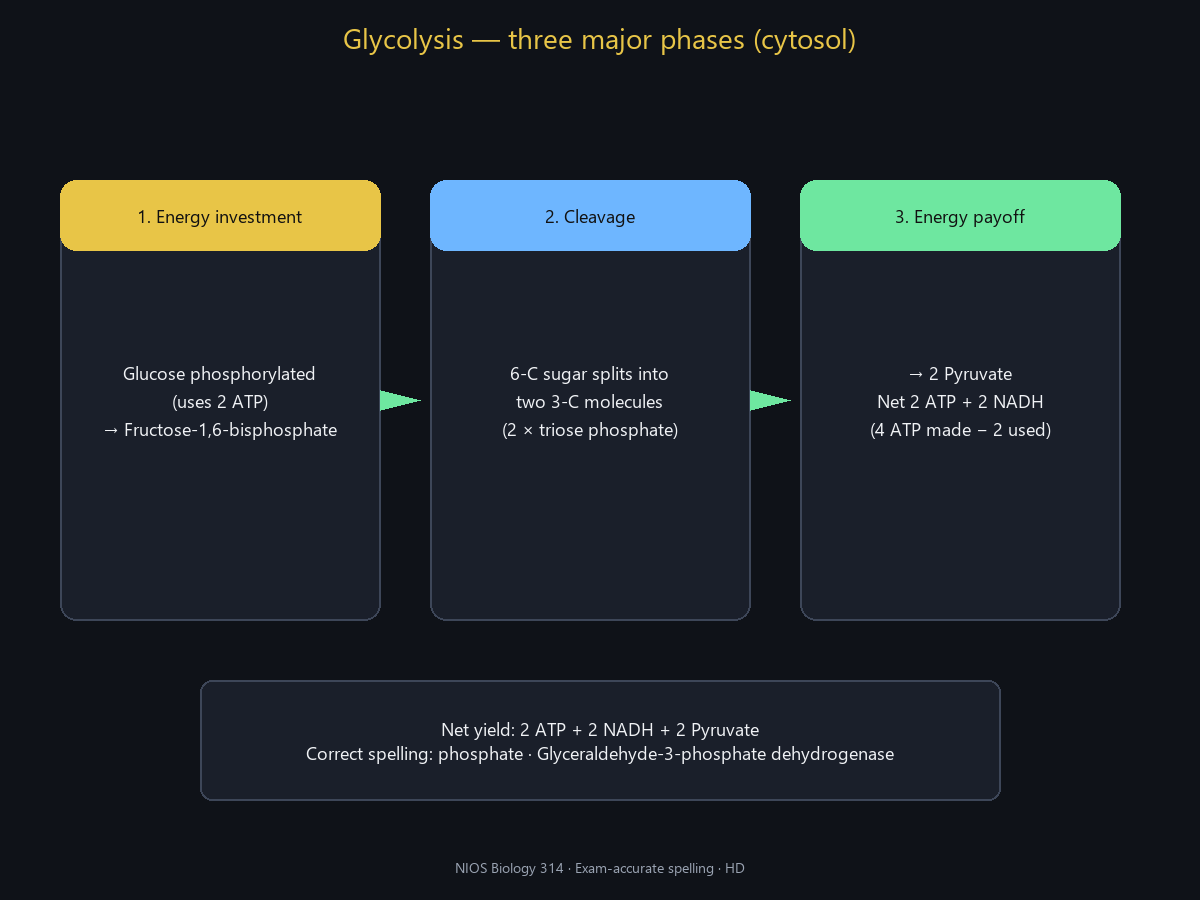
Why it clicks: Pay 2 ATP early, gain 4 later → net 2 ATP per glucose.
Problem Solving — L12 Respiration in Plants
Six problems spanning this chapter’s NIOS Biology (314) syllabus. Every question is built from the notes and formula sheet: solve with definitions and equations first, then read the formal textbook-style write-up, the easy explanation, and the topic in depth (key relations, meaning, exam tips). If the question says draw, a labelled pencil sketch is provided. Explanations open by default.
Write the overall equation of aerobic respiration of glucose.
Solution — step by step
- C₆H₁₂O₆ + 6O₂ → 6CO₂ + 6H₂O + energy (ATP + heat).
Final answer: C₆H₁₂O₆ + 6O₂ → 6CO₂ + 6H₂O + energy
Key relations / definitions
Textbook formal language
Aerobic respiration fully oxidises glucose using oxygen as terminal acceptor.
Key relations: C₆H₁₂O₆ + 6O₂ → 6CO₂ + 6H₂O + energy (ATP). State the definition or law first (NIOS style), use correct biological terms, and end with a clear boxed conclusion.
Easy language (same idea, plain words)
Sugar + oxygen → carbon dioxide + water + usable energy.
Read the question once for the idea, once for the details. Write the definition or equation, then apply it. Check labels and units if any numbers appear.
Topic in depth — Aerobic respiration
Photosynthesis is roughly the reverse carbon path—but not identical detail.
Linked to chapter notes (L12). Remember: C₆H₁₂O₆ + 6O₂ → 6CO₂ + 6H₂O + energy (ATP). Most exam errors mix up similar terms, reverse cause and effect, or skip labelled diagrams.
Exam tip
Open with a one-line definition, then use: C₆H₁₂O₆ + 6O₂ → 6CO₂ + 6H₂O + energy (ATP). For diagram questions, label every part asked and keep lines neat.
Common mistakes
- Confusing prokaryote with eukaryote (or plant with animal tissues).
- Mixing up similar pathways (e.g. photosynthesis vs respiration; mitosis vs meiosis).
- Writing vague answers without key technical terms from NIOS notes.
- Forgetting to label diagrams or state units where numbers are used.
Where does glycolysis occur? What is its end product in aerobic cells before mitochondria?
Solution — step by step
- Cytoplasm (cytosol).
- Pyruvate (2 per glucose); net ~2 ATP + 2 NADH.
Final answer: Cytoplasm; pyruvate
Key relations / definitions
Textbook formal language
Glycolysis is the common first pathway of respiration in almost all organisms.
Key relations: Glucose → 2 pyruvate; Net 2 ATP + 2 NADH; cytoplasm; anaerobic or aerobic. State the definition or law first (NIOS style), use correct biological terms, and end with a clear boxed conclusion.
Easy language (same idea, plain words)
Sugar splitting happens in the cell liquid and makes pyruvate.
Read the question once for the idea, once for the details. Write the definition or equation, then apply it. Check labels and units if any numbers appear.
Topic in depth — Cytoplasmic stage
No O₂ needed for glycolysis itself.
Linked to chapter notes (L12). Remember: Glucose → 2 pyruvate; Net 2 ATP + 2 NADH; cytoplasm; anaerobic or aerobic. Most exam errors mix up similar terms, reverse cause and effect, or skip labelled diagrams.
Exam tip
Open with a one-line definition, then use: Glucose → 2 pyruvate; Net 2 ATP + 2 NADH; cytoplasm; anaerobic or aerobic. For diagram questions, label every part asked and keep lines neat.
Common mistakes
- Confusing prokaryote with eukaryote (or plant with animal tissues).
- Mixing up similar pathways (e.g. photosynthesis vs respiration; mitosis vs meiosis).
- Writing vague answers without key technical terms from NIOS notes.
- Forgetting to label diagrams or state units where numbers are used.
Locate Krebs cycle and electron transport chain in a mitochondrion.
Solution — step by step
- Krebs (TCA) cycle: mitochondrial matrix.
- ETC / oxidative phosphorylation: inner mitochondrial membrane.
Final answer: Matrix (Krebs); inner membrane (ETC)
Key relations / definitions
Textbook formal language
Compartments of mitochondrion organise oxidative metabolism.
Key relations: Pyruvate → acetyl-CoA; Krebs in mitochondrial matrix; ETC on inner membrane. State the definition or law first (NIOS style), use correct biological terms, and end with a clear boxed conclusion.
Easy language (same idea, plain words)
Circle reactions in the juice; electron chain on the folded wall.
Read the question once for the idea, once for the details. Write the definition or equation, then apply it. Check labels and units if any numbers appear.
Topic in depth — Link reaction & Krebs
Chloroplast is not the site of Krebs in plants’ dark respiration.
Linked to chapter notes (L12). Remember: Pyruvate → acetyl-CoA; Krebs in mitochondrial matrix; ETC on inner membrane. Most exam errors mix up similar terms, reverse cause and effect, or skip labelled diagrams.
Exam tip
Open with a one-line definition, then use: Pyruvate → acetyl-CoA; Krebs in mitochondrial matrix; ETC on inner membrane. For diagram questions, label every part asked and keep lines neat.
Common mistakes
- Confusing prokaryote with eukaryote (or plant with animal tissues).
- Mixing up similar pathways (e.g. photosynthesis vs respiration; mitosis vs meiosis).
- Writing vague answers without key technical terms from NIOS notes.
- Forgetting to label diagrams or state units where numbers are used.
Compare alcoholic and lactic acid fermentation products.
Solution — step by step
- Alcoholic (yeast): ethanol + CO₂ regenerates NAD⁺.
- Lactic (muscle/some bacteria): lactate regenerates NAD⁺.
Final answer: Ethanol+CO₂ vs lactate
Key relations / definitions
Textbook formal language
Fermentation allows ATP from glycolysis without oxygen by regenerating NAD⁺.
Key relations: Alcoholic: yeast → ethanol + CO₂; Lactic: muscle/Lactobacillus → lactate. State the definition or law first (NIOS style), use correct biological terms, and end with a clear boxed conclusion.
Easy language (same idea, plain words)
No oxygen: yeast makes booze and gas; hard-working muscle makes lactic acid.
Read the question once for the idea, once for the details. Write the definition or equation, then apply it. Check labels and units if any numbers appear.
Topic in depth — Anaerobic paths
Far less ATP than full aerobic oxidation.
Linked to chapter notes (L12). Remember: Alcoholic: yeast → ethanol + CO₂; Lactic: muscle/Lactobacillus → lactate. Most exam errors mix up similar terms, reverse cause and effect, or skip labelled diagrams.
Exam tip
Open with a one-line definition, then use: Alcoholic: yeast → ethanol + CO₂; Lactic: muscle/Lactobacillus → lactate. For diagram questions, label every part asked and keep lines neat.
Common mistakes
- Confusing prokaryote with eukaryote (or plant with animal tissues).
- Mixing up similar pathways (e.g. photosynthesis vs respiration; mitosis vs meiosis).
- Writing vague answers without key technical terms from NIOS notes.
- Forgetting to label diagrams or state units where numbers are used.
Define RQ. What is the approximate RQ when pure carbohydrate is respired aerobically?
Solution — step by step
- RQ = volume CO₂ released / volume O₂ absorbed.
- For carbohydrate, RQ ≈ 1.
Final answer: RQ = CO₂/O₂; ≈1 for carbohydrate
Key relations / definitions
Textbook formal language
RQ indicates nature of respiratory substrate.
Key relations: RQ = CO₂ evolved / O₂ consumed; Carbohydrate ≈ 1; fat < 1; organic acid > 1. State the definition or law first (NIOS style), use correct biological terms, and end with a clear boxed conclusion.
Easy language (same idea, plain words)
RQ compares CO₂ out to O₂ in; sugar gives about 1.
Read the question once for the idea, once for the details. Write the definition or equation, then apply it. Check labels and units if any numbers appear.
Topic in depth — Respiratory quotient
Fats need more O₂ so RQ drops below 1.
Linked to chapter notes (L12). Remember: RQ = CO₂ evolved / O₂ consumed; Carbohydrate ≈ 1; fat < 1; organic acid > 1. Most exam errors mix up similar terms, reverse cause and effect, or skip labelled diagrams.
Exam tip
Open with a one-line definition, then use: RQ = CO₂ evolved / O₂ consumed; Carbohydrate ≈ 1; fat < 1; organic acid > 1. For diagram questions, label every part asked and keep lines neat.
Common mistakes
- Confusing prokaryote with eukaryote (or plant with animal tissues).
- Mixing up similar pathways (e.g. photosynthesis vs respiration; mitosis vs meiosis).
- Writing vague answers without key technical terms from NIOS notes.
- Forgetting to label diagrams or state units where numbers are used.
Why is aerobic respiration energetically more efficient than fermentation per glucose?
Solution — step by step
- Aerobic path fully oxidises pyruvate via Krebs + ETC, yielding many ATP.
- Fermentation stops after glycolysis with only net 2 ATP per glucose.
Final answer: Full oxidation + ETC vs only glycolysis ATP
Key relations / definitions
Textbook formal language
Oxygen as terminal acceptor allows large free-energy harvest.
Key relations: Aerobic complete oxidation ≫ anaerobic ATP per glucose. State the definition or law first (NIOS style), use correct biological terms, and end with a clear boxed conclusion.
Easy language (same idea, plain words)
With oxygen you burn sugar completely for lots of ATP; without, only a small sip.
Read the question once for the idea, once for the details. Write the definition or equation, then apply it. Check labels and units if any numbers appear.
Topic in depth — ATP yield idea
Exact textbook ATP numbers vary historically (36/38 vs ~30–32)—state “much higher” if unsure.
Linked to chapter notes (L12). Remember: Aerobic complete oxidation ≫ anaerobic ATP per glucose. Most exam errors mix up similar terms, reverse cause and effect, or skip labelled diagrams.
Exam tip
Open with a one-line definition, then use: Aerobic complete oxidation ≫ anaerobic ATP per glucose. For diagram questions, label every part asked and keep lines neat.
Common mistakes
- Confusing prokaryote with eukaryote (or plant with animal tissues).
- Mixing up similar pathways (e.g. photosynthesis vs respiration; mitosis vs meiosis).
- Writing vague answers without key technical terms from NIOS notes.
- Forgetting to label diagrams or state units where numbers are used.