OneNIOS Study Hub
Biology — Class 12 — L11: Photosynthesis
Lesson-11.pdf). Content covers sections 11.1–11.8.Overview — Why photosynthesis is the master process
Photosynthesis (photo = light; synthesis = to join) is the single most important process on Earth for human and almost all other life. Green plants, algae and chlorophyll-containing bacteria use sunlight energy to build organic food from simple inorganic molecules. Nearly all organic molecules of the living world come directly or indirectly from photosynthetic organic matter. Oxidation of those compounds releases stored energy for metabolism. Critically, photosynthesis is the only natural process that liberates oxygen used by aerobic organisms for respiration.
Chloroplasts act as solar cells producing carbohydrates. This NIOS lesson covers significance and definition; pigments and photosystems; light and dark reactions; cyclic vs non-cyclic photophosphorylation; C₃ and C₄ pathways; factors and Blackman’s limiting factor; chemosynthesis and chemiosmosis. Notes follow textbook order only.
Link to L10: NADPH₂ and ATP from light reactions power nitrate reduction and carbon skeletons for amino acids. Link to L12: respiration oxidises the carbohydrates made here; photorespiration is detailed there. Autotrophs feed the biosphere; heterotrophs (including humans) depend on that fixed carbon and the oxygen released — two reasons the textbook calls photosynthesis the single most important process on Earth for living organisms.
Section 1: Significance and definition (11.1)
Significance (textbook list): chlorophyll captures and stores energy for all life; light energy converts to chemical energy; only green plants directly use solar energy for food (autotrophs vs heterotrophs); O₂ makes the environment livable for aerobes; simple carbs become lipids, proteins, nucleic acids; plants feed almost all organisms; fossil fuels are ancient photosynthetic products.
Definition: green plants, in light, combine water and carbon dioxide to form carbohydrates; oxygen is released as a by-product.
Landmark ideas: Priestley and Ingenhousz — plants take up CO₂ and release O₂; Ingenhousz — O₂ only in sunlight from green parts; Robert Hill (1939) — isolated chloroplasts evolve O₂ when illuminated with an electron acceptor (Hill reaction) — water is the electron/proton source for CO₂ fixation; O₂ is by-product.
Overall equation: 6CO₂ + 12H₂O → C₆H₁₂O₆ + 6H₂O + 6O₂ (chlorophyll, sunlight). CO₂ is reduced (fixed) to carbohydrate; water is split by light (photolysis). O₂ released comes from water, not from CO₂ — classic trap question.
Where: green parts, mainly leaves (also green stems, floral buds). Mesophyll cells contain chloroplasts — actual sites of photosynthesis. CO₂ enters via stomata; water via xylem; products leave in phloem.
Section 2: Photosynthetic pigments (11.2)
Thylakoid membranes hold pigments that absorb light and run photochemical reactions. Chloroplasts orient membranes for maximum absorption. Higher-plant pigments: chlorophylls and carotenoids (carotene + xanthophyll).
Chlorophyll absorbs maximally in violet-blue and red; reflects green → leaves look green. Carotenoids absorb wavelengths chlorophylls miss and transfer energy to chlorophyll. Carotene is orange-yellow; breaks down to vitamin A; colours carrot.
Chlorophyll a is the main pigment that traps solar energy and converts it to chemical energy. Present in all autotrophic plants except photosynthetic bacteria — the essential pigment of the reaction centre. Accessory pigments (Chl-b, carotenoids) pass absorbed energy to Chl-a. Reaction centres + harvesting pigments form functional clusters: photosystems PSI and PSII (~250–400 Chl-a each).
- PSI: reaction centre P₇₀₀ (max absorption 700 nm); primary acceptor Fe–S protein; carriers include plastocyanin, ferredoxin, cytochrome.
- PSII: P₆₈₀; primary acceptor pheophytin (modified Chl without Mg); carriers plastoquinone, cytochromes.
Together they convert solar energy into assimilatory power: ATP and NADPH₂.
Memorise Table 11.1 as paired facts: wavelength of reaction centre; identity of primary acceptor; typical carriers. PSII is “water-splitting photosystem”; PSI is “NADP-reducing photosystem.” Accessory pigments are called accessory because they do not form the reaction centre themselves — they only harvest and funnel energy to Chl-a. Without accessories, leaves would waste much of the spectrum between the blue and red peaks of chlorophyll.
Section 3: Role of sunlight, absorption and action spectra (11.3)
Light consists of photons (quanta). Chlorophyll absorbs light, becomes excited, loses an electron to a higher orbit, then returns to ground state. Energy may be lost as heat or fluorescence, or do work — in photosynthesis, driving water splitting and electron transport.
Action spectrum: graph of effectiveness of different wavelengths (VIBGYOR) in stimulating photosynthesis (e.g. O₂ produced). Absorption spectrum: relative absorbance of wavelengths by a pigment. The two graphs are similar — especially for chlorophyll a — showing these pigments drive photosynthesis. Rate is maximum in blue and red; very little in green and yellow (reflected).
Section 4: Photochemical and biosynthetic phases (11.4)
Entire process inside chloroplast at different sites: light reaction (thylakoid ETC) and dark/biosynthetic reaction (stroma).
Light: PSII and PSI absorb light; electrons excited; primary acceptors reduced; reaction centres oxidised — light → chemical energy. Electrons flow downhill through carriers; flow is coupled to ATP formation; NADP is reduced to NADPH₂. Products (ATP, NADPH₂) move into stroma. Dark: CO₂ reduced by this reducing power to carbohydrates. Dark reaction does not require light if light products are available — can run in light or dark.
4.1 Electron transport and photophosphorylation
PSII absorbs → P₆₈₀ excited → electrons to pheophytin → P₆₈₀ oxidised → photolysis of water restores electrons and releases O₂. Electrons go down chain to PSI (P₇₀₀); energy released forms ATP. PSI absorbs light; electrons to primary acceptor then to NADP → NADPH₂. Continuous flow: H₂O → PSII → PSI → NADP. NADPH₂ used to reduce CO₂ in the biosynthetic pathway.
Photophosphorylation: ADP + Pi → ATP using energy from light-driven electron flow (in chloroplast).
- Non-cyclic (Z-scheme): unidirectional flow H₂O → PSII → PSI → NADP; products ATP + NADPH₂ + O₂; both photosystems; green plants and cyanobacteria.
- Cyclic: only PSI; electrons return to oxidised P₇₀₀; ATP only; no photolysis, no O₂; mainly photosynthetic bacteria (purple sulphur); higher plants may run cyclic beside non-cyclic for extra ATP. Light-reaction energy conversion efficiency ~39%.
| Cyclic | Non-cyclic | |
|---|---|---|
| Photosystems | PSI only | PSI + PSII |
| Electron source | Returns to P₇₀₀ | Water (photolysis) |
| NADPH₂ | No | Yes |
| O₂ evolved | No | Yes |
| Main organisms | Photosynthetic bacteria | Green plants, cyanobacteria |
Section 5: Biosynthetic pathway — dark reaction (11.5)
ATP and NADPH₂ from light reaction reduce CO₂ in the stroma. Independent of light when those products are present. Two major CO₂-fixation pathways: C₃ and C₄.
5.1 C₃ cycle (Calvin cycle — Melvin Calvin)
CO₂ accepted by 5-carbon ribulose bisphosphate (RuBP) → two molecules of 3-carbon 3-phosphoglyceric acid (PGA) — first stable product → name C₃ cycle. Carboxylation catalysed by Rubisco (ribulose bisphosphate carboxylase/oxygenase) — probably Earth’s most abundant protein. PGA reduced to triose phosphate using NADPH₂ and ATP; much diverted to glucose/sucrose; remaining regenerates RuBP so the cycle continues.
5.2 C₄ cycle (Hatch–Slack)
Adaptation to dry, hot environments: photosynthesise at low CO₂ and partial stomatal closure; grow with low water, high temperature and high light. Examples: sugarcane, maize. Photorespiration absent → higher photosynthetic rate (photorespiration detail in L12). Leaves show Kranz anatomy (Kranz = wreath): parenchyma sheath around vascular bundles; dimorphic chloroplasts — mesophyll chloroplasts smaller with well-developed grana, little starch; bundle-sheath chloroplasts larger, agranal, many starch grains.
Initial CO₂ acceptor: 3C PEP (phosphoenol pyruvate) in mesophyll cytosol + PEP carboxylase (PEPCo) → 4C oxaloacetic acid (OAA) — first stable product. OAA travels to bundle-sheath chloroplasts; CO₂ released and fixed by Calvin cycle (RuBP + Rubisco) into sugars. Thus two carboxylases: PEPCo (mesophyll) and Rubisco (bundle sheath). High local CO₂ at Rubisco suppresses oxygenation (photorespiration).
| C₃ plants | C₄ plants | |
|---|---|---|
| CO₂ fixation | Once (all green cells) | Twice (mesophyll then bundle sheath) |
| First acceptor | RuBP | PEP (mesophyll); RuBP (bundle sheath) |
| First product | PGA (3C) | OAA (4C) |
| Key enzyme(s) | Rubisco | PEPCo + Rubisco |
| Anatomy | No Kranz | Kranz; dimorphic chloroplasts |
| Photorespiration | Occurs | Absent |
| Efficiency / yield | Lower | Higher (hot dry) |
Role of NADP: electron and H⁺ acceptor; reduced to NADPH₂. Dark reaction named for light independence when power is supplied. Rubisco in C₃ mesophyll and C₄ bundle sheath; PEPCo only in C₄ mesophyll. C₄ more efficient because no photorespiration and better CO₂ capture at low stomatal aperture.
C₃ vs C₄ table expansion for long answers: fixation occurs once in C₃ and twice in C₄; acceptor is only RuBP in C₃ but PEP then RuBP in C₄; fixing enzymes are Rubisco alone vs PEPCo + Rubisco; first products PGA vs OAA; high CO₂ helps C₃ markedly while C₄ stays efficient at low CO₂; leaf anatomy single chloroplast type vs Kranz dimorphic; photorespiration present vs absent; yield usually lower vs higher. Name maize, jowar, bajra, sugarcane as C₄ crops from the “what you have learnt” section. Bundle-sheath chloroplasts lack grana but store starch — structural proof that Calvin is concentrated there while light harvesting is stronger in mesophyll grana.
Light energy is required in two light-dependent sets of events: photolysis of water and the photo-excitation of PSI and PSII that drive electron transport and photophosphorylation. Dark reactions do not absorb photons but still use the chemical products of those events.
Section 6: Factors affecting rate (11.6)
Internal: chlorophyll amount; leaf age and anatomy (stomata number/structure, intercellular spaces, palisade/spongy ratio, cuticle); demand for photosynthate (growing plants faster than mature when sinks are active).
External: temperature, light, CO₂, water, minerals. Blackman’s law of limiting factors (1905): when a process depends on several factors, its rate is limited by the slowest (limiting) factor — even if others are optimal.
- Light: rate rises with intensity within limits; rarely limiting outdoors except night/cloud; compensation point = light intensity where photosynthetic CO₂ use equals respiratory CO₂ production. Wavelength: red and blue enhance rate. Globally plants absorb only ~1–2% of incident light (much reflected/transmitted).
- Temperature: very high/low adverse; ~5–37°C rise helps dark-reaction enzymes; above that denaturation; Q₁₀ ≈ 2 between 5–35°C per 10°C.
- CO₂: raw material; atmospheric ~0.03% often limiting; increasing CO₂ at optimum light/temp raises rate up to ~3%.
- Water: indirect — wilting closes stomata, cuts CO₂ entry.
- Oxygen: not limiting as product; excess O₂ reduces photosynthetic rate by promoting aerobic respiration (and photorespiration in C₃).
- Minerals: Mg (chlorophyll), Cu, Mn, Cl in enzymes — deficiency lowers rate.
Practice a limiting-factor paragraph: “If light intensity is high and temperature optimal but CO₂ is only 0.03%, CO₂ is limiting; raising CO₂ increases rate until light or enzyme capacity becomes limiting.” That is Blackman in applied language. Global light absorption: of sunlight reaching green plants, ~70% may be transmitted, ~28–29% reflected, only ~1–2% absorbed for photosynthesis — so light energy capture, not “absence of sun,” can still constrain global primary productivity.
Temperature affects mainly enzyme-catalysed dark reactions; light reactions are more photochemical. Excess oxygen around a green plant promotes aerobic respiration (and photorespiration in C₃), lowering net photosynthetic carbon gain — answer “excess O₂ reduces rate of photosynthesis” with that mechanism. Water stress closes stomata: CO₂ cannot enter even if light and enzymes are fine — water is therefore an indirect factor in the textbook sense.
Section 7: Chemosynthesis and chemiosmosis (11.7–11.8)
Photosynthetic autotrophs use light. Some colourless bacteria use chemical energy from oxidation of inorganic substances (H₂S, NH₃…) to reduce CO₂ to carbohydrate — chemosynthetic autotrophs; process = chemosynthesis (CO₂ assimilation in darkness using chemical energy). Examples: nitrifying bacteria Nitrosomonas and Nitrobacter (NH₃ → NO₂⁻/related); sulphur, iron, hydrogen/methane bacteria.
Vs photosynthesis: no light/chlorophyll; chemical energy not light; no O₂ evolution; no photophosphorylation; only certain bacteria.
Chemiosmosis: energy of H⁺ gradient across a membrane drives ATP synthase (ADP + Pi → ATP). Membranes: inner mitochondrial or chloroplast thylakoid. Flow of H⁺ “pushes” ATP synthesis. Chloroplasts use this during photosynthesis. Prokaryotes lack mitochondria/chloroplasts and cannot use organelle membrane gradients as described. Peter Mitchell — Nobel 1978 for chemiosmotic theory.
Section 8: Summary map and exam checklist
Photosynthesis = light (grana/thylakoid) + dark (stroma). Light: photolysis, ETC, cyclic/non-cyclic photophosphorylation → ATP, NADPH₂, O₂. Dark: C₃ Calvin (RuBP, PGA, Rubisco) or C₄ (PEP, OAA, PEPCo, Kranz). Factors internal/external; Blackman. Chemosynthesis without light. Chemiosmotic ATP.
One-line keys: define photosynthesis + equation; O₂ from H₂O; pigments Chl + carotenoids; accessory pass energy to Chl-a; max rate blue/red, min green/yellow; light energy stored as chemical (ATP/NADPH₂/sugar); NADP → NADPH₂; dark = light-independent if power present; Rubisco vs PEPCo locations; Kranz; C₄ no photorespiration; photolysis needs light; internal factors list; limiting factor principle; Nitrosomonas/Nitrobacter; prokaryotes lack membrane organelles for chemiosmosis as in book.
Terminal-style: path of electrons light reaction; photophosphorylation; photolysis significance; dark reaction outline; C₃ vs C₄; PSI vs PSII; products of light reaction and their fate; why cyclic is cyclic; two carboxylases in C₄; chemosynthetic autotrophs; CO₂ effect on rate; excess O₂ effect; is global light absorption limiting (only 1–2% absorbed).
Use Formula Sheet lock/unlock boxes; drill 10 MCQs and 20 flashcards. Prioritise equation, O₂ origin, Z-scheme vs cyclic, Calvin vs C₄ tables, and Blackman.
Section 9: Extra depth for full coverage
Priestley–Ingenhousz–Hill progression shows how the field moved from “plants purify air” to the water-splitting, electron-acceptor view of O₂ release. When you write “Hill reaction,” mention isolated chloroplasts, light, artificial electron acceptor, and O₂ evolution — it proves water, not CO₂, is the oxygen source.
Electron acceptor in general terms is any molecule that takes high-energy electrons from excited chlorophyll; NADP is the terminal acceptor in non-cyclic flow that becomes NADPH₂ for the Calvin cycle. Photophosphorylation is named by analogy with oxidative phosphorylation in mitochondria but is light-driven in chloroplasts.
C₃ plants suffer photorespiration when Rubisco oxygenates RuBP under high O₂ / low CO₂ / heat — carbon and energy loss. C₄ spatial separation concentrates CO₂ around Rubisco and nearly abolishes that loss — hence higher yields of maize and sugarcane in tropical agriculture. Rice is C₃; that contrast appears in applied questions.
Compensation point is not zero light — it is the intensity where net CO₂ exchange is zero because photosynthesis equals respiration. Below it the plant is a net CO₂ producer (respiring more); above it a net fixer. At night only respiration occurs.
For limiting factors, practice sketching: rate vs light intensity at two CO₂ levels — curve rises then plateaus; higher CO₂ raises the plateau until another factor (temperature, enzyme capacity) limits. That graph is the classic Blackman illustration.
Assimilatory power (ATP + NADPH₂) is the bridge sentence between light and dark: “Products of light reaction used in stroma to reduce CO₂.” Never say dark reaction can never occur in light — it occurs whenever power and CO₂ are available.
Chemosynthesis links to nitrogen cycle (nitrifiers) from Lesson 10: oxidation of ammonia provides energy to fix carbon without sunlight — ecological niches in soil and dark environments. Chemiosmosis unifies chloroplast and mitochondrion ATP making: both use H⁺ gradients and ATP synthase; only the energy source (light vs food oxidation) differs.
Closed-book drill: (1) equation and O₂ source; (2) essential vs accessory pigments; (3) absorption vs action spectrum; (4) PSI/PSII table; (5) non-cyclic path H₂O to NADP; (6) cyclic vs non-cyclic table; (7) three phases of Calvin; (8) C₄ path and Kranz; (9) C₃ vs C₄ table; (10) Blackman + five external factors; (11) chemosynthesis definition + example; (12) chemiosmosis one sentence. Completing these twelve covers terminal exercises for this chapter.
Section 10: One-paragraph process walkthrough
Light hits a leaf; photons excite antenna pigments and reaction centres of PSII and PSI. PSII oxidises water, releasing O₂, protons and electrons. Electrons travel the Z-scheme through plastoquinone and cytochrome complex to PSI, generating a proton gradient used chemiosmotically for ATP. PSI boosts electrons to reduce NADP to NADPH₂. In the stroma, Rubisco carboxylates RuBP to two PGA molecules; ATP and NADPH₂ reduce PGA toward triose phosphates that become glucose, sucrose and starch while RuBP is regenerated. In a maize leaf the same Calvin chemistry is fed by CO₂ released from C₄ acids made by PEPCo in mesophyll, so the plant thrives with partly closed stomata on a hot day. Heterotrophs later eat the sugar or the animals that ate it; fossil coal and oil are ancient trapped photosynthate. That single narrative unifies significance, light reaction, dark reaction, C₄ and human dependence on green plants.
Fate of light-reaction products: ATP and NADPH₂ leave the thylakoid region for stroma carbon fixation; O₂ diffuses out of the leaf as the by-product that supports global aerobic life. Cyclic photophosphorylation is “cyclic” because electrons leave P₇₀₀ and return to the same P₇₀₀ after driving ATP formation — they do not end on NADP.
Quick formula strip: overall equation; Hill = H₂O as e⁻ source; P₆₈₀ / P₇₀₀; non-cyclic H₂O→NADP; cyclic PSI loop; RuBP+CO₂→2 PGA (Rubisco); PEP+CO₂→OAA (PEPCo); Blackman slowest factor; chemiosmosis H⁺→ATP. Say these with one example each before the exam. Connect L10: NADPH₂ also powers nitrite reductase in plastids — same reducing power serves carbon and nitrogen assimilation on a sunny day. For spectra: action spectrum tracks rate of photosynthesis; absorption spectrum tracks pigment colour capture; their similarity proves chlorophylls (especially a) run the process, with peaks in blue and red light and a trough in green-yellow. Efficiency of energy conversion in light reactions is high and estimated around thirty-nine percent in the textbook. Peter Mitchell received the Nobel Prize in nineteen seventy-eight for the chemiosmotic model of ATP synthesis used in chloroplasts and mitochondria alike during all major cellular energy transduction processes on Earth.
MCQ Quiz — L11 Photosynthesis
Flashcards — L11
Golden Rules — L11 Photosynthesis
Most exam-important points from this chapter:
Equation & O₂ origin
Memorise 6CO₂+12H₂O→sugar+O₂. Photolysis of water supplies O₂ and electrons. Hill reaction supports water as electron source. Never say O₂ comes from CO₂.
Light machinery
Chl-a is essential; accessories harvest. PSI P₇₀₀ and PSII P₆₈₀. Non-cyclic Z-scheme makes ATP+NADPH₂+O₂; cyclic PSI makes extra ATP only. Assimilatory power drives the dark reaction.
C₃ vs C₄
C₃: RuBP→PGA (Rubisco), photorespiration, no Kranz. C₄: PEP→OAA (PEPCo) then Calvin in bundle sheath; Kranz; no photorespiration; maize/sugarcane; hot dry adaptation.
Dark reaction name
Light-independent if ATP+NADPH₂ available — occurs in light or dark. Stroma. Calvin: carboxylation, reduction, RuBP regeneration.
Factors & side topics
Blackman: slowest factor limits rate. CO₂ often limiting outdoors. Light, T, water, minerals matter. Chemosynthesis uses chemical energy (nitrifiers). Chemiosmosis: H⁺ gradient → ATP (Mitchell).
Past Year Questions — L11 Photosynthesis
PE-only questions for this chapter only. 8 item(s). No overlap with other lessons. Tap Show answer after you try each question.
Q1. In C4 plants, the initial acceptor of CO2 is
Why it clicks: C4 first acceptor in mesophyll is PEP → OAA (4-C). RuBP is C3/Calvin acceptor.
Q2. Match Column-I with the functions given in Column-II. 2 Column-I Column-II (i) Pneumatophores (a) Roots with chlorophyll and manufacture food (ii) Haustoria (b) Roots developing from nodes and provide anchorage (c) Roots which grow vertically up in the air and help in respiration (d) Roots which penetrate the host plant and suck food from host
Why it clicks: Match root modification to job: breathing vs parasitic suction.
Q3. Photosynthesis occurs in green parts of the plants mostly the leaves which have chloroplasts. The thylakoids of chloroplast contain pigments which absorb l ight of different wavelengths and carry out the photochemical reactions. These pigments are packed into functional clusters called photosystems-PS-I and PS-II. (a) Name the pigments that constitute the photosystems. (b) What is the function of Photosystems?
Why it clicks: PS = functional pigment clusters on thylakoid membranes.
Q4. (II) Distinguish between C3 and C4 plants with reference to the following characteristics. Features C3 Plants C4 Plants (a) Carbon di-oxide acceptor (b) Carbon di-oxide fixing enzymes (c) First product of photosynthesis A
Why it clicks: C4 is a CO₂ pump; first stable product is four-carbon.
Q5. (a) What is Chemosynthesis? Write any four differences between chemosynthes is and photosynthesis
Why it clicks: Same goal (organic carbon), different energy battery.
Q6. Match column -I statement with the right option of column II 2 a) Phylloclade b) Tuber i. Protection ii. Reproduction iii. Storage iv. Photosynthesis
Why it clicks: Phylloclade photosynthesises; tuber stores food.
Q7. (I) With the help of a diagram only explain the Calvin cycle?
This question needs a diagram — open the answer to view the HD model figure.
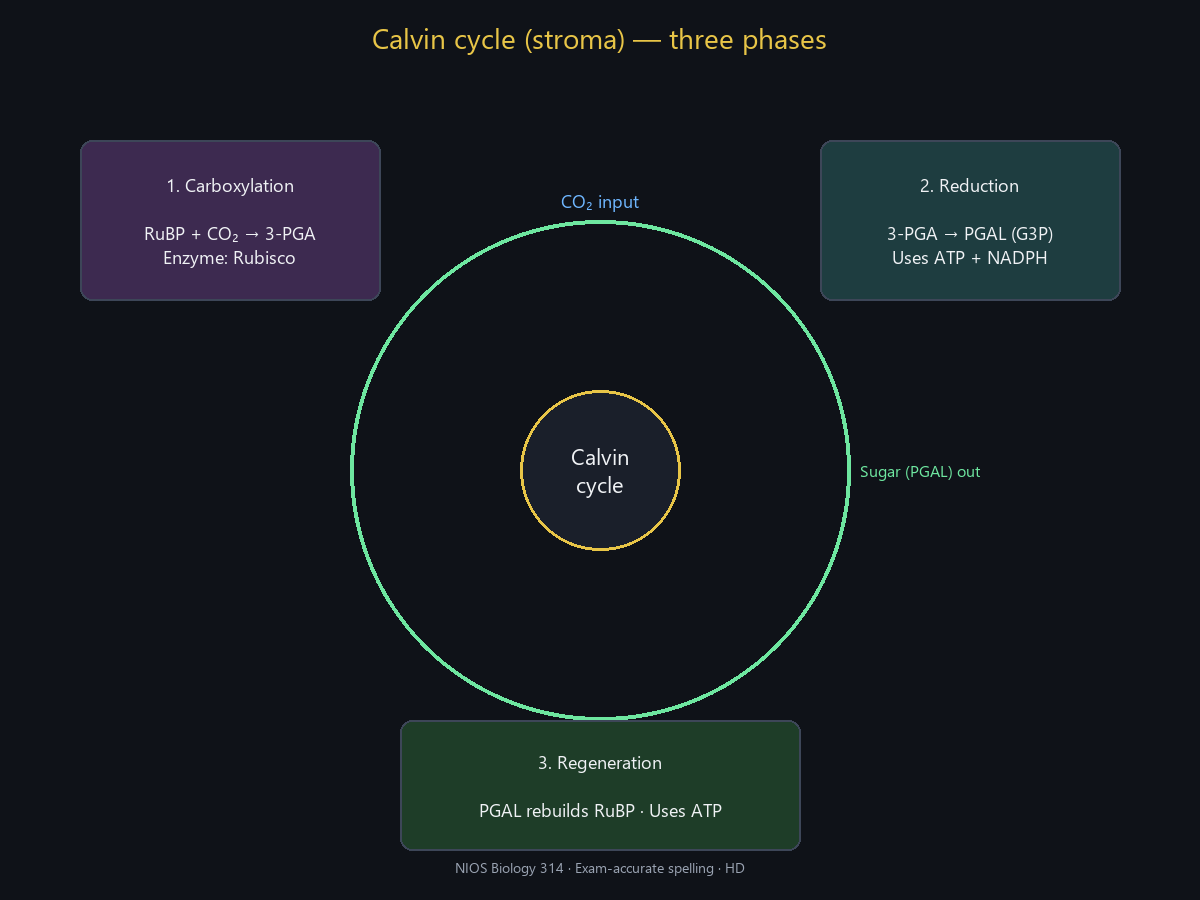
Why it clicks: Three gears: fix CO₂, reduce, rebuild RuBP.
Q8. i. In photosynthesis, there are two reactions light and dark reaction why are they called so? explain ii. What are the products obtained in each reaction? iii. What are P 680 and P700?
Why it clicks: P numbers = wavelength of maximum absorption of the reaction-centre chlorophyll.
Problem Solving — L11 Photosynthesis
Six problems spanning this chapter’s NIOS Biology (314) syllabus. Every question is built from the notes and formula sheet: solve with definitions and equations first, then read the formal textbook-style write-up, the easy explanation, and the topic in depth (key relations, meaning, exam tips). If the question says draw, a labelled pencil sketch is provided. Explanations open by default.
Write the balanced overall equation of photosynthesis and state where O₂ comes from.
Pencil sketch (labelled)
Solution — step by step
- 6CO₂ + 6H₂O → C₆H₁₂O₆ + 6O₂ (in light, chlorophyll).
- O₂ liberated from photolysis of water (not from CO₂).
Final answer: Equation as above; O₂ from H₂O
Key relations / definitions
Textbook formal language
Photosynthesis converts light energy into chemical energy of carbohydrates.
Key relations: 6CO₂ + 6H₂O → C₆H₁₂O₆ + 6O₂ (light, chlorophyll). State the definition or law first (NIOS style), use correct biological terms, and end with a clear boxed conclusion.
Easy language (same idea, plain words)
Plants use CO₂ and water to make sugar and release oxygen; oxygen comes from splitting water.
Read the question once for the idea, once for the details. Write the definition or equation, then apply it. Check labels and units if any numbers appear.
Topic in depth — Overall photosynthesis
Van Niel / Hill work historically clarified O₂ source.
Linked to chapter notes (L11). Remember: 6CO₂ + 6H₂O → C₆H₁₂O₆ + 6O₂ (light, chlorophyll). Most exam errors mix up similar terms, reverse cause and effect, or skip labelled diagrams.
Exam tip
Open with a one-line definition, then use: 6CO₂ + 6H₂O → C₆H₁₂O₆ + 6O₂ (light, chlorophyll). For diagram questions, label every part asked and keep lines neat.
Common mistakes
- Confusing prokaryote with eukaryote (or plant with animal tissues).
- Mixing up similar pathways (e.g. photosynthesis vs respiration; mitosis vs meiosis).
- Writing vague answers without key technical terms from NIOS notes.
- Forgetting to label diagrams or state units where numbers are used.
List three products/outcomes of the light reaction.
Solution — step by step
- ATP (photophosphorylation).
- NADPH.
- O₂ from water photolysis.
Final answer: ATP, NADPH, O₂
Key relations / definitions
Textbook formal language
Light reaction captures photons and generates assimilatory power for Calvin cycle.
Key relations: PSII & PSI; photolysis; ATP + NADPH; Occurs in thylakoid membrane. State the definition or law first (NIOS style), use correct biological terms, and end with a clear boxed conclusion.
Easy language (same idea, plain words)
Light stage makes energy bags ATP/NADPH and oxygen gas.
Read the question once for the idea, once for the details. Write the definition or equation, then apply it. Check labels and units if any numbers appear.
Topic in depth — Light-dependent stage
Calvin cycle is dark reaction (light-independent but needs ATP/NADPH).
Linked to chapter notes (L11). Remember: PSII & PSI; photolysis; ATP + NADPH; Occurs in thylakoid membrane. Most exam errors mix up similar terms, reverse cause and effect, or skip labelled diagrams.
Exam tip
Open with a one-line definition, then use: PSII & PSI; photolysis; ATP + NADPH; Occurs in thylakoid membrane. For diagram questions, label every part asked and keep lines neat.
Common mistakes
- Confusing prokaryote with eukaryote (or plant with animal tissues).
- Mixing up similar pathways (e.g. photosynthesis vs respiration; mitosis vs meiosis).
- Writing vague answers without key technical terms from NIOS notes.
- Forgetting to label diagrams or state units where numbers are used.
Name the CO₂ acceptor in C₃ plants and the enzyme that carboxylates it. Where does this occur?
Solution — step by step
- Acceptor: RuBP (ribulose-1,5-bisphosphate).
- Enzyme: Rubisco.
- Site: chloroplast stroma.
Final answer: RuBP + Rubisco in stroma
Key relations / definitions
Textbook formal language
Calvin–Benson cycle fixes CO₂ into carbohydrate using ATP and NADPH.
Key relations: RuBP + CO₂ → 3-PGA (Rubisco); Stroma of chloroplast. State the definition or law first (NIOS style), use correct biological terms, and end with a clear boxed conclusion.
Easy language (same idea, plain words)
RuBP catches CO₂ with Rubisco’s help inside the chloroplast liquid stroma.
Read the question once for the idea, once for the details. Write the definition or equation, then apply it. Check labels and units if any numbers appear.
Topic in depth — C₃ cycle essentials
C₄ plants use PEP carboxylase first in mesophyll—different path.
Linked to chapter notes (L11). Remember: RuBP + CO₂ → 3-PGA (Rubisco); Stroma of chloroplast. Most exam errors mix up similar terms, reverse cause and effect, or skip labelled diagrams.
Exam tip
Open with a one-line definition, then use: RuBP + CO₂ → 3-PGA (Rubisco); Stroma of chloroplast. For diagram questions, label every part asked and keep lines neat.
Common mistakes
- Confusing prokaryote with eukaryote (or plant with animal tissues).
- Mixing up similar pathways (e.g. photosynthesis vs respiration; mitosis vs meiosis).
- Writing vague answers without key technical terms from NIOS notes.
- Forgetting to label diagrams or state units where numbers are used.
According to Blackman’s law of limiting factors, what happens if light is intense but CO₂ is very low?
Solution — step by step
- Rate is limited by the deficient factor (CO₂).
- Increasing light further gives little gain until CO₂ rises.
Final answer: CO₂ limits the rate (Blackman)
Key relations / definitions
Textbook formal language
Multiple factors interact; the most limiting controls rate at a given time.
Key relations: Blackman: rate limited by slowest factor; Light, CO₂, temperature, water, chlorophyll. State the definition or law first (NIOS style), use correct biological terms, and end with a clear boxed conclusion.
Easy language (same idea, plain words)
The weakest link decides speed—if CO₂ is scarce, extra light won’t help much.
Read the question once for the idea, once for the details. Write the definition or equation, then apply it. Check labels and units if any numbers appear.
Topic in depth — Limiting factors
Also temperature affects enzyme steps of dark reaction.
Linked to chapter notes (L11). Remember: Blackman: rate limited by slowest factor; Light, CO₂, temperature, water, chlorophyll. Most exam errors mix up similar terms, reverse cause and effect, or skip labelled diagrams.
Exam tip
Open with a one-line definition, then use: Blackman: rate limited by slowest factor; Light, CO₂, temperature, water, chlorophyll. For diagram questions, label every part asked and keep lines neat.
Common mistakes
- Confusing prokaryote with eukaryote (or plant with animal tissues).
- Mixing up similar pathways (e.g. photosynthesis vs respiration; mitosis vs meiosis).
- Writing vague answers without key technical terms from NIOS notes.
- Forgetting to label diagrams or state units where numbers are used.
State one anatomical and one physiological advantage of C₄ plants over C₃ in hot bright conditions.
Solution — step by step
- Kranz anatomy (bundle sheath + mesophyll specialisation).
- Concentrates CO₂ for Rubisco / minimises photorespiration; higher water-use efficiency often.
Final answer: Kranz anatomy; less photorespiration / efficient CO₂ pump
Key relations / definitions
Textbook formal language
C₄ pathway is an evolutionary adaptation to photorespiration pressure.
Key relations: C₄: PEP carboxylase, Kranz anatomy; Reduces photorespiration in hot climates. State the definition or law first (NIOS style), use correct biological terms, and end with a clear boxed conclusion.
Easy language (same idea, plain words)
C₄ plants pack CO₂ for the sugar factory so heat doesn’t waste as much energy.
Read the question once for the idea, once for the details. Write the definition or equation, then apply it. Check labels and units if any numbers appear.
Topic in depth — C₄ advantage
Examples: maize, sugarcane (C₄); wheat, rice (C₃).
Linked to chapter notes (L11). Remember: C₄: PEP carboxylase, Kranz anatomy; Reduces photorespiration in hot climates. Most exam errors mix up similar terms, reverse cause and effect, or skip labelled diagrams.
Exam tip
Open with a one-line definition, then use: C₄: PEP carboxylase, Kranz anatomy; Reduces photorespiration in hot climates. For diagram questions, label every part asked and keep lines neat.
Common mistakes
- Confusing prokaryote with eukaryote (or plant with animal tissues).
- Mixing up similar pathways (e.g. photosynthesis vs respiration; mitosis vs meiosis).
- Writing vague answers without key technical terms from NIOS notes.
- Forgetting to label diagrams or state units where numbers are used.
Where in the chloroplast do (i) light reaction and (ii) Calvin cycle occur?
Solution — step by step
- (i) Thylakoid membranes (grana).
- (ii) Stroma.
Final answer: Thylakoid; stroma
Key relations / definitions
Textbook formal language
Compartmentalisation separates photochemistry from carbon fixation enzymes.
Key relations: Thylakoid: light reaction; Stroma: Calvin cycle. State the definition or law first (NIOS style), use correct biological terms, and end with a clear boxed conclusion.
Easy language (same idea, plain words)
Light work on the green membrane stacks; sugar chemistry in the fluid stroma.
Read the question once for the idea, once for the details. Write the definition or equation, then apply it. Check labels and units if any numbers appear.
Topic in depth — Site map
Mitochondria are for respiration—not photosynthesis site.
Linked to chapter notes (L11). Remember: Thylakoid: light reaction; Stroma: Calvin cycle. Most exam errors mix up similar terms, reverse cause and effect, or skip labelled diagrams.
Exam tip
Open with a one-line definition, then use: Thylakoid: light reaction; Stroma: Calvin cycle. For diagram questions, label every part asked and keep lines neat.
Common mistakes
- Confusing prokaryote with eukaryote (or plant with animal tissues).
- Mixing up similar pathways (e.g. photosynthesis vs respiration; mitosis vs meiosis).
- Writing vague answers without key technical terms from NIOS notes.
- Forgetting to label diagrams or state units where numbers are used.