OneNIOS Study Hub
Biology — Class 12 — L3: Kingdoms Plantae and Animalia
Lesson-03.pdf). Content covers sections 3.1–3.9.Overview — Completing the Five Kingdoms
In earlier lessons you studied Monera, Protoctista and Fungi. This NIOS Biology lesson (Module 1) covers the remaining two kingdoms: Plantae (eukaryotic, multicellular, photosynthetic autotrophs) and Animalia (eukaryotic, multicellular, ingestive heterotrophs). Together these groups hold most of the biodiversity you see daily—from moss on walls and ferns in gardens to wheat, rice, insects, birds and mammals.
The textbook goals are clear: classify plants up to divisions and major seed groups; recognise typical features of bryophytes, pteridophytes and spermatophytes; know dicot families Malvaceae and Fabaceae and monocot families Liliaceae and Poaceae; justify animals in Animalia; classify animals to phyla with characters and examples; take Arthropoda and Chordata to classes; and outline major mammalian groups. This notes page follows those sections only, using the same clean reading style as physics notes and the pink/green biology highlighting already set for the subject.
When you revise, keep two ladders: a plant ladder (non-vascular → vascular seedless → naked seed → enclosed seed) and an animal ladder (cellular → tissue → organ-system; no coelom → false coelom → true coelom; non-chordate → chordate). Almost every classification question can be answered by walking one of those ladders with a textbook example attached.
Section 1: Kingdom Plantae — Divisions and Bryophyta (3.1–3.2)
According to the textbook, plants are multicellular, eukaryotic, photosynthetic autotrophs (rarely heterotrophs) with cellulosic cell walls. All are embryophytes—the embryo is retained and nourished on the parent plant. Kingdom Plantae (Embryophyta) is divided into:
- Bryophyta — amphibians of the plant kingdom; non-vascular
- Pteridophyta — true root, stem and leaves; vascular tissue present
- Spermatophyta — seed-producing plants with vascular tissues, split into Gymnospermae (naked seeds) and Angiospermae (seeds enclosed in ovary wall → fruit). Angiosperms further split into dicotyledons (two cotyledons) and monocotyledons (one cotyledon).
1.1 Bryophyta — amphibians of the plant kingdom
Bryophytes complete their life cycle in both water and on land, so they are called amphibians of the plant kingdom. They grow mainly in damp, shady places, especially in hills. They are embryophytes without vascular tissues (neither xylem nor phloem). Multicellular sporophytes are always borne on gametophytes. There are no true leaves and roots because the independent plant body is gametophytic (haploid). Sex organs are jacketed—surrounded by one or more layers of sterile cells.
Three main types: (1) flat ribbon-like liverworts (e.g. Marchantia); (2) small leafy body of mosses (e.g. Funaria); (3) flat thalloid body with horn-like sporophyte—hornworts (Anthoceros). In all bryophytes the main plant body is the gametophyte, larger, more persistent and photosynthetic, bearing sex organs. Mosses have a leafy stem called gametophore; liverworts and hornworts are usually a thallus (ribbon- or heart-shaped). Plants are anchored by rhizoids (unicellular in liverworts/hornworts, multicellular in mosses) that help in anchorage and absorption.
Male sex organs are antheridia; female are archegonia. Gametes fuse to a zygote that develops into a sporophyte remaining attached to and dependent on the gametophyte for food and minerals. Sporogenous tissue undergoes meiosis to produce haploid spores; on dispersal, spores germinate into a new gametophyte. Thus the life cycle shows alternation of generations.
Textbook comparison: gametophytic phase is haploid and generally autotrophic with multicellular jacketed sex organs; sporophytic phase is diploid, often heterotrophic or partially autotrophic, short-lived, attached to gametophyte, and produces spores by meiosis. Bryophytes are pioneers of vegetation on rock, lava, sand and water and act as soil binders. Mosses hold water better than bare soil, improving microhabitat for other seeds. They provide food for fish and birds; dried plants are used as nesting material.
Section 2: Pteridophyta and Spermatophyta (3.3–3.5)
2.1 Pteridophytes (ferns)
Ferns are lower vascular plants. Vascular tissue of xylem and phloem conducts water and nutrients, so they are placed under Trachaeophyta/vascular plants. Habitat: damp, shady places, gardens and cool hills. The main plant body is the sporophyte (diploid) with roots absorbing water and minerals. Leaves (fronds) arise from a thick horizontal underground stem or rhizome with adventitious roots. Young leaves and leaflet bases may be covered by dry brown scales (ramenta). Young leaves show circinate coiling. Leaf axis is rachis; leaflets are pinnae; divisions of pinnae are pinnules.
On the under surface, sporangia form groups called sori, sometimes covered by an indusium. Meiosis produces haploid spores. Spores germinate into an independent small thallus-like gametophyte, the prothallus, bearing antheridia and archegonia. Fusion yields a zygote that grows into a diploid sporophyte. The young embryo depends temporarily on the gametophyte until roots and leaves form; then the gametophyte dies. Thus gametophyte is free-living but short-lived; a new sporophyte starts dependent on a tiny gametophyte—alternation of generations continues, but sporophyte is dominant (opposite to bryophytes).
2.2 Gymnospermae
Gymnosperms plus angiosperms form Spermatophyta (seed plants). Gymnosperms bear naked ovules on flat scale leaves (ovuliferous scales) not enclosed in carpels/ovary; scales arranged in cones. Adult plant is tall, woody, perennial, mostly evergreen. Stem usually branched (rarely unbranched as in Cycas). Leaves simple (Pinus) or compound (Cycas); may be dimorphic (foliage + scale leaves). Stem vascular bundles in a ring with secondary growth.
Cones are usually unisexual. Pollen grains form in microsporangia of male cones; in Pinus, pollen has two wings for wind dispersal and produces two male gametes. Ovules sit naked on megasporophylls of female cone—hence gymnosperm = naked seed. Fertilisation inside ovule produces seed (winged in Pinus). Common examples: Pinus, Sequoia, Juniperus, Cedrus, Cycas. Products: timber, resins, turpentine, chilgoza; sago (sabudana) from old Cycas stems.
2.3 Angiospermae and dicot vs monocot
Familiar plants—pea, mango, coconut, wheat, rice—are angiosperms. Seeds are always enclosed in the fruit (mature fertilised ovary). Independent plant is sporophyte bearing flowers. Compared with gymnosperms: seeds in fruit; xylem has vessels as well as tracheids (gymnosperms mainly tracheids). Angiosperms divide into dicotyledons (two cotyledons) and monocotyledons (one cotyledon).
Textbook Fig. 3.5 contrasts: monocot—parallel leaf veins, trimerous flowers, one cotyledon, vascular bundles without cambium pattern of dicots; dicot—reticulate veins, pentamerous flowers, two cotyledons, cambium and ring arrangement of bundles in stem, etc.
2.4 Four angiosperm families (textbook)
Fabaceae (Papilionaceae) — pea family, includes pulses. Herbs/shrubs/rarely trees. Flower zygomorphic, bisexual; calyx 5 sepals united; corolla 5 petals papilionaceous (standard, two wings, keel); androecium 10 stamens diadelphous (9+1); gynoecium superior, monocarpellary, marginal placentation; fruit a pod. Examples: Pisum sativum (pea), Cajanus cajan (arhar), Phaseolus aureus (moong), Glycine max (soyabean), Arachis hypogaea (groundnut), Cicer arietinum (chickpea).
Malvaceae — china rose family. Hibiscus rosa-sinensis (gurhal) typical: pentamerous, actinomorphic flowers with epicalyx; monadelphous numerous stamens forming staminal tube; 5 carpels syncarpous, superior ovary, axile placentation; fruit capsule. Also cotton, bhindi, hollyhock.
Liliaceae — lily family, monocot. Mostly perennial herbs with rhizome or bulb. Leaves may be fleshy and cauline (arising from underground stem). Flowers bisexual, actinomorphic, trimerous, hypogynous; petaloid perianth usually 6 (3+3), free or united; stamens usually 6 (3+3) opposite perianth lobes; carpels 3 syncarpous, superior ovary, axile placentation; fruit often a capsule. Useful plants listed in the book include Aloe barbadensis (ghrit kumari), Asparagus racemosus (shatawar), tulip, Gloriosa superba, Lilium candidum, and Allium cepa (onion).
Poaceae — grass family, monocot. Herbs, rarely woody as in sugarcane. Inflorescence is a spike of spikelets (e.g. wheat); a small spikelet may contain few flowers. Flowers are very small and inconspicuous with scale-like structures; stamens 3, sometimes 6 as in rice and bamboo; three carpels syncarpous, unilocular superior ovary with a single basal ovule; fruit is a caryopsis (seed coat and ovary wall inseparably fused). Cereals and grasses: Oryza sativa (rice), Triticum aestivum (wheat), Zea mays (maize), Saccharum officinarum (sugarcane), S. spontaneum (sarkanda), Hordeum vulgare (barley). These four families give enough floral and fruit characters to answer most “identify the family” short questions in the diversity module.
Flower terminology used in the families is worth locking: actinomorphic flowers can be divided into equal halves through any radius; zygomorphic flowers (Fabaceae) only through one plane; epicalyx is an extra whorl of bracteoles below the calyx (Malvaceae); papilionaceous corolla has standard, wings and keel; diadelphous stamens form two groups (9+1); monadelphous stamens unite into one staminal tube. Writing these definitions once in your own words prevents confusion during classification drills.
Section 3: Kingdom Animalia — Basis and Non-Chordates (3.6–3.8)
Animals are multicellular eukaryotes with ingestive heterotrophic nutrition, power of locomotion, and heightened sensitivity through a nervous system. Classification uses organisation, symmetry, body cavity, embryonic germ layers, and presence/absence of notochord.
Organisation: cellular grade (sponges as cell aggregates); tissue grade (cnidarians); organ-system grade (most animals). Symmetry: asymmetrical (sponges); radial (cnidaria, echinoderm adults); bilateral (most others). Coelom: acoelomates (no cavity), pseudocoelomates (false cavity, roundworms), eucoelomates (true coelom). Germ layers: diploblastic (ectoderm + endoderm: sponges, cnidaria) vs triploblastic (+ mesoderm). Notochord: present at some stage → Chordata; absent → non-chordates.
Porifera (sponges): many pores and canal system; osculum; spongocoel; cellular grade, no organs; skeleton of spicules or spongin; asexual budding and sexual reproduction; almost all marine. Examples Sycon, Euspongia.
Cnidaria: no head/segmentation; two-layered wall with mesogloea; cnidoblasts for prey capture; polyp (sessile budding) and medusa (sexual, free-swimming); radial symmetry; mostly marine (Hydra freshwater). Hydra, jellyfish, sea anemone, corals.
Platyhelminthes (flatworms): dorsoventrally flattened, unsegmented, no body cavity; suckers/hooks in parasites; alimentary canal with mouth only or absent (tapeworm); mostly parasites—Planaria free-living; Fasciola (liver fluke); Taenia (human tapeworm).
Aschelminthes / Nematoda: cylindrical body; pseudocoelom; gut with mouth and anus; sexes separate (males smaller); Ascaris, pinworm, Wuchereria (filaria).
Annelida: segmented true coelomates; setae or parapodia; nephridia for excretion; digestive tube open at both ends; Nereis, Pheretima (earthworm), Hirudinaria (leech).
Arthropoda: segmented; head, thorax, abdomen (or cephalothorax); jointed legs; chitinous cuticle with moulting; sexes usually separate. Classes: Crustacea (prawn—carapace, many appendages), Myriapoda (millipede/centipede—many legs), Insecta (cockroach—3 pairs of legs, often wings), Arachnida (scorpion—4 pairs walking legs, chelicerae). Largest animal phylum.
Mollusca: soft unsegmented body; often hard shell; muscular foot; Pila, Unio, Sepia, octopus.
Echinodermata: marine, unsegmented; five radiating areas; radial adults, bilateral larvae; endoskeleton of ossicles with spines; movement by tube feet; regeneration; starfish (Asterias).
Arthropod classes need separate memory: Insecta have body divided into head, thorax and abdomen, three pairs of thoracic legs and often two pairs of wings (cockroach). Arachnida have cephalothorax with chelicerae, pedipalps and four pairs of walking legs; abdomen usually without legs (scorpion). Crustacea often have a carapace and many paired appendages (prawn). Myriapoda have numerous body segments each with one or two pairs of legs (millipede, Scolopendra). These class differences answer “how many pairs of legs” questions in the textbook intext exercises.
Among parasites, link host and organ: Fasciola in sheep liver, Taenia in human intestine, Ascaris in human gut, Wuchereria causing filariasis. Free-living contrast forms (Planaria, earthworm in soil) show that not every flatworm or annelid is a parasite—the textbook specifically asks whether all Platyhelminthes are parasites (answer: no; Planaria is free-living).
Section 4: Phylum Chordata and Vertebrate Classes (3.9)
Chordate hallmarks at some life stage: notochord, dorsal tubular nerve cord, gill slits; body with head and trunk and two pairs of appendages. These three characters must be written together when the question says “main characters of Chordata.” Subphyla: Urochordata (notochord only in larval stage—uro means tail region of larva; adult bag-shaped with tunic or testa, limbs absent, nerve cord reduced—example Herdmania); Cephalochordata (notochord and nerve cord throughout life and entire body length; elongated body flattened from sides; no paired fins—Amphioxus); Vertebrata (notochord replaced by vertebral column; well-developed head; paired fins or limbs; cartilaginous or bony endoskeleton; dorsal nerve cord divided into brain and spinal cord—all animals with a backbone).
Agnatha are jawless vertebrates (circular mouth, seven pairs of gill slits, no paired fins—Petromyzon lamprey). Gnathostomata are jawed vertebrates including the six vertebrate classes of fishes through mammals. When comparing cartilaginous and bony fishes, list at least: skeleton type, mouth position, tail type, number of gills, presence/absence of operculum, and one example each (Scoliodon vs Labeo).
Vertebrates: Agnatha (jawless, e.g. Petromyzon) vs Gnathostomata (jawed). Fishes: Chondrichthyes—cartilaginous skeleton, ventral mouth, heterocercal tail, 5–7 gill pairs, no operculum (Scoliodon dogfish). Osteichthyes—bony skeleton, terminal mouth, homocercal tail, four gill pairs, operculum present (Labeo rohu).
Amphibia (double life): skin glandular; pentadactyl limbs without claws; head and trunk, no neck; eggs in water; larvae with gills, adults with lungs; three-chambered heart; frog, toad, salamander. Reptilia: dry scaly skin; clawed digits (or limbless snakes); lungs; three-chambered heart (partially divided ventricle; four-chambered in crocodiles); leathery-shelled eggs on land—turtle, lizard, cobra, crocodile.
Aves: warm-blooded (homoiothermal); feathers; beak without teeth; forelimbs as wings; pneumatic bones; four-chambered heart; lungs with air sacs; syrinx voice box; only left ovary/oviduct in females; oviparous with calcareous shell—pigeon, crow, ostrich, kiwi.
Mammalia: hair; mammary glands; sweat/oil glands; external pinna; usually heterodont thecodont teeth; seven cervical vertebrae; four-chambered heart; warm-blooded; mostly viviparous with placenta. Subclasses: Prototheria (no external ear well developed as in higher forms; females oviparous; mammary glands without nipples—duck-billed platypus); Metatheria (external ear present; immature young born and carried in marsupium—kangaroo); Eutheria (well-developed pinna; placenta nourishes embryo; mature young born—most familiar mammals). Birds and mammals both keep constant body temperature and are termed homoiothermal (endothermal).
Practical products from the plant half of the lesson connect to daily life: rice, wheat and maize (Poaceae) as staple grains; pulses and groundnut (Fabaceae) as protein foods; cotton and bhindi (Malvaceae); onion and aloe (Liliaceae); pine timber and resin, Cycas sago (gymnosperms). Animal examples connect to health (parasitic flatworms and nematodes), food (fishes like Rohu), and ecology (earthworms improving soil). Holding one economic or ecological line for each major group makes short-answer writing faster under exam pressure.
Also remember the special developmental note for echinoderms: adults are radially symmetrical while larvae are bilaterally symmetrical—an evolutionary clue the textbook highlights. Regeneration of lost arms in starfish is another distinctive echinoderm trait. For annelids, regeneration is quite frequent; for cnidarians, the polyp–medusa alternation of asexual budding and sexual medusa stages is the reproductive pattern to state when asked.
Section 5: Connecting Plant and Animal Diversity
Plant classification climbs from non-vascular land pioneers (bryophytes) through vascular seedless ferns to naked-seeded gymnosperms and fruit-bearing angiosperms that feed humanity (Poaceae cereals, Fabaceae pulses). Animal classification climbs from cellular sponges through tissue and organ-system grades to chordates with notochord and finally mammals with milk glands. In both kingdoms the textbook method is the same: list defining characters, then match examples.
Exam strategy: (1) State kingdom criteria first. (2) For plants, ask vascular? seeds? naked or enclosed? number of cotyledons? family flower formula. (3) For animals, ask coelom? germ layers? jointed legs? notochord? heart chambers? (4) Always give the textbook example organism.
Work the intext questions after each section: unique feature of bryophytes; definition of alternation of generations; dominant generation of pteridophytes; meaning of gymnosperm; number of stamens in Papilionaceae and Malvaceae; botanical names of rice and arhar; phylum with cnidoblasts; earthworm locomotory structures; pairs of legs in insects vs scorpions vs spiders; tube feet; three chordate characters; amphibian heart chambers; syrinx; aquatic reptile. Writing one-line answers in your own words is the best check that you have extracted the chapter correctly from Lesson-03.pdf.
This completes Lesson 3 of Module 1—building directly on kingdoms Monera, Protoctista and Fungi from Lesson 2. Together Lessons 2 and 3 finish the five-kingdom overview used in the NIOS diversity module before the course moves into tissues, plant morphology and physiology.
One more plant detail often tested: in angiosperms the independent plant is the sporophyte that bears flowers; spores develop into gametophytes that produce gametes inside floral organs. In gymnosperms, independent plants also are sporophytes but reproductive structures are cones rather than flowers, and seeds remain naked. Pteridophytes never form seeds—dispersal units are spores from sporangia on leaves. Bryophytes never form true roots or vascular tissue—rhizoids and a dependent sporophyte mark them. Drawing a four-row table of these four groups with columns for vascular tissue, dominant generation, seeds, and example organism is the fastest full-chapter summary you can make from the textbook alone.
For animals, a similar table of phyla with columns for coelom, germ layers, symmetry, distinctive organ, and example covers Porifera through Echinodermata. A second table for vertebrate classes with habitat, body covering, respiration, heart chambers, and temperature regulation covers fishes through mammals. Completing those two tables from memory after reading this notes page means you have internalised Lesson 3 the way the NIOS objectives intend—classification with evidence, not rote lists without meaning.
MCQ Quiz — L3 Kingdoms Plantae and Animalia
Flashcards — L3
Golden Rules — L3 Kingdoms Plantae and Animalia
Most exam-important points from this chapter:
Plant ladder
Non-vascular bryophytes (gametophyte dominant) → vascular pteridophytes (sporophyte dominant, prothallus) → gymnosperms (naked seeds, cones) → angiosperms (seeds in fruits, flowers). Always state vascular tissue and seed enclosure.
Family snap tests
Fabaceae: butterfly flower, 9+1 stamens, pod, pulses. Malvaceae: epicalyx, monadelphous stamens. Liliaceae: trimerous, petaloid perianth. Poaceae: spikelets, caryopsis, cereals.
Animal ID characters
Match unique organs: cnidoblasts (Cnidaria), nephridia (Annelida), jointed legs + chitin (Arthropoda), tube feet (Echinodermata), notochord trio (Chordata). State coelom and germ layers when asked.
Chordate to mammal
Notochord + dorsal nerve cord + gill slits. Fishes: cartilage vs bone + operculum. Amphibia 3 chambers; reptiles dry scales; birds feathers + syrinx + pneumatic bones; mammals milk + hair.
Dicot vs monocot
Cotyledon number, leaf venation, flower merosity, and stem vascular pattern separate the two angiosperm classes—use with family examples rice/wheat vs pea/china rose.
Past Year Questions — L3 Kingdoms Plantae and Animalia
PE-only questions for this chapter only. 7 item(s). No overlap with other lessons. Tap Show answer after you try each question.
Q1. What does the following sequence represent? Blue-green algae → Crustose lichens → Foliose lichens Dicotyledonous trees ← Shrubs ← Mosses
Why it clicks: Pioneer community (blue-green algae/lichens) → mosses → shrubs → trees is primary succession on bare substrate.
Q2. Cephalothorax is a characteristic feature present in the phylum
Why it clicks: Cephalothorax = fused head + thorax, classic of many arthropods (e.g. prawn, spider).
Q3. Which of the following is an example of an oviparous mammal?
Why it clicks: Monotreme mammal that lays eggs (oviparous). Kangaroo/whale/bat are viviparous.
Q4. How will you distinguish between the vascular bundles of a dicot root and a dicot stem?
Why it clicks: Compare arrangement (radial vs ring) and presence of cambium/pith—high-yield anatomy difference.
Q5. Which one of the following represent the gametophyte of fern?
Why it clicks: Fern gametophyte is the small green heart-shaped prothallus. Frond/sorus belong to sporophyte.
Q6. Maize is a monocot plant. Give any two valid reasons for considering of so. m
Why it clicks: Monocot checklist + habitat = biotic + abiotic; migration changes N by adding/removing individuals.
Q7. Draw a neat labelled diagram of a V.S. of a monocot leaf and label the following parts: a) xylem b) phloem c) Bundle sheath d) Bulliform cells e) Mesophyll tissue f) Vascular bundle
This question needs a diagram — open the answer to view the HD model figure.
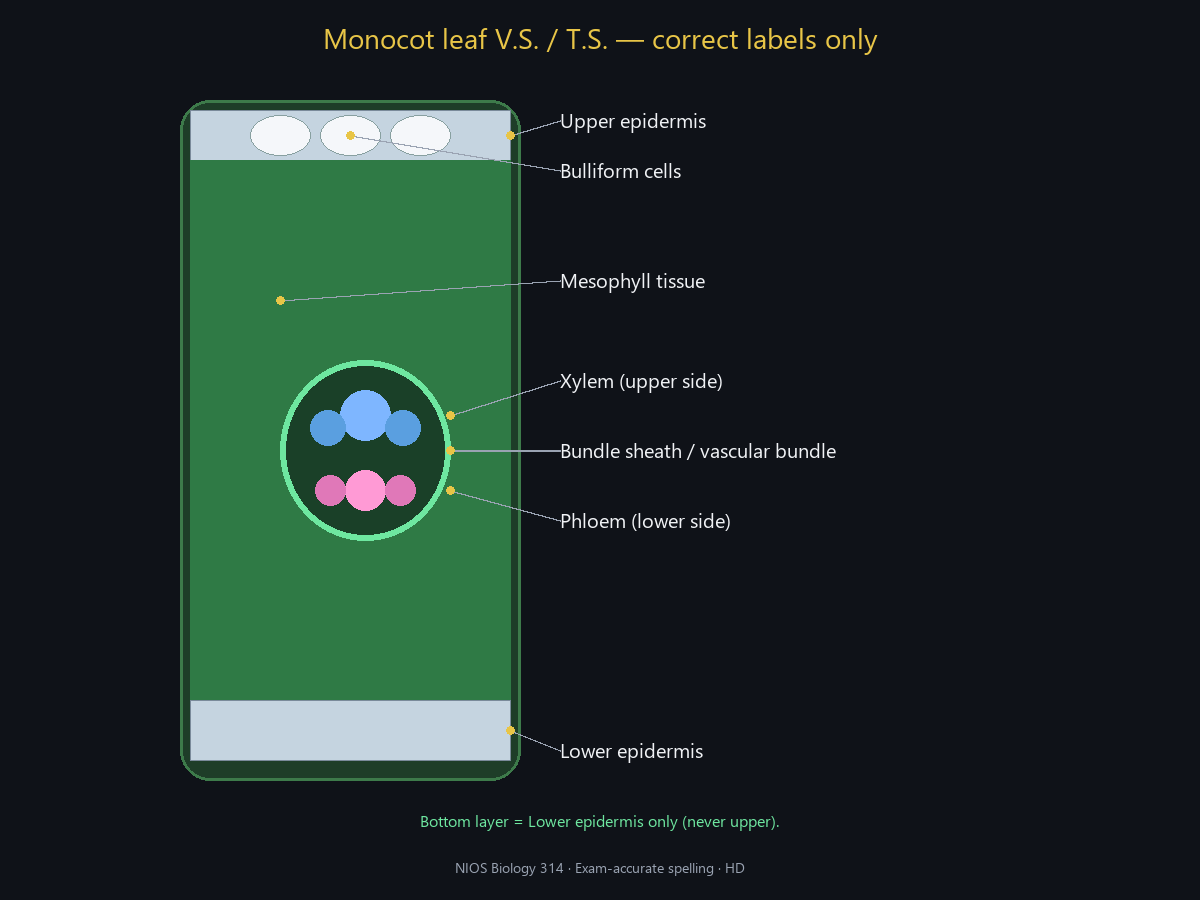
Why it clicks: Bulliform cells and bundle sheath are hallmark monocot/grass leaf labels.
Problem Solving — L3 Kingdoms Plantae and Animalia
Six problems spanning this chapter’s NIOS Biology (314) syllabus. Every question is built from the notes and formula sheet: solve with definitions and equations first, then read the formal textbook-style write-up, the easy explanation, and the topic in depth (key relations, meaning, exam tips). If the question says draw, a labelled pencil sketch is provided. Explanations open by default.
List three features that distinguish a typical plant cell from a typical animal cell.
Solution — step by step
- Cellulose cell wall (plants) vs no wall (animals).
- Chloroplasts for photosynthesis (plants) absent in animals.
- Large central vacuole common in mature plant cells.
Final answer: Wall + chloroplast + large vacuole (plants)
Key relations / definitions
Textbook formal language
Plantae are multicellular photosynthetic eukaryotes with cellulose walls; Animalia are multicellular heterotrophs without walls.
Key relations: Plant: cellulose wall, chloroplast, large vacuole; Animal: no wall, no chloroplast. State the definition or law first (NIOS style), use correct biological terms, and end with a clear boxed conclusion.
Easy language (same idea, plain words)
Plants have walls and green chloroplasts; animal cells do not.
Read the question once for the idea, once for the details. Write the definition or equation, then apply it. Check labels and units if any numbers appear.
Topic in depth — Plant vs animal cells
Fungi have chitin walls and no chloroplasts—neither Plantae nor Animalia.
Linked to chapter notes (L3). Remember: Plant: cellulose wall, chloroplast, large vacuole; Animal: no wall, no chloroplast. Most exam errors mix up similar terms, reverse cause and effect, or skip labelled diagrams.
Exam tip
Open with a one-line definition, then use: Plant: cellulose wall, chloroplast, large vacuole; Animal: no wall, no chloroplast. For diagram questions, label every part asked and keep lines neat.
Common mistakes
- Confusing prokaryote with eukaryote (or plant with animal tissues).
- Mixing up similar pathways (e.g. photosynthesis vs respiration; mitosis vs meiosis).
- Writing vague answers without key technical terms from NIOS notes.
- Forgetting to label diagrams or state units where numbers are used.
Why are bryophytes called the amphibians of the plant kingdom?
Solution — step by step
- They live on land but need water for sexual reproduction (motile gametes).
- Like amphibians that need water for breeding.
Final answer: Land plants needing water for fertilisation
Key relations / definitions
Textbook formal language
Bryophytes lack true vascular tissue and depend on water films for sperm transfer.
Key relations: Algae: mostly aquatic, no true roots/stems/leaves; Bryophytes: amphibians of plant kingdom. State the definition or law first (NIOS style), use correct biological terms, and end with a clear boxed conclusion.
Easy language (same idea, plain words)
Mosses grow on land but sperm still swim—so water is needed for sex.
Read the question once for the idea, once for the details. Write the definition or equation, then apply it. Check labels and units if any numbers appear.
Topic in depth — Plant grades
Pteridophytes/gymnosperms/angiosperms have progressive land adaptations.
Linked to chapter notes (L3). Remember: Algae: mostly aquatic, no true roots/stems/leaves; Bryophytes: amphibians of plant kingdom. Most exam errors mix up similar terms, reverse cause and effect, or skip labelled diagrams.
Exam tip
Open with a one-line definition, then use: Algae: mostly aquatic, no true roots/stems/leaves; Bryophytes: amphibians of plant kingdom. For diagram questions, label every part asked and keep lines neat.
Common mistakes
- Confusing prokaryote with eukaryote (or plant with animal tissues).
- Mixing up similar pathways (e.g. photosynthesis vs respiration; mitosis vs meiosis).
- Writing vague answers without key technical terms from NIOS notes.
- Forgetting to label diagrams or state units where numbers are used.
State the main transport roles of xylem and phloem.
Solution — step by step
- Xylem conducts water and mineral salts (largely upward).
- Phloem transports organic food (sugars) from source to sink.
Final answer: Xylem water/minerals; phloem food
Key relations / definitions
Textbook formal language
Vascular tissues allow tall plant body plans; xylem is mainly dead tracheary elements, phloem living sieve elements.
Key relations: Xylem: water & minerals upward; Phloem: food translocation. State the definition or law first (NIOS style), use correct biological terms, and end with a clear boxed conclusion.
Easy language (same idea, plain words)
Xylem is the water pipe; phloem is the food pipe.
Read the question once for the idea, once for the details. Write the definition or equation, then apply it. Check labels and units if any numbers appear.
Topic in depth — Xylem and phloem
Do not say “xylem carries food.”
Linked to chapter notes (L3). Remember: Xylem: water & minerals upward; Phloem: food translocation. Most exam errors mix up similar terms, reverse cause and effect, or skip labelled diagrams.
Exam tip
Open with a one-line definition, then use: Xylem: water & minerals upward; Phloem: food translocation. For diagram questions, label every part asked and keep lines neat.
Common mistakes
- Confusing prokaryote with eukaryote (or plant with animal tissues).
- Mixing up similar pathways (e.g. photosynthesis vs respiration; mitosis vs meiosis).
- Writing vague answers without key technical terms from NIOS notes.
- Forgetting to label diagrams or state units where numbers are used.
Compare organisation level of Porifera and Cnidaria in one line each.
Solution — step by step
- Porifera: cellular level of organisation (no true tissues).
- Cnidaria: tissue level; radial symmetry; cnidoblasts.
Final answer: Porifera cellular; Cnidaria tissue + radial
Key relations / definitions
Textbook formal language
Animal phyla show rising grades: cellular → tissue → organ → organ-system.
Key relations: Porifera: cellular level, asymmetrical or radial; Cnidaria: tissue level, radial. State the definition or law first (NIOS style), use correct biological terms, and end with a clear boxed conclusion.
Easy language (same idea, plain words)
Sponges are loose cells; hydra has real tissues and stinging cells.
Read the question once for the idea, once for the details. Write the definition or equation, then apply it. Check labels and units if any numbers appear.
Topic in depth — Symmetry and levels
Exam loves: Porifera, Cnidaria, Platyhelminthes characters.
Linked to chapter notes (L3). Remember: Porifera: cellular level, asymmetrical or radial; Cnidaria: tissue level, radial. Most exam errors mix up similar terms, reverse cause and effect, or skip labelled diagrams.
Exam tip
Open with a one-line definition, then use: Porifera: cellular level, asymmetrical or radial; Cnidaria: tissue level, radial. For diagram questions, label every part asked and keep lines neat.
Common mistakes
- Confusing prokaryote with eukaryote (or plant with animal tissues).
- Mixing up similar pathways (e.g. photosynthesis vs respiration; mitosis vs meiosis).
- Writing vague answers without key technical terms from NIOS notes.
- Forgetting to label diagrams or state units where numbers are used.
List four fundamental chordate characters present at least in embryonic stages.
Solution — step by step
- Notochord.
- Dorsal hollow nerve cord.
- Pharyngeal gill slits.
- Post-anal tail.
Final answer: Notochord; dorsal hollow nerve cord; pharyngeal slits; post-anal tail
Key relations / definitions
Textbook formal language
Chordata is defined by these four features appearing during life history.
Key relations: Notochord, dorsal hollow nerve cord, pharyngeal slits, post-anal tail (at some stage). State the definition or law first (NIOS style), use correct biological terms, and end with a clear boxed conclusion.
Easy language (same idea, plain words)
Backbone animals (and some cousins) share those four traits at least as embryos.
Read the question once for the idea, once for the details. Write the definition or equation, then apply it. Check labels and units if any numbers appear.
Topic in depth — Chordate features
Notochord is not the same as vertebral column—though related evolutionarily.
Linked to chapter notes (L3). Remember: Notochord, dorsal hollow nerve cord, pharyngeal slits, post-anal tail (at some stage). Most exam errors mix up similar terms, reverse cause and effect, or skip labelled diagrams.
Exam tip
Open with a one-line definition, then use: Notochord, dorsal hollow nerve cord, pharyngeal slits, post-anal tail (at some stage). For diagram questions, label every part asked and keep lines neat.
Common mistakes
- Confusing prokaryote with eukaryote (or plant with animal tissues).
- Mixing up similar pathways (e.g. photosynthesis vs respiration; mitosis vs meiosis).
- Writing vague answers without key technical terms from NIOS notes.
- Forgetting to label diagrams or state units where numbers are used.
Name Whittaker’s five kingdoms and the criterion that separates Monera from the rest.
Pencil sketch (labelled)
Solution — step by step
- Monera, Protoctista (Protista), Fungi, Plantae, Animalia.
- Monera = prokaryotes; other four = eukaryotes.
Final answer: Five kingdoms; Monera alone prokaryotic
Key relations / definitions
Textbook formal language
Five-kingdom classification emphasises cell type, body organisation and nutrition mode.
Key relations: Whittaker: Monera, Protoctista, Fungi, Plantae, Animalia. State the definition or law first (NIOS style), use correct biological terms, and end with a clear boxed conclusion.
Easy language (same idea, plain words)
Bacteria alone are prokaryotes; everything else in Whittaker’s scheme has a nucleus.
Read the question once for the idea, once for the details. Write the definition or equation, then apply it. Check labels and units if any numbers appear.
Topic in depth — Five-kingdom idea
Modern systems refine this, but NIOS exam expects Whittaker basics.
Linked to chapter notes (L3). Remember: Whittaker: Monera, Protoctista, Fungi, Plantae, Animalia. Most exam errors mix up similar terms, reverse cause and effect, or skip labelled diagrams.
Exam tip
Open with a one-line definition, then use: Whittaker: Monera, Protoctista, Fungi, Plantae, Animalia. For diagram questions, label every part asked and keep lines neat.
Common mistakes
- Confusing prokaryote with eukaryote (or plant with animal tissues).
- Mixing up similar pathways (e.g. photosynthesis vs respiration; mitosis vs meiosis).
- Writing vague answers without key technical terms from NIOS notes.
- Forgetting to label diagrams or state units where numbers are used.