OneNIOS Study Hub
Biology — Class 12 — L2: The Kingdoms Monera, Protoctista and Fungi
Lesson-02.pdf). Content covers sections 2.1–2.3.Overview — Three Microscopic Kingdoms
The living world includes many organisms that are simple in body organisation yet crucial to ecosystems and human life. This lesson, drawn from the NIOS Biology textbook (Module 1 — Diversity and Evolution of Life), deals with three kingdoms: Monera (bacteria and cyanobacteria), Protoctista (unicellular eukaryotes such as protozoa, diatoms and some algae), and Fungi. Bacteria, most protoctists and many fungi are microscopic and are often grouped as micro-organisms. After reading, you should be able to state why organisms are placed in these kingdoms, describe generalised bacterial and cyanobacterial structure, explain economic importance of bacteria, justify cyanobacteria in Monera, outline protoctist structure and human impact, and describe fungi (yeast, Rhizopus, mushroom, Penicillium), mycorrhizae and fungal usefulness.
Historically, many of these organisms were forced into plant or animal kingdoms. Modern classification recognises that Monera alone is fully prokaryotic (no true nucleus), while protoctists and fungi are eukaryotic. That single distinction—presence or absence of a nuclear membrane and membrane-bound organelles—is the first exam-critical idea of the chapter. The textbook stresses that bacteria were Earth’s only cellular life for a vast span of geological time, so their simple cell plan is not a “failure” of evolution—it is an ancient, highly successful design still dominant in numbers today.
When you study this lesson for exams, keep three parallel checklists in mind for each kingdom: (1) body organisation and cell type, (2) nutrition and energy, (3) human significance (disease, food, industry, soil). The NIOS chapter is rich in named examples—learn the organism–role pairs (e.g. Lactobacillus–curd, Plasmodium–malaria, Penicillium–penicillin) because board questions often ask exactly those pairings.
Section 1: Kingdom Monera — Structure, Life Processes and Types (2.1–2.1.2)
Kingdom Monera includes all bacteria and cyanobacteria (commonly called blue-green algae). Because only bacteria (and related prokaryotes) lack a true nucleus—that is, genetic material is not enclosed by a nuclear membrane—Monera is the only prokaryotic kingdom and the most primitive cellular kingdom in the five-kingdom scheme used in the course.
According to the textbook, bacteria were the first cellular organisms to evolve on Earth after life originated around 3.5 billion years ago, and they remained the only cellular organisms for almost the next two billion years. Most bacteria are unicellular (the word monere means single), though actinomycetes and some cyanobacteria form multicellular filaments that may be branched. Monerans are also the most numerous of all living cellular organisms on Earth.
1.1 Structure of a bacterial cell (Fig. 2.1)
A typical single-celled bacterium has a cell wall of peptidoglycan outside the plasma membrane, a single circular chromosome, and ribosomes—but no membrane-bound organelles such as mitochondria, chloroplasts, endoplasmic reticulum or Golgi complex. The textbook figure labels: slime capsule (in some bacteria), cell membrane, cell wall, flagellum (in some), ribosome granules, cytoplasm, DNA nuclear material without a nuclear membrane, and volutin phosphate compound granules.
Cell wall. All prokaryotes have a rigid cell wall that protects the cell and gives it shape. The wall is made of peptidoglycan (unique to bacteria), plus lipids, polysaccharides and some proteins.
Pili (singular: pilus) are short, thin, tubular projections from the wall in some bacteria. They help cells stick together during conjugation.
Flagella enable motility. They are longer and thicker than pili, and their structure differs from eukaryotic flagella.
Plasma membrane lies below the wall, encloses cytoplasm, and is made of lipids and proteins as in eukaryotes. Inner extensions called mesosomes are the sites of cellular respiration (energy release) in bacteria.
Genetic material. One circular chromosome of double-helical DNA lies in a cytoplasmic region called the nucleoid. Because there is no nuclear membrane, bacteria are prokaryotes. Many species also carry extra DNA rings called plasmids, which replicate with the chromosome, may carry antibiotic-resistance genes, and can act as the sex factor (F-factor) that makes a cell a donor (“male”) in conjugation.
Cell organelles. Membrane-bound organelles are absent. Only 70S ribosomes are present, different from eukaryotic 80S-type ribosomes discussed in earlier lessons.
Exam line from the book: Prokaryotes have no nuclear membrane around genetic material and no membrane-bound cell organelles except mesosomes. They have only the 70S ribosomes.
1.2 Nutrition, respiration and reproduction
Nutrition falls into four textbook categories: (i) Autotrophs synthesise their own organic food; (ii) Saprotrophs feed on dead organic matter; (iii) Symbionts obtain food from living partners with mutual benefit; (iv) Parasites absorb food from living hosts and harm them.
Respiration may be aerobic (using oxygen) or anaerobic (without oxygen). Breakdown of food for energy occurs at mesosomes.
Asexual reproduction is by binary fission (Fig. 2.2). Under favourable conditions, one bacterium divides into two in about 20 minutes. The figure sequence shows: cell wall and ring of DNA; start of DNA replication; continued growth; fully replicated DNA; fully grown cell; division into two.
Sexual recombination (genetic recombination) is a primitive form of gene exchange, not the same as sexual reproduction in higher organisms. Two conjugating bacteria are held by pili; a DNA segment or the F-factor is transferred from donor to recipient (Fig. 2.3). This transfers genetic traits such as antibiotic resistance. The textbook is careful: this is not formation of gametes or embryos, but lateral movement of DNA between cells. Donor cells that carry the F-factor behave as “male”; recipients act as “female.” After transfer, the recipient may gain new properties and can itself become a donor if it acquires the F-factor.
Because binary fission is so rapid, a single cell in favourable moist, warm, nutrient-rich conditions can generate enormous numbers in a few hours—relevant to food spoilage, infection and laboratory culture. The chapter’s intext questions ask you to estimate how many bacteria can arise from one cell in an hour (roughly three doublings if each takes 20 minutes under ideal conditions, though real rates vary). Always state the assumption of favourable conditions when discussing generation time.
Section 2: Beneficial and Harmful Bacteria; Cyanobacteria; Groups of Monera (2.1.3–2.1.5)
The textbook stresses that bacteria can harm humans by causing disease, yet many species are extremely useful in agriculture, industry and medicine.
2.1 Diseases caused by bacteria (textbook table)
- Vibrio cholerae — cholera
- Salmonella typhi — typhoid
- Clostridium tetani — tetanus
- Corynebacterium diphtheriae — diphtheria
- Mycobacterium tuberculosis — tuberculosis
These are real-world textbook examples of bacterial pathogens. Prevention (clean water, vaccination, hygiene) is not detailed here but follows from knowing the causative organisms.
2.2 Beneficial activities of bacteria (textbook table)
- Rhizobium lives in root nodules of legumes (peas, grams, pulses). It fixes atmospheric nitrogen as ammonia, which is converted into useful amino acids for the plant—classic mutualism in farming.
- Azotobacter lives free in soil, fixes nitrogen and increases fertility.
- Streptomyces produces the antibiotic streptomycin.
- Lactobacillus ferments lactose (milk sugar) to lactic acid, setting milk into curd—everyday food technology from the textbook.
- Methanogenic bacteria are used in sewage treatment (and live in anaerobic habitats).
2.3 Cyanobacteria (blue-green algae)
Cyanobacteria were earlier called blue-green algae (Fig. 2.4). They were highly successful on the primitive Earth because they carried out oxygenic photosynthesis, releasing oxygen that gradually changed Earth’s atmosphere. The textbook comparison with bacteria is exam gold:
- Bacteria: smaller cells; may have flagella; some green bacteria photosynthesise without releasing oxygen (anoxygenic); sexual recombination by conjugation in some.
- Cyanobacteria: larger cells; no flagella; all photosynthesise like green plants and release oxygen (oxygenic); sexual recombination observed in some.
Cyanobacteria are placed in Monera because they are prokaryotic (no true nucleus, peptidoglycan-type wall organisation consistent with prokaryotes), despite plant-like photosynthesis. That is the textbook justification for their inclusion. Students sometimes misclassify them as plants or as protoctists because of chlorophyll and oxygen release; the nuclear status decides the kingdom. Their historical role—oxygenating the early atmosphere—connects this lesson to Earth history and to the later evolution of aerobic eukaryotes that depend on oxygen-rich air.
The textbook figure of cyanobacteria (Fig. 2.4) and the comparison table with bacteria should be rewritten from memory: size, flagella, type of photosynthesis (oxygenic vs anoxygenic in some bacteria), and recombination. If a question asks “differences between bacteria and cyanobacteria,” list at least three clear points from that table.
2.4 Three groups within Monera
Kingdom Monera includes: (1) Archaebacteria, (2) Eubacteria, and (3) Cyanobacteria.
Archaebacteria live in unusual, often low-oxygen environments: methanogenic bacteria (sewage, intestinal tracts), thermoacidophilic bacteria (hot springs), and halophilic bacteria (highly salty water where sun concentrates seawater). Eubacteria include all other bacteria excluding cyanobacteria. All cyanobacteria are oxygenic photoautotrophs.
Section 3: Kingdom Protoctista — Unicellular Eukaryotes (2.2)
Protoctista (protists) are unicellular eukaryotes. The kingdom includes protozoa, diatoms and unicellular algae. Unlike monerans, they have membrane-bound organelles: a nucleus with chromosomes inside a nuclear membrane, mitochondria, chloroplasts (in photosynthetic forms), Golgi bodies and endoplasmic reticulum. Mitochondria are the respiratory organelles.
Nutrition may be photosynthetic, parasitic or saprotrophic. Locomotion may use cilia or flagella with the classic 9 + 2 microtubule arrangement, unlike bacterial flagella made of a single coiled protein, flagellin. Reproduction is both asexual and sexual. Some protoctists benefit humans; others cause disease. The textbook intext question puts the separation crisply: protoctists are single-celled like many monerans, yet they are placed in a separate kingdom because they are eukaryotic—they possess a true nucleus and membrane-bound organelles.
Respiration in protoctists occurs in mitochondria, another organelle monerans lack. Osmoregulation in freshwater forms such as Amoeba depends on the contractile vacuole, which expels excess water that enters by osmosis—linking this chapter to membrane transport concepts from cell biology lessons.
3.1 Classification of Protoctista
Phylum Protozoa has four classes in the course: (i) Rhizopoda — e.g. Amoeba; (ii) Flagellata — e.g. Euglena; (iii) Ciliata — e.g. Paramecium; (iv) Sporozoa — e.g. Plasmodium. Protistan algae include Phylum Bacillariophyta (diatoms) and Phylum Chlorophyta (e.g. Chlorella).
3.2 Amoeba and Entamoeba (textbook examples)
Amoeba lives in mud and freshwater ponds with decaying leaves. It moves by blunt pseudopodia, captures food into a food vacuole, and uses a contractile vacuole for osmoregulation. Sexual reproduction is uncommon; asexual reproduction is by binary fission.
Entamoeba histolytica causes amoebic dysentery in humans. Infection occurs when cysts are swallowed with contaminated food or water; cysts release Entamoeba in the intestine, causing local abscesses. Symptoms: abdominal pain, nausea, blood and mucus in stool. This is a major public-health example from the textbook.
3.3 Plasmodium — the malarial parasite
The life cycle of Plasmodium has an asexual phase in human blood and a sexual phase in the female Anopheles mosquito (Fig. 2.6). The textbook notes tissue cycle in liver (cryptozoites), asexual cycle in red blood cells (merozoites), sexual cycle forming gametocytes, and development in the mosquito including sporozoites in salivary glands. When an infected female mosquito bites a person, sporozoites enter the human body and begin the liver and blood stages. Later, when another female mosquito takes a blood meal containing gametocytes, the sexual cycle continues in the insect. Male Anopheles cannot transmit malaria because it feeds on plant juices, not human blood—a high-yield exam fact. Control strategies implied by the textbook storyline include avoiding mosquito bites and eliminating breeding sites, because breaking the vector link stops the sexual phase of the parasite.
3.4 Euglena, diatoms and other algae
Euglena thrives in stagnant pools with decaying organic matter. Structures (Fig. 2.7): proteinaceous elastic pellicle; cytostome and reservoir (cell mouth); red light-sensitive stigma (eyespot); contractile vacuole; flagellum for propulsion; chloroplasts with chlorophyll for photosynthesis. Reproduction is by binary fission. Euglena illustrates mix of plant-like and animal-like features within protoctists.
Diatoms live in fresh and salt water and moist soil. Thousands of species feed aquatic animals. They may be unicellular, colonial or filamentous, with varied shapes; each cell has a nucleus and plastids; walls deposit silica. After death, siliceous remains can form diatomaceous earth, used as filters and furnace linings—a textbook industrial application.
Other algae may be unicellular (e.g. Chlamydomonas) or multicellular (e.g. Spirogyra). They photosynthesise with chlorophyll and may have extra pigments: phycocyanin (blue), fucoxanthin (brown), phycoerythrin (red). The colour of the Red Sea is linked to dominance of the blue-green alga Trichodesmium erythraeus (textbook note). Green algae have chloroplasts (cup-shaped in Chlamydomonas, ribbon-shaped in Spirogyra) with pyrenoids storing starch.
3.5 Usefulness of algae (textbook list)
- Food for fish as phytoplankton
- Rich in vitamins A and E
- Marine forms supply iodine, potassium and other minerals
- Blue-green algae fix nitrogen, acting as natural fertiliser
- Diatomaceous earth from silica walls used as filters and furnace lining
Section 4: Kingdom Fungi — Structure, Types and Examples (2.3–2.3.3)
On warm humid days, bread, chapati, leather or shoes may grow a powdery layer; mushrooms appear on lawns. These are fungi. Earlier they were treated as plants without chlorophyll and without root–stem–leaf differentiation; they are now a separate kingdom.
4.1 Characteristics of fungi
- Heterotrophic unicellular or multicellular eukaryotes
- Body of slender filaments called hyphae (one-celled or multicelled, with one or more nuclei); yeast is single-celled
- Cell walls of chitin
- Hyphae may be divided by porous septa allowing cytoplasmic streaming
- Network of hyphae = mycelium, which can spread through soil, wood or other substrates for kilometres
- No chlorophyll; nutrition by absorption, often of dead organic matter (saprotrophy)
- Aquatic fungi may have flagellate gametes or spores; higher fungi lack flagella at all stages
- Reproduction asexual (spores) and sexual (conjugation)
Textbook summary: Fungi are eukaryotic, unicellular or multicellular saprotrophs having filaments which grow through soil, wood and other substrates.
4.2 Five main kinds of fungi (plus associations)
- Myxomycetes — slime moulds, irregular shape
- Phycomycetes — unicellular filamentous branched, e.g. Rhizopus, Phytophthora
- Ascomycetes — unicellular (yeasts) or multicellular branched, e.g. Aspergillus, Penicillium, Neurospora
- Basidiomycetes — rusts, smuts, mushrooms, toadstools
- Deuteromycetes — only asexual reproduction, e.g. Alternaria
- Lichens and mycorrhizae — symbiotic associations
4.3 Yeast — structure, nutrition and reproduction
Yeasts do not form hyphae; cells are typically oval. Features (Fig. 2.10): cell wall, nucleus, one or more vacuoles, granular cytoplasm with glycogen and fat globules.
Nutrition: saprotrophic. Yeast absorbs glucose directly; for sucrose it secretes invertase (sucrase) that breaks sucrose into simple sugars which are absorbed. Anaerobic respiration yields energy:
Asexual reproduction is by budding (Fig. 2.11): bud forms, nucleus divides, chain of buds may appear. Sexual reproduction may involve conjugation; fused contents undergo meiosis then mitosis producing eight thick-walled cells—an ascus of ascospores that may be wind-dispersed.
4.4 Mushroom, lichens and mycorrhizae
Basidiomycetes (mushroom): vegetative mycelium is embedded in soil or wood; under favourable conditions an umbrella-like fruiting body grows with stalk and cap (Fig. 2.12). Agaricus campestris is edible.
Lichens combine a fungus with a green or blue-green alga: alga prepares food; fungus protects and absorbs water and minerals—mutual benefit (symbiosis).
Mycorrhizae are fungi associated with plant roots: roots gain minerals; fungus gains food from the plant—another textbook mutualism used in agriculture and ecology explanations.
Section 5: Economic Importance of Fungi — Harm and Benefit (2.3.4)
Harmful fungi. Crops (sugarcane, maize, cereals, vegetables) suffer fungal disease. Puccinia graminis (wheat rust) causes brown patches on wheat leaf and stem, lowers yield and spoils grain quality. Rhizopus (bread mould) grows on warm humid bread as a cottony mycelium that later greys/blackens as spores form. Hyphae penetrate the bread, secrete digestive enzymes (extracellular digestion), and absorb food. Asexual spores scatter by wind; sexual reproduction produces a zygospore that later forms a germ sporangium of haploid spores (no columella, unlike ordinary asexual sporangium).
In humans, fungi cause skin diseases such as ringworm and athlete’s foot, and some ear infections. These examples show fungi as pathogens of both plants and people, not only as food spoilers.
Beneficial fungi. Edible mushrooms (e.g. Agaricus campestris). Yeast for bread, beer, soya sauce, cheese and wine—the same anaerobic fermentation equation that yields alcohol and carbon dioxide also raises bread dough (CO₂ bubbles). Mycorrhizae aid plant mineral nutrition in forests and farms. Neurospora is a classic genetics experimental organism. Antibiotics: penicillin from Penicillium notatum (Fig. 2.15), discovered by chance by Alexander Fleming in 1927—the textbook’s landmark real-world medical story. When you revise, pair each fungus with one “use or harm” line so you can write short answers quickly.
Sexual reproduction in Rhizopus (Fig. 2.14) involves conjugation of neighbouring hyphae to form a zygospore; after rest, meiosis and mitoses produce a germ sporangium of haploid spores that lack a columella (unlike ordinary asexual sporangia). That structural detail is a typical “differentiate asexual and sexual structures” exam point.
Chapter Connections and Exam Focus
Link Monera’s prokaryotic cell to any question on “first organisms” or “why cyanobacteria are not plants.” Link protoctists to disease (malaria, amoebic dysentery) and industrial silica deposits. Link fungi to food, antibiotics and crop pathology. Always state whether an organism is prokaryote or eukaryote, and give one textbook example for benefit and one for harm when asked economic importance.
This completes Lesson 2 of Module 1. Next lessons in the public exam set move to Plantae/Animalia and higher organisation—but mastery of these three kingdoms is foundational for microbiology-related questions throughout the course. Revisit the intext questions in the PDF after you finish the notes: structure of the nucleoid, peptidoglycan, pili vs flagella, aerobic vs anaerobic respiration, DNA transfer, nitrogen-fixing bacteria, malaria and amoebic dysentery agents, contractile vacuole, hyphae, yeast budding, penicillin source, and Fleming’s discovery. Answering those prompts in your own words is the best check that you have truly learned the chapter from the textbook—not just skimmed it.
Finally, remember the economic and ecological thread that runs through all three kingdoms: monerans fix nitrogen and treat sewage yet cause cholera and TB; protoctists feed aquatic animals and form industrial silica deposits yet cause malaria and dysentery; fungi spoil bread and crops yet bake our food, flavour our drinks, and gave us penicillin. That balanced view is exactly how the NIOS chapter presents micro-organisms—simple in structure, enormous in impact.
MCQ Quiz — L2 The Kingdoms Monera, Protoctista and Fungi
Flashcards — L2
Golden Rules — L2 The Kingdoms Monera, Protoctista and Fungi
Most exam-important points from this chapter:
Monera = only prokaryotes
Bacteria and cyanobacteria lack a nuclear membrane. DNA is in the nucleoid; only 70S ribosomes and mesosomes for respiration. Peptidoglycan walls. Plasmids may carry resistance genes. This is the most primitive cellular kingdom.
Bacteria: harm and help
Memorise pathogens: V. cholerae, S. typhi, C. tetani, C. diphtheriae, M. tuberculosis. Benefits: Rhizobium and Azotobacter (N2 fixation), Streptomyces (streptomycin), Lactobacillus (curd), methanogens (sewage).
Protoctista = unicellular eukaryotes
True nucleus and organelles (mitochondria, etc.). Locomotion: pseudopodia, cilia or 9+2 flagella. Diseases: Entamoeba histolytica (amoebic dysentery), Plasmodium via female Anopheles only. Male mosquito does not transmit malaria.
Fungi: hyphae, chitin, saprotrophy
Eukaryotes with chitin walls; mycelium of hyphae; no chlorophyll. Yeast: budding and alcohol fermentation equation. Rhizopus on bread; Puccinia wheat rust; Penicillium → penicillin (Fleming 1927). Mycorrhizae and lichens are symbiotic.
Compare kingdoms quickly
Monera: prokaryote. Protoctista: unicellular eukaryote with organelles. Fungi: filamentous (or yeast) eukaryotic heterotrophs. Cyanobacteria stay in Monera despite photosynthesis because they are prokaryotic.
Past Year Questions — L2 The Kingdoms Monera, Protoctista and Fungi
PE-only questions for this chapter only. 3 item(s). No overlap with other lessons. Tap Show answer after you try each question.
Q1. Draw a neat and labelled diagram of a mushroom
This question needs a diagram — open the answer to view the HD model figure.
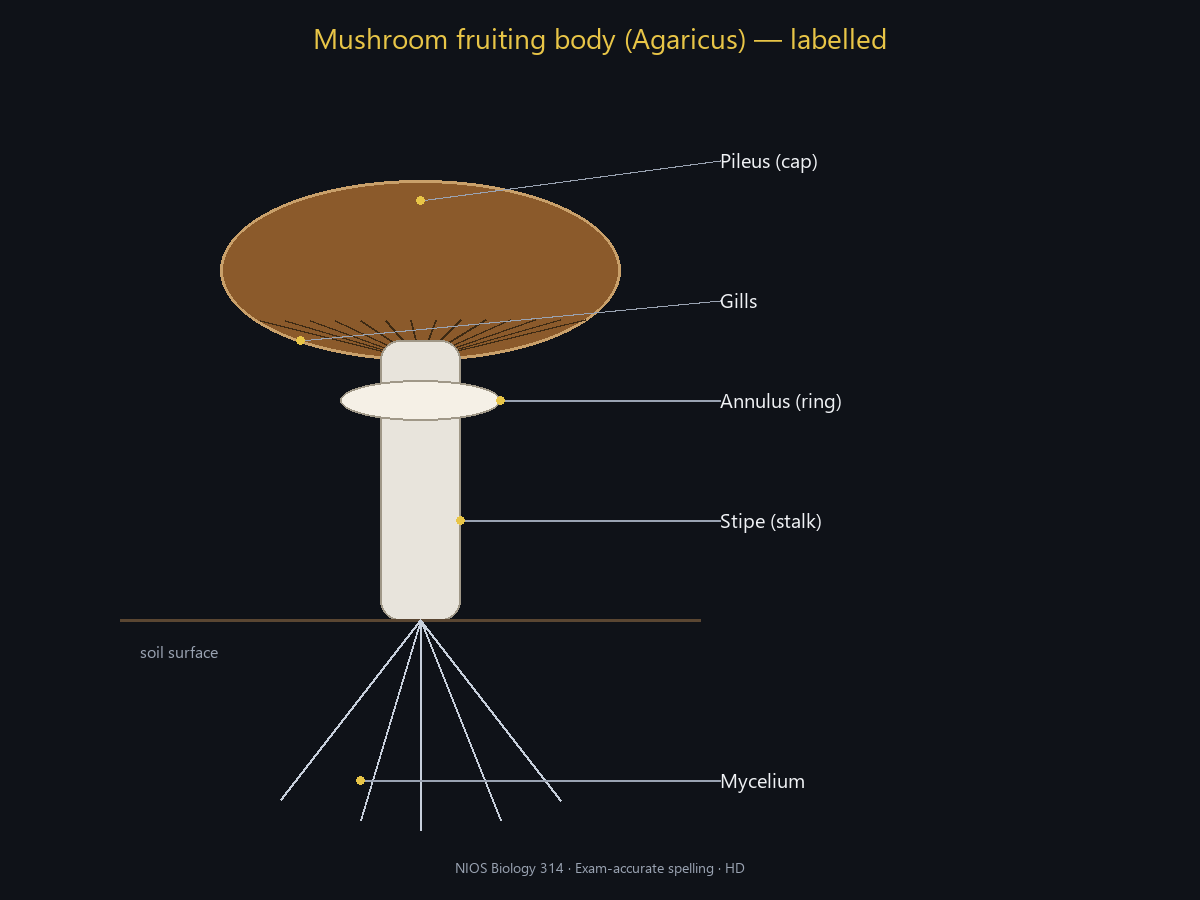
Why it clicks: Mushroom is the fruiting body of a basidiomycete fungus (Kingdom Fungi). Marks go to neat labels of cap, stalk, gills and underground mycelium.
Q2. What are the four nutritional categories found in bacteria?
Why it clicks: Bacteria span all four modes—unlike animals which are only chemoheterotrophs. Exam often lists these four names.
Q3. Why cyanobacteria is included in Monera?
Why it clicks: Photosynthesis alone does not make a plant—prokaryotic cell organisation decides Monera.
Problem Solving — L2 Kingdoms Monera, Protoctista and Fungi
Six problems spanning this chapter’s NIOS Biology (314) syllabus. Every question is built from the notes and formula sheet: solve with definitions and equations first, then read the formal textbook-style write-up, the easy explanation, and the topic in depth (key relations, meaning, exam tips). If the question says draw, a labelled pencil sketch is provided. Explanations open by default.
Why is Kingdom Monera the only kingdom of prokaryotes? Name one diagnostic wall chemical of bacteria. Draw a labelled sketch of a bacterium showing nucleoid and wall.
Pencil sketch (labelled)
Solution — step by step
- Prokaryotes lack a true nucleus and membrane-bound organelles; all such organisms are placed in Monera.
- Bacterial cell walls typically contain peptidoglycan (murein).
- Sketch: outer wall/membrane, cytoplasm, nucleoid region (no nuclear envelope).
Final answer: Monera = prokaryotes only; wall chemical = peptidoglycan
Key relations / definitions
Textbook formal language
Whittaker’s Monera unites organisms whose genetic material is not enclosed in a nuclear envelope. Peptidoglycan is a defining feature of most bacterial walls.
Key relations: Monera = all prokaryotes; No nuclear membrane. State the definition or law first (NIOS style), use correct biological terms, and end with a clear boxed conclusion.
Easy language (same idea, plain words)
Bacteria (and cyanobacteria) have DNA free in the cytoplasm—no true nucleus—so they alone form Monera. Their wall often has peptidoglycan.
Read the question once for the idea, once for the details. Write the definition or equation, then apply it. Check labels and units if any numbers appear.
Topic in depth — Why Monera is unique
Do not put cyanobacteria in Plantae just because they photosynthesise; cell organisation decides Monera.
Linked to chapter notes (L2). Remember: Monera = all prokaryotes; No nuclear membrane. Most exam errors mix up similar terms, reverse cause and effect, or skip labelled diagrams.
Exam tip
Open with a one-line definition, then use: Monera = all prokaryotes; No nuclear membrane. For diagram questions, label every part asked and keep lines neat.
Common mistakes
- Confusing prokaryote with eukaryote (or plant with animal tissues).
- Mixing up similar pathways (e.g. photosynthesis vs respiration; mitosis vs meiosis).
- Writing vague answers without key technical terms from NIOS notes.
- Forgetting to label diagrams or state units where numbers are used.
Under favourable conditions a bacterium divides about every 20 minutes. Starting from 1 cell, how many cells after 1 hour (assume no death)?
Pencil sketch (labelled)
Solution — step by step
- 1 hour = 60 min ⇒ 60/20 = 3 generations.
- N = N₀ × 2ⁿ = 1 × 2³ = 8 cells.
Final answer: 8 cells
Key relations / definitions
Textbook formal language
Binary fission doubles the population each generation under ideal conditions; N = N₀·2ⁿ.
Key relations: Binary fission ≈ 20 min under favourable conditions. State the definition or law first (NIOS style), use correct biological terms, and end with a clear boxed conclusion.
Easy language (same idea, plain words)
Three doublings: 1 → 2 → 4 → 8.
Read the question once for the idea, once for the details. Write the definition or equation, then apply it. Check labels and units if any numbers appear.
Topic in depth — Bacterial reproduction rate
Real cultures slow when nutrients run out; exam uses ideal exponential growth.
Linked to chapter notes (L2). Remember: Binary fission ≈ 20 min under favourable conditions. Most exam errors mix up similar terms, reverse cause and effect, or skip labelled diagrams.
Exam tip
Open with a one-line definition, then use: Binary fission ≈ 20 min under favourable conditions. For diagram questions, label every part asked and keep lines neat.
Common mistakes
- Confusing prokaryote with eukaryote (or plant with animal tissues).
- Mixing up similar pathways (e.g. photosynthesis vs respiration; mitosis vs meiosis).
- Writing vague answers without key technical terms from NIOS notes.
- Forgetting to label diagrams or state units where numbers are used.
How does Rhizobium benefit a legume plant? Where does it live?
Solution — step by step
- Lives in root nodules of legumes.
- Fixes atmospheric N₂ into ammonia usable by the plant; plant supplies carbohydrates.
- Symbiosis: mutual benefit.
Final answer: Root-nodule symbiont; fixes N₂ for the plant
Key relations / definitions
Textbook formal language
Biological nitrogen fixation by Rhizobium converts inert N₂ into plant-available nitrogen compounds inside nodules.
Key relations: Rhizobium + legumes → root nodules; N₂ → NH₃ (biological fixation). State the definition or law first (NIOS style), use correct biological terms, and end with a clear boxed conclusion.
Easy language (same idea, plain words)
Rhizobium is the “nitrogen factory” in pea/bean roots; plant feeds the bacterium sugar.
Read the question once for the idea, once for the details. Write the definition or equation, then apply it. Check labels and units if any numbers appear.
Topic in depth — Rhizobium
Distinguish free-living Azotobacter from symbiotic Rhizobium.
Linked to chapter notes (L2). Remember: Rhizobium + legumes → root nodules; N₂ → NH₃ (biological fixation). Most exam errors mix up similar terms, reverse cause and effect, or skip labelled diagrams.
Exam tip
Open with a one-line definition, then use: Rhizobium + legumes → root nodules; N₂ → NH₃ (biological fixation). For diagram questions, label every part asked and keep lines neat.
Common mistakes
- Confusing prokaryote with eukaryote (or plant with animal tissues).
- Mixing up similar pathways (e.g. photosynthesis vs respiration; mitosis vs meiosis).
- Writing vague answers without key technical terms from NIOS notes.
- Forgetting to label diagrams or state units where numbers are used.
Name the pathogen of malaria and its insect vector. Why is only the female mosquito a vector?
Solution — step by step
- Pathogen: Plasmodium (protozoan).
- Vector: female Anopheles mosquito.
- Females need blood meals for egg development; males do not suck blood.
Final answer: Plasmodium; female Anopheles
Key relations / definitions
Textbook formal language
Malaria is a vector-borne protozoan disease; the definitive/sexual stages occur in the mosquito, asexual stages in humans.
Key relations: Plasmodium; vector = female Anopheles. State the definition or law first (NIOS style), use correct biological terms, and end with a clear boxed conclusion.
Easy language (same idea, plain words)
Plasmodium is the germ; female Anopheles injects it when it bites for blood.
Read the question once for the idea, once for the details. Write the definition or equation, then apply it. Check labels and units if any numbers appear.
Topic in depth — Malaria parasite
Aedes carries dengue/chikungunya—not classic malaria.
Linked to chapter notes (L2). Remember: Plasmodium; vector = female Anopheles. Most exam errors mix up similar terms, reverse cause and effect, or skip labelled diagrams.
Exam tip
Open with a one-line definition, then use: Plasmodium; vector = female Anopheles. For diagram questions, label every part asked and keep lines neat.
Common mistakes
- Confusing prokaryote with eukaryote (or plant with animal tissues).
- Mixing up similar pathways (e.g. photosynthesis vs respiration; mitosis vs meiosis).
- Writing vague answers without key technical terms from NIOS notes.
- Forgetting to label diagrams or state units where numbers are used.
What is the main wall material of fungi? Write the alcoholic fermentation equation of yeast.
Solution — step by step
- Wall: chitin (not cellulose).
- Anaerobic: glucose → 2 ethanol + 2 CO₂ + energy (ATP).
Final answer: Chitin; C₆H₁₂O₆ → 2C₂H₅OH + 2CO₂ (+ ATP)
Key relations / definitions
Textbook formal language
Fungi are eukaryotic heterotrophs with chitinous walls; yeast fermentation is anaerobic respiration used in baking and brewing.
Key relations: Fungal wall: chitin; Yeast: C₆H₁₂O₆ → 2C₂H₅OH + 2CO₂ (+ ATP). State the definition or law first (NIOS style), use correct biological terms, and end with a clear boxed conclusion.
Easy language (same idea, plain words)
Fungi walls = chitin (like insect shells). Yeast turns sugar into alcohol and bubbles of CO₂ without oxygen.
Read the question once for the idea, once for the details. Write the definition or equation, then apply it. Check labels and units if any numbers appear.
Topic in depth — Fungal wall and yeast
Do not confuse with bacterial peptidoglycan or plant cellulose.
Linked to chapter notes (L2). Remember: Fungal wall: chitin; Yeast: C₆H₁₂O₆ → 2C₂H₅OH + 2CO₂ (+ ATP). Most exam errors mix up similar terms, reverse cause and effect, or skip labelled diagrams.
Exam tip
Open with a one-line definition, then use: Fungal wall: chitin; Yeast: C₆H₁₂O₆ → 2C₂H₅OH + 2CO₂ (+ ATP). For diagram questions, label every part asked and keep lines neat.
Common mistakes
- Confusing prokaryote with eukaryote (or plant with animal tissues).
- Mixing up similar pathways (e.g. photosynthesis vs respiration; mitosis vs meiosis).
- Writing vague answers without key technical terms from NIOS notes.
- Forgetting to label diagrams or state units where numbers are used.
From which organism is penicillin obtained? State one use of antibiotics.
Solution — step by step
- From the fungus Penicillium notatum (and related species).
- Antibiotics kill or inhibit growth of pathogenic bacteria (not viruses).
Final answer: Penicillium notatum; treat bacterial infections
Key relations / definitions
Textbook formal language
Antibiotics are antimicrobial compounds; penicillin historically opened chemotherapy of bacterial disease.
Key relations: Penicillium notatum → penicillin (Fleming, 1927). State the definition or law first (NIOS style), use correct biological terms, and end with a clear boxed conclusion.
Easy language (same idea, plain words)
Mould Penicillium makes penicillin—kills bacteria, not viruses (cold/flu).
Read the question once for the idea, once for the details. Write the definition or equation, then apply it. Check labels and units if any numbers appear.
Topic in depth — Penicillin source
Overuse leads to resistance—exam often asks responsible use.
Linked to chapter notes (L2). Remember: Penicillium notatum → penicillin (Fleming, 1927). Most exam errors mix up similar terms, reverse cause and effect, or skip labelled diagrams.
Exam tip
Open with a one-line definition, then use: Penicillium notatum → penicillin (Fleming, 1927). For diagram questions, label every part asked and keep lines neat.
Common mistakes
- Confusing prokaryote with eukaryote (or plant with animal tissues).
- Mixing up similar pathways (e.g. photosynthesis vs respiration; mitosis vs meiosis).
- Writing vague answers without key technical terms from NIOS notes.
- Forgetting to label diagrams or state units where numbers are used.