OneNIOS Study Hub
Biology — Class 12 — L25: Principles of Ecology
Lesson-25.pdf). Content covers sections 25.1–25.7.Overview — Life on Earth’s support systems
Earth alone among solar planets supports life because soil, water and air supply essentials. Living beings differ yet interact with each other and the environment. This NIOS Module 4 lesson covers environment, ecology and biosphere; habitat and niche; population; ecosystem structure (pond model); food chains, webs and energy flow; biotic interactions; biomes; ecological succession; and carbon, water and phosphorus cycles.
After this lesson you should define environment, ecology, biosphere, habitat, niche, population, community, ecosystem and biome; describe biotic/abiotic components; explain food chain/web and 10% energy rule; list biomes and succession stages; and outline major biogeochemical cycles. Notes follow textbook order only.
Section 1: Environment, ecology, organisation (25.1)
Environment — all physical, chemical and biotic conditions surrounding and influencing organisms. Abiotic: climatic (T, light, humidity, wind, precipitation, pressure), edaphic (soil), chemical (air composition, minerals). Resources: air, soil, water; regulators: light, temperature, pressure. Biotic: plants, animals, microorganisms.
Ecology — scientific study of relationships between organisms and environment (Greek oikos = household, logos = study).
Levels: genes → cell → organ → organism → population → community → ecosystem → biome → biosphere. Organism — self-reproducing, growing unit shaped by surroundings. Population — same species, place, time; lives in a habitat (physical “address” — forest, ocean, river; even human gut for tapeworm). Habitat needs: space, food, water, shelter. Major habitats: terrestrial, freshwater, estuarine, oceanic.
Niche — functional role/“profession”: how a species uses habitat resources for survival and reproduction. Unique per species; two species cannot share the same niche long (competition displaces one). Example: insects on one plant feed on different parts; forest plants differ in height and light needs (stratification).
Adaptation — structure, behaviour or physiology that allows survival in a habitat (fish gills/fins; bird beaks; desert camel; aquatic plants reduced roots/wood). Genetic basis via evolution. Species — group that can interbreed successfully (e.g. all humans = Homo sapiens).
Section 2: Population (25.4)
Population = freely interbreeding individuals of one species in a defined area and time. Traits: continues while individuals die; sex ratio; age structure (pre-reproductive, reproductive, post-reproductive). Density = individuals/unit area (quadrats; pugmarks for large mammals; human census).
Natality (birth rate), mortality (death rate), immigration (+), emigration (−) set density. Rapid growth: many reproductive-age individuals. Stationary: balanced ages. Declining: many post-reproductive.
Growth curves: J-shaped — exponential when resources abundant, then crash (seasonal insects). S-shaped (sigmoid) — lag, then rapid growth, then plateau when carrying capacity reached (natality ≈ mortality). Human population often discussed with S-type approach to limits.
Section 3: Community, biosphere, ecosystem (25.2–25.3)
Community — populations of different species sharing a place. Community + abiotic environment = ecosystem (self-sustaining functional unit). Synecology = study of groups vs environment. Biosphere — thin life-supporting layer; depends on atmosphere, lithosphere, hydrosphere. Ecosphere = biosphere + those three abiotic spheres as one unit.
Ecosystems: terrestrial (forest, desert, grassland) or aquatic (pond, lake, ocean); man-made (crop, aquarium). Pond model: light and temperature abiotic; O₂, CO₂, minerals, organic detritus; producers (phytoplankton, rooted plants); consumers (herbivores, carnivores); decomposers (bacteria, fungi in sediment).
Section 4: Structure and function — food chain, web, energy (25.4)
Structure: species composition; stratification (vertical layers in forest canopy → understorey → floor; horizontal patchiness in desert). Function: productivity, energy flow, nutrient cycling.
Food chain: transfer of food by eating and being eaten. Example: grasses → grasshopper → frog → snake → hawk. Each step = trophic level (usually ≤4–5). Numbers fall, size often rises, up the chain.
- Producers (autotrophs) — 1st level; GPP = total photosynthesis; NPP = GPP − plant respiration; NPP available to consumers.
- Primary consumers (herbivores) — 2nd level; “key industry” converting plant to animal tissue.
- Secondary/tertiary carnivores — higher levels.
- Decomposers — detritus feeders recycle nutrients.
Special groups: scavengers, omnivores (humans), parasites. Humans can be primary (vegetarian), secondary or tertiary consumers.
Food web: interconnected food chains (snake eats frog or rat; sunfish eats several prey).
Energy flow: solar → chemical in producers → linear one-way flow up chain. Much energy lost as heat and respiration at each step. 10% law: roughly 10% of energy reaches next trophic level (1000 kcal plant → ~100 herbivore → ~10 carnivore → ~1 top carnivore). Limits chain length. Nutrients cycle; energy does not.
Ecological pyramids: standing crop as number, biomass or energy — producers at base, higher consumers as tiers (pyramid of numbers, biomass, energy).
Section 5: Biotic interactions (25.5)
| Interaction | Effect | Example idea |
|---|---|---|
| Amensalism | − / 0 | Penicillium antibiotic vs bacteria |
| Predation | + / − | Tiger–prey |
| Parasitism | + / − | Cuscuta, Ascaris, viruses |
| Competition | − / − | Shared scarce resource |
| Commensalism | + / 0 | Remora on shark; epiphytes on trees |
| Mutualism | + / + | Anemone–hermit crab; pollination |
Intraspecific competition (same species) is intense; interspecific between species. Close obligatory mutualism = symbiosis (termite + gut flagellates digesting cellulose; neither survives alone).
Section 6: Biomes (25.6)
Biome — large landscape ecosystem with characteristic flora and fauna. Terrestrial: tundra, forest, desert, grassland. Aquatic: freshwater, marine.
Tropical rain forest: high T and light; rainfall >200 cm/yr; rich humus, high productivity/biomass; tall evergreen trees, lianas, epiphytes, buttresses; rich fauna (insects, flying frog, monkeys, leopard).
Temperate deciduous: 75–150 cm rain; cold winters; trees shed leaves (oak, birch); rodents important grazers; fox, wolf, deer.
Coniferous (taiga/boreal): cold, long winters, acidic poor soil; spruce, fir, pine; low productivity; moose, lynx, wolf.
Grassland (savanna etc.): between forest and desert; grasses dominate; bison, zebra, antelope; few large carnivores; rich insects/reptiles.
Desert: <25 cm rain often; extremes of T; cactus, Acacia; burrowers, camel.
Tundra: arctic (permafrost, very cold) or alpine (high peaks); short season; mosses, lichens, dwarf shrubs; reindeer, lemmings; fur insulation.
Aquatic: limnology = freshwater study. Lentic (standing) vs lotic (running). Plankton = floating microbes/plants/animals. Wetlands = ecotones (swamp, marsh, mangrove). Marine: ~71% Earth, high salinity ~3.6%, pressure rises with depth, tides; high biodiversity; no insects or vascular plants in open sea.
Section 7: Ecological succession (25.7)
Communities replace each other over time = succession. Primary: bare rock, lava, new sand dunes — no prior community; pioneers (e.g. lichens) → seral stages → stable climax. Sequence of communities = sere. Xerarch on dry land; hydrarch in water. Secondary: after fire, flood, ploughing — faster because soil and seed bank remain. Climax stays relatively stable if undisturbed. Animals shift as plants change.
Section 8: Biogeochemical cycles (25.7)
Nutrients cycle between organisms and environment; energy flows one way. Decomposers return elements from detritus to producers.
Carbon cycle: atmospheric/ocean CO₂ → photosynthesis → biomass → respiration & decomposition return CO₂; combustion of fossil fuels and forest fires add CO₂. Human industry and autos raise CO₂ → greenhouse effect and global warming. Forests act as slow carbon reservoirs.
Water (hydrologic) cycle: evaporation, condensation, precipitation; solar energy and gravity drive it. Oceans hold most free water; ice caps and deep ocean are reservoirs; little is fresh liquid available. Transpiration from plants is major land flux.
Phosphorus cycle: rock phosphate reservoir → erosion → plants take orthophosphate → animals → decomposers; loss to deep ocean sediments; guano and fish partly return P; bones/teeth resist weathering. Humans accelerate P loss; return often inadequate.
Section 9: Exam map and closed-book drill
Environment abiotic/biotic; ecology definition; levels of organisation; habitat vs niche; species/population; density, B/D/I/E; J vs S curves; ecosystem/pond; food chain/web; GPP/NPP; 10% law; pyramids; six interactions; major biomes; succession terms; C/H₂O/P cycles.
Use Formula Sheet; drill 10 MCQs and 20 flashcards. Prioritise habitat/niche, 10% energy, interaction table, and succession vocabulary.
Section 10: Extra depth for full coverage
Earth’s three physical systems — soil (lithosphere surface), water (hydrosphere), air (atmosphere) — make life possible. Ecology’s household metaphor stresses that organisms share resources and constraints in a common house. Stratification lets many species pack into one habitat by using different vertical niches (canopy birds vs floor insects).
Population density methods: plants via quadrats; large mammals via direct count or pugmarks; humans via census every decade. Equal births and deaths → plateau phase. Carrying capacity is the environment’s sustainable limit when mortality matches natality.
Food chain features: weaker eaten by stronger; fewer but often larger organisms higher up; short chains because energy runs out. Decomposers close matter cycles so ecosystems do not exhaust nutrients. Humans sit at multiple trophic levels depending on diet — rice puts you as primary consumer; fish from a long aquatic chain can put you near tertiary.
Energy is linear because heat loss is irreversible; carbon and phosphorus return via decomposers and geochemical paths. That is why “energy flow” and “nutrient cycle” are different phrases in every textbook summary.
Biome climate rules of thumb: rain forest wet and productive; desert dry; tundra cold with permafrost; taiga conifers in cold acidic soils; grassland intermediate rainfall. Savannas are tropical grasslands with scattered trees. Deciduous means seasonal leaf drop.
Succession biomass generally increases toward climax; pioneers grow fast and live short; climax is complex and stable. Secondary succession on abandoned fields is the familiar weeds → grasses → shrubs → trees path and is easier to observe than primary succession on bare rock.
Carbon: photosynthesis fixes CO₂; respiration and decay release it; fossil fuel burning adds extra. Water: ocean evaporation vs precipitation imbalance is closed by runoff. Phosphorus: no large atmospheric pool — rock-bound and easily lost to deep sea; sea birds’ guano is a classic return path.
Closed-book drill: (1) environment/ecology/biosphere; (2) abiotic list; (3) levels of organisation; (4) habitat vs niche; (5) population density and growth curves; (6) ecosystem definition + pond components; (7) food chain example + trophic names; (8) food web vs chain; (9) GPP/NPP and 10% law; (10) three pyramids; (11) six biotic interactions; (12) four terrestrial biomes traits; (13) lentic vs lotic; (14) pioneer/climax/sere; (15) carbon cycle steps; (16) water cycle processes; (17) phosphorus reservoir and loss. Completing these covers Lesson 25 terminals for Module 4.
Section 11: Expanded syllabus review
Earth’s life support rests on three physical systems — soil, water and air — that provide materials for metabolism, growth and reproduction. Environment is everything outside an organism that influences it: abiotic climate and soil chemistry plus biotic neighbours. Ecology is the science of those relationships; the word’s roots mean “study of the household,” a useful metaphor for shared resources and limits.
Organisation of life runs from genes and cells up through organisms, populations, communities, ecosystems, biomes and the biosphere. A population is not just a pile of individuals: it has density, birth and death rates, immigration and emigration, age structure and sex ratio. Density can be estimated with quadrats for plants, pugmarks for large mammals, and full census for humans. J-shaped growth explodes when resources are plentiful then collapses when seasons or food fail. S-shaped growth slows as carrying capacity is approached and natality nearly equals mortality.
Habitat is the address; niche is the profession. Many species share a forest habitat but partition light, food and shelter so niches differ. Two species cannot permanently occupy the identical niche — competitive exclusion. Adaptation (beaks, gills, thorns, fur thickness) fits organisms to their habitats and has a genetic, evolutionary basis.
An ecosystem is a self-sustaining unit of biotic and abiotic parts. The pond model is classic: sunlight, temperature, dissolved gases and minerals; floating and rooted producers; herbivores and carnivores; decomposers in sediment. Structure includes species composition and stratification; function includes productivity, energy flow and nutrient cycles. Autotrophs fix solar energy; GPP is total fixation, NPP is what remains after plant respiration for consumers.
Food chains are linear paths of eating; food webs are networks. Trophic levels rarely exceed four or five because of the 10% energy rule: most energy is lost as heat and used in respiration at each step. Energy flow is linear; nutrients recycle via decomposers. Ecological pyramids display numbers, biomass or energy with producers at the base. Humans may be primary, secondary or tertiary consumers depending on diet. Scavengers, omnivores and parasites are special feeding groups.
Biotic interactions: amensalism (Penicillium vs bacteria), predation, parasitism (Cuscuta, Ascaris), competition (inter- and intraspecific), commensalism (remora–shark, epiphytes), mutualism and tight symbiosis (termite–flagellate, pollination). Intraspecific competition is often fiercest because needs match closely.
Biomes are climate packages of flora and fauna. Tropical rain forests: high rain and productivity. Temperate deciduous forests: seasonal leaf drop. Coniferous taiga: cold, acidic soils, evergreens. Grasslands/savannas: grass dominance, large herbivores. Deserts: scarce water, specialised plants and burrowers. Tundra: permafrost or alpine cold, low productivity. Aquatic systems: freshwater lentic vs lotic; marine vast, saline, pressure and light gradients; wetlands as ecotones.
Succession replaces communities over time. Primary succession starts on bare rock or new land with pioneers (lichens often) through seral stages to a stable climax. Secondary succession after fire or farming is faster because soil and seeds remain. Xerarch is dry-land succession; hydrarch is aquatic. Biomass generally rises toward climax.
Biogeochemical cycles move elements through life and the non-living world. Carbon: CO₂ fixed by photosynthesis, returned by respiration and decay, boosted by fossil fuel combustion and deforestation — linked to greenhouse warming. Water: evaporation, condensation, precipitation driven by sun and gravity; oceans dominate the reservoir. Phosphorus: rock-bound, no big atmospheric pool, easily lost to deep sediments; guano helps return; human use accelerates loss. Nutrients cycle; energy does not — that single contrast organises the whole functional ecology section.
Quick formula strip: habitat/niche; J vs S; GPP−R=NPP; 10% energy; chain vs web; six interactions; rain forest/desert/tundra; pioneer→climax; C/H₂O/P cycles. Say each with one example ecosystem. You are exam-ready when definitions, the 10% law, interaction signs, and succession vocabulary all come without notes on the NIOS Module 4 paper.
Section 12: Worked examples and comparison tables
Food chain practice: grasses → grasshopper → frog → snake → eagle. Trophic levels 1–5; frog is secondary consumer if it eats herbivorous grasshopper; snake can be tertiary. Energy sketch: if plants store 10,000 kcal available, herbivores might convert about 1,000, primary carnivores 100, secondary carnivores 10 — the 10% rule of thumb, with losses to heat and respiration at each box.
Pond food web idea: phytoplankton feed zooplankton and some bottom feeders; zooplankton feed small fish; small fish feed larger fish and birds; decomposers attack all dead matter. Removing one link still leaves alternate paths — that is the ecological value of a web over a single chain.
Interaction sign chart to memorise: predation and parasitism are +/−; competition −/−; mutualism +/+; commensalism +/0; amensalism −/0; neutralism 0/0. Penicillium vs bacteria is amensalism; Cuscuta on host is parasitism; remora on shark is commensalism; termite and flagellate is mutualism/symbiosis.
Biome climate snapshot: tropical rain forest >200 cm rain, high biomass; temperate deciduous 75–150 cm, seasonal leaf fall; coniferous cold acidic soils, spruce/fir/pine; grassland intermediate moisture, grasses and large grazers; desert often <25 cm rain; arctic tundra permafrost and short growing season. Savanna = tropical grassland with scattered trees. Alpine tundra = high mountain peaks above tree line.
Succession sequence on bare rock often: crustose lichens → foliose lichens → mosses → herbs → shrubs → trees → climax forest. On abandoned field (secondary): weeds → grasses → shrubs → pines → hardwood climax over decades to centuries. Secondary is faster because soil and seed banks exist.
Carbon: atmosphere and oceans store CO₂; plants fix it; animals and microbes release it; burning coal and oil adds extra. Water: sun evaporates ocean and land water; plants transpire; clouds form; rain returns water; runoff balances ocean budgets. Phosphorus: rock weathering starts the cycle; no large air pool; deep ocean sediments are a sink; guano returns some marine P to land.
Population plateau means births ≈ deaths. Immigration increases density; emigration decreases it. A young age structure with many pre-reproductive individuals predicts future growth. Natural ecosystems (forest, pond) differ from human-modified ones (crop fields, cities) that depend on fertilisers and fossil fuels.
That finishes Principles of Ecology for Module 4: know definitions cold, draw one chain and one energy pyramid, and explain why energy cannot cycle the way carbon does.
Decomposers are necessary because without them dead biomass would lock nutrients away forever; bacteria and fungi return minerals so producers can grow again. Plants are autotrophs because they make organic food from inorganic CO₂ and water using light; animals are heterotrophs because they must consume organic matter. Energy is linear because each transfer loses heat that cannot be recaptured as usable chemical energy by the same path. Maximum steps in a typical food chain are about four or five. Carrying capacity is reached when mortality equals birth rate. You are exam-ready when habitat versus niche, the 10% law, and the six interaction types all come without notes on the public examination paper for this Module 4 lesson.
MCQ Quiz — L25 Principles of Ecology
Flashcards — L25
Golden Rules — L25 Principles of Ecology
Most exam-important points from this chapter:
Environment & organisation
Abiotic + biotic environment. Ecology = interactions. Habitat = address; niche = profession (unique). Levels up to biome and biosphere.
Population & ecosystem
Density from B, D, I, E. J vs S growth. Ecosystem = biotic + abiotic. Pond: producers, consumers, decomposers.
Energy & food
Chain vs web. GPP−R=NPP. Energy linear, ~10% per level, short chains. Nutrients cycle. Pyramids of N, biomass, energy.
Interactions & biomes
Know +/− table: predation, parasitism, competition, mutualism, commensalism, amensalism. Rain forest, deciduous, taiga, grassland, desert, tundra; aquatic types.
Succession & cycles
Primary slow from bare land; secondary faster. Pioneer→climax. Carbon, water, phosphorus cycles; human CO₂ and P loss matter.
Past Year Questions — L25 Principles of Ecology
PE-only questions for this chapter only. 10 item(s). No overlap with other lessons. Tap Show answer after you try each question.
Q1. Which of the following makes up the final trophic level in a food chain?
Why it clicks: Decomposers form the final trophic role recycling dead matter.
Q2. Fill in the blanks (attempt any two from A to D): 2 The flowchart given below is a diagrammatic representation of trophic levels in a A in an ecosystem: Fourth trophic level Third trophic level (Carnivore) Second trophic level First trophic level [a WmZ [aE (A go D
This question needs a diagram — open the answer to view the HD model figure.
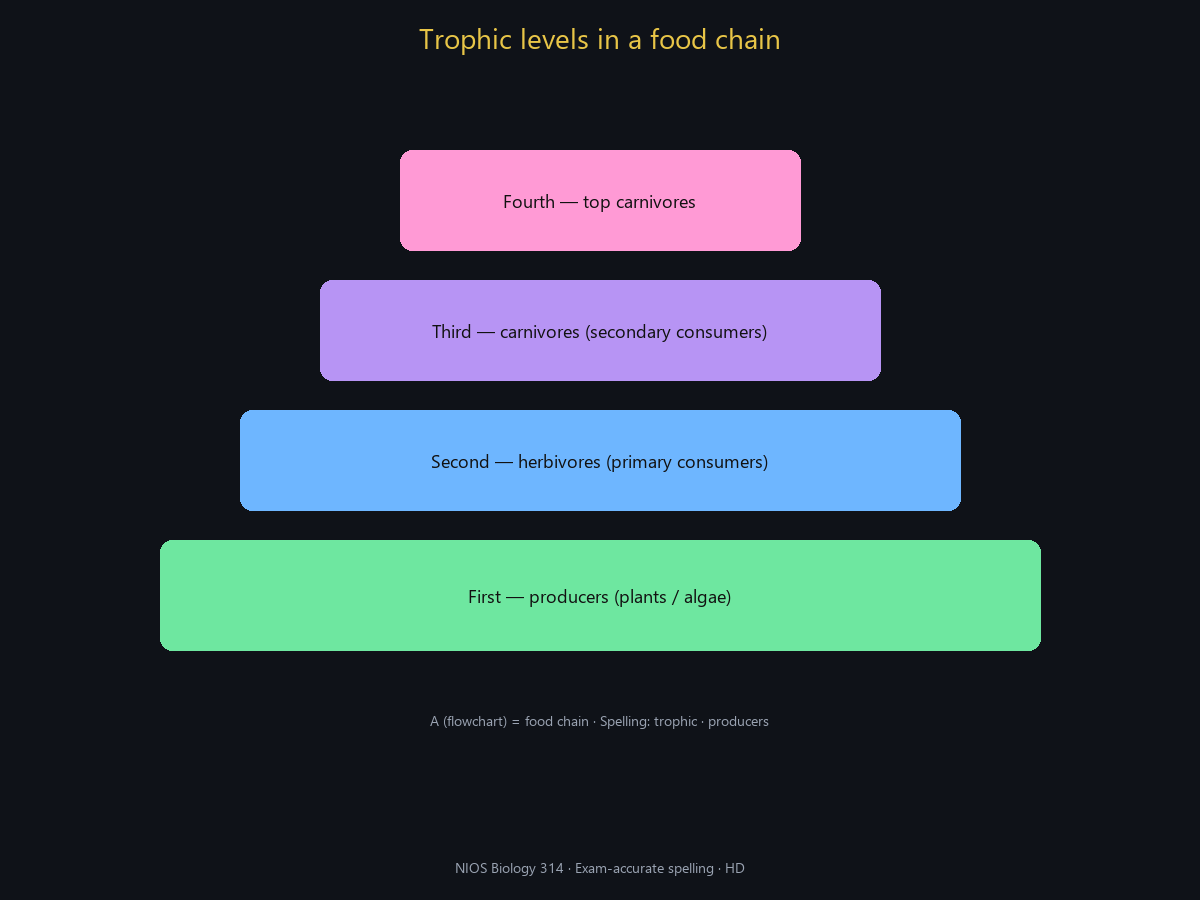
Why it clicks: Base producers, then consumers up the chain.
Q3. Fill in the blanks (attempt any two from A to D): 2 A and B are two adaptations to promote cross-pollination in flowers; while C and D are two devices to ensure self-pollination. [a WmZ [aE (A go D
Why it clicks: Open flowers that force outcrossing vs closed flowers that self.
Q4. Define the following terms: 2 (a) Population (b) Adaptation
Why it clicks: Population = same species group; adaptation = useful inherited trait.
Q5. Which one of the following adaptations is seen in plants to promot e self-pollination?
Why it clicks: Closed flowers force self-pollination. Dichogamy/unisexuality/self-sterility promote cross-pollination.
Q6. In the given food chain identify the trophic level of frog
Why it clicks: Typical chain grass → insect → frog → snake: frog is secondary consumer = third trophic level.
Q7. The biological community in an area or ecosystem is a complex networ k of interactions. Interactions may be of various types. In commensalism type
Why it clicks: + / 0 interaction.
Q8. Aquatic ecosystems are classified on the basis of salinity into tw o types-Fresh water and Marine. The common flora and fauna found in fresh water bodies like ri vers, lake include phytoplanktons, water hyacinth, water lily and zooplankton, cra b and fishes respectively. Wet lands are between aquatic and terrestrial ecosystem. They show an edge effect and form an ecotone. (a) What is the study of fresh water ecosystem known as? (b) Define ecotone
Why it clicks: Wetland edge = classic ecotone example.
Q9. Build a food chain showing one producer and three consumers. What will be the trophic level of the final consumer of this food chain?
Why it clicks: Count levels from producer = 1.
Q10. Genes → cells →organ → organism → population Species → community → Ecosystem →biome →Biosphere 35 Defence against microorganisms such as virus and bacteria; recognition and destruction of mutant cells
Why it clicks: Hierarchy from molecule to whole Earth living system.
Problem Solving — L25 Principles of Ecology
Six problems spanning this chapter’s NIOS Biology (314) syllabus. Every question is built from the notes and formula sheet: solve with definitions and equations first, then read the formal textbook-style write-up, the easy explanation, and the topic in depth (key relations, meaning, exam tips). If the question says draw, a labelled pencil sketch is provided. Explanations open by default.
Arrange: community, organism, ecosystem, population — from smallest to largest grouping.
Pencil sketch (labelled)
Solution — step by step
- Organism → population → community → ecosystem.
Final answer: Organism → population → community → ecosystem
Key relations / definitions
Textbook formal language
Ecology studies interactions at multiple nested scales.
Key relations: Organism → population → community → ecosystem → biome → biosphere. State the definition or law first (NIOS style), use correct biological terms, and end with a clear boxed conclusion.
Easy language (same idea, plain words)
One living thing, many of one kind, many kinds together, plus environment.
Read the question once for the idea, once for the details. Write the definition or equation, then apply it. Check labels and units if any numbers appear.
Topic in depth — Ecology hierarchy
Biome is larger climatic unit; biosphere is global life layer.
Linked to chapter notes (L25). Remember: Organism → population → community → ecosystem → biome → biosphere. Most exam errors mix up similar terms, reverse cause and effect, or skip labelled diagrams.
Exam tip
Open with a one-line definition, then use: Organism → population → community → ecosystem → biome → biosphere. For diagram questions, label every part asked and keep lines neat.
Common mistakes
- Confusing prokaryote with eukaryote (or plant with animal tissues).
- Mixing up similar pathways (e.g. photosynthesis vs respiration; mitosis vs meiosis).
- Writing vague answers without key technical terms from NIOS notes.
- Forgetting to label diagrams or state units where numbers are used.
List biotic components of an ecosystem with one example each of producer, consumer, decomposer.
Pencil sketch (labelled)
Solution — step by step
- Producer: green plant/phytoplankton.
- Consumer: herbivore/carnivore (e.g. deer/tiger).
- Decomposer: bacteria/fungi.
Final answer: Producer plant; consumer animal; decomposer microbe
Key relations / definitions
Textbook formal language
Energy enters via producers; decomposers recycle matter.
Key relations: Biotic + abiotic; Producers, consumers, decomposers. State the definition or law first (NIOS style), use correct biological terms, and end with a clear boxed conclusion.
Easy language (same idea, plain words)
Plants make food, animals eat, microbes clean up dead stuff.
Read the question once for the idea, once for the details. Write the definition or equation, then apply it. Check labels and units if any numbers appear.
Topic in depth — Components
Without decomposers, nutrients would lock in dead organic matter.
Linked to chapter notes (L25). Remember: Biotic + abiotic; Producers, consumers, decomposers. Most exam errors mix up similar terms, reverse cause and effect, or skip labelled diagrams.
Exam tip
Open with a one-line definition, then use: Biotic + abiotic; Producers, consumers, decomposers. For diagram questions, label every part asked and keep lines neat.
Common mistakes
- Confusing prokaryote with eukaryote (or plant with animal tissues).
- Mixing up similar pathways (e.g. photosynthesis vs respiration; mitosis vs meiosis).
- Writing vague answers without key technical terms from NIOS notes.
- Forgetting to label diagrams or state units where numbers are used.
State Lindeman’s 10% law. Why are food chains usually short?
Pencil sketch (labelled)
Solution — step by step
- Only about 10% of energy passes to next trophic level.
- Energy dwindles quickly so few top-carnivore levels are supported.
Final answer: ~10% transfer; energy loss limits chain length
Key relations / definitions
Textbook formal language
Energy flow is unidirectional; matter cycles.
Key relations: ~10% energy to next trophic level; Pyramids of energy always upright. State the definition or law first (NIOS style), use correct biological terms, and end with a clear boxed conclusion.
Easy language (same idea, plain words)
Each step wastes most energy as heat—so chains can’t be very long.
Read the question once for the idea, once for the details. Write the definition or equation, then apply it. Check labels and units if any numbers appear.
Topic in depth — Trophic levels & 10% law
Pyramids of number/biomass can invert; energy pyramid not.
Linked to chapter notes (L25). Remember: ~10% energy to next trophic level; Pyramids of energy always upright. Most exam errors mix up similar terms, reverse cause and effect, or skip labelled diagrams.
Exam tip
Open with a one-line definition, then use: ~10% energy to next trophic level; Pyramids of energy always upright. For diagram questions, label every part asked and keep lines neat.
Common mistakes
- Confusing prokaryote with eukaryote (or plant with animal tissues).
- Mixing up similar pathways (e.g. photosynthesis vs respiration; mitosis vs meiosis).
- Writing vague answers without key technical terms from NIOS notes.
- Forgetting to label diagrams or state units where numbers are used.
Differentiate habitat and niche with a one-line example.
Solution — step by step
- Habitat: place where organism lives (pond for frog).
- Niche: functional role (frog as insect predator in pond community).
Final answer: Habitat=place; niche=role
Key relations / definitions
Textbook formal language
Competitive exclusion relates to overlapping niches.
Key relations: Habitat: address; Niche: profession/role. State the definition or law first (NIOS style), use correct biological terms, and end with a clear boxed conclusion.
Easy language (same idea, plain words)
Habitat is the address; niche is the job.
Read the question once for the idea, once for the details. Write the definition or equation, then apply it. Check labels and units if any numbers appear.
Topic in depth — Habitat vs niche
Two species may share habitat but differ in niche.
Linked to chapter notes (L25). Remember: Habitat: address; Niche: profession/role. Most exam errors mix up similar terms, reverse cause and effect, or skip labelled diagrams.
Exam tip
Open with a one-line definition, then use: Habitat: address; Niche: profession/role. For diagram questions, label every part asked and keep lines neat.
Common mistakes
- Confusing prokaryote with eukaryote (or plant with animal tissues).
- Mixing up similar pathways (e.g. photosynthesis vs respiration; mitosis vs meiosis).
- Writing vague answers without key technical terms from NIOS notes.
- Forgetting to label diagrams or state units where numbers are used.
Distinguish primary and secondary succession.
Solution — step by step
- Primary: starts on bare lifeless substrate (rock, new island).
- Secondary: starts where soil remains after disturbance (abandoned field, burnt forest).
Final answer: Primary no soil start; secondary soil remains
Key relations / definitions
Textbook formal language
Succession is directional community change toward climax under given climate.
Key relations: Primary on bare rock; secondary on cleared land; Climax community. State the definition or law first (NIOS style), use correct biological terms, and end with a clear boxed conclusion.
Easy language (same idea, plain words)
From bare rock is primary; from a cleared farm field is secondary—faster.
Read the question once for the idea, once for the details. Write the definition or equation, then apply it. Check labels and units if any numbers appear.
Topic in depth — Ecological succession
Climax is relatively stable end community.
Linked to chapter notes (L25). Remember: Primary on bare rock; secondary on cleared land; Climax community. Most exam errors mix up similar terms, reverse cause and effect, or skip labelled diagrams.
Exam tip
Open with a one-line definition, then use: Primary on bare rock; secondary on cleared land; Climax community. For diagram questions, label every part asked and keep lines neat.
Common mistakes
- Confusing prokaryote with eukaryote (or plant with animal tissues).
- Mixing up similar pathways (e.g. photosynthesis vs respiration; mitosis vs meiosis).
- Writing vague answers without key technical terms from NIOS notes.
- Forgetting to label diagrams or state units where numbers are used.
Explain eutrophication in two steps and one consequence.
Pencil sketch (labelled)
Solution — step by step
- Excess nutrients (N, P) from fertilisers/sewage enter water.
- Algal bloom → death/decomposition → O₂ depletion → fish kills.
Final answer: Nutrient load → bloom → hypoxia/fish death
Key relations / definitions
Textbook formal language
Cultural eutrophication is a major freshwater problem.
Key relations: Air/water/soil pollution; eutrophication; greenhouse effect. State the definition or law first (NIOS style), use correct biological terms, and end with a clear boxed conclusion.
Easy language (same idea, plain words)
Too much fertiliser feeds algae; when algae die, oxygen vanishes and fish die.
Read the question once for the idea, once for the details. Write the definition or equation, then apply it. Check labels and units if any numbers appear.
Topic in depth — Human impact
Link to L10 fertiliser misuse.
Linked to chapter notes (L25). Remember: Air/water/soil pollution; eutrophication; greenhouse effect. Most exam errors mix up similar terms, reverse cause and effect, or skip labelled diagrams.
Exam tip
Open with a one-line definition, then use: Air/water/soil pollution; eutrophication; greenhouse effect. For diagram questions, label every part asked and keep lines neat.
Common mistakes
- Confusing prokaryote with eukaryote (or plant with animal tissues).
- Mixing up similar pathways (e.g. photosynthesis vs respiration; mitosis vs meiosis).
- Writing vague answers without key technical terms from NIOS notes.
- Forgetting to label diagrams or state units where numbers are used.