OneNIOS Study Hub
Biology — Class 12 — L23: Molecular Inheritance and Gene Expression
Lesson-23.pdf). Content covers sections 23.1–23.9.Overview — From gene to protein
The nucleus holds chromosomes; chromosomes bear genes; genes carry hereditary information. Genes are segments of DNA. This NIOS Module 3 lesson covers one gene–one enzyme, proof that DNA is genetic material, DNA/RNA structure, bacterial gene transfer, replication, central dogma, genetic code, transcription and translation, gene regulation (lac operon, housekeeping genes), and mutations with mutagens.
After this lesson you should state one gene–one polypeptide; outline Griffith, Avery and Hershey–Chase; describe DNA double helix and nucleosomes; compare DNA and RNA; explain conjugation, transformation, transduction; list replication steps; explain central dogma and the code; outline protein synthesis; describe lac operon and mutation types. Notes follow textbook order only. Link to L22: genes as Mendelian factors made of DNA.
Section 1: One gene–one enzyme (23.1)
Archibald Garrod (Inborn Errors of Metabolism) linked inherited disorders (phenylketonuria, alkaptonuria) to missing enzymes. Beadle and Tatum, using Neurospora mutants, showed loss of a gene blocks a metabolic pathway at a missing enzyme → one gene–one enzyme hypothesis. Later refined: one gene → one polypeptide (enzymes may be multi-chain proteins).
Section 2: DNA as genetic material (23.2)
Griffith (1928): smooth virulent S. pneumoniae kills mice; rough non-virulent is harmless. Heat-killed S mixed with live R → mice die and live S recovered = transformation.
Avery, MacLeod, McCarty (1944): DNA from virulent S transforms R to virulent; DNase destroys transforming activity → DNA is the transforming principle.
Hershey and Chase (1952): T2 phage — 35S labels protein coat (stays outside bacteria); 32P labels DNA (enters bacteria) → new phage made from DNA. Confirmed DNA is genetic material.
Section 3: Structure of DNA (23.3)
DNA is a polynucleotide of nucleotides: deoxyribose + nitrogen base + phosphate. Nucleoside = base + sugar. Bases: purines A, G; pyrimidines T, C. Four nucleotides in DNA.
Chargaff’s rule: A = T and G = C (purines = pyrimidines overall).
Watson–Crick double helix (Franklin & Wilkins X-ray; Nobel for structure): two antiparallel strands (5′→3′ vs 3′→5′); sugar–phosphate backbone; bases pair A–T (2 H-bonds), G–C (3 H-bonds); complementary strands; 10 bp per turn, 3.4 nm/turn, base spacing 0.34 nm, diameter 2.0 nm. Hereditary material must replicate, store, transmit, express and regulate information.
Eukaryotic packaging: DNA wraps histone octamer = nucleosome (beads on a string) → solenoid → supercoils → metaphase chromosome. Prokaryotes: one circular double-stranded DNA chromosome.
Section 4: RNA types (23.4)
| DNA | RNA | |
|---|---|---|
| Strands | Double | Usually single |
| Sugar | Deoxyribose | Ribose |
| Base with A | Thymine | Uracil (no T) |
| Role | Heredity | m/t/rRNA; genetic in retroviruses |
| Synthesis | Self-replicates | On DNA template |
mRNA — carries code from nucleus to ribosome. tRNA — clover leaf; anticodon pairs with codon; transfers amino acids (3′ ends CCA; unusual bases). rRNA — structural/functional part of ribosome.
Section 5: Gene transfer in bacteria (23.5)
Conjugation: F⁺ donates plasmid/F factor to F⁻; may form Hfr (high frequency recombination) when F integrated; single-strand transfer then complementary strand synthesis; recombination into recipient chromosome.
Transformation: extracellular DNA enters bacterium and recombines — as in Streptococcus experiments.
Transduction: phage carries bacterial DNA to new host; lysogeny = phage DNA integrates and multiplies with host; later may excise with host genes.
Section 6: DNA replication (23.6)
Faithful copying in S-phase for next generation. Steps:
- Unwinding — helicase; topoisomerase keeps open; replication fork.
- Primer — short RNA (primase) provides 3′-OH for DNA polymerase.
- New strand — DNA pol synthesises 5′→3′ on template; continuous leading strand; discontinuous lagging strand as Okazaki fragments; DNA ligase joins fragments (ATP).
Proofreading corrects errors. Semiconservative (Meselson–Stahl): each new duplex keeps one parental strand. Semidiscontinuous: one continuous, one fragmented strand synthesis.
Section 7: Central dogma and genetic code (23.7)
Central dogma: information flow DNA → RNA → protein. Transcription copies gene to mRNA; translation builds polypeptide at ribosome. Retroviruses: RNA → DNA (reverse transcriptase) then usual path.
Genetic code (Nirenberg, Matthaei, Ochoa): sequence of bases coding amino acids. Cistron = DNA segment coding one polypeptide. Properties: (1) triplet codon; (2) unambiguous (one codon → one aa); (3) comma-less, non-overlapping; (4) degenerate (64 codons, 20 aa; wobble at 3rd base); (5) read on mRNA; (6) AUG start (Met); (7) UAA, UAG, UGA stop; (8) nearly universal.
Section 8: Transcription and translation (23.7.3–23.7.4)
Transcription (prokaryotes): cistronic DNA unwinds (helicase/topo); RNA polymerase starts with sigma factor; mRNA complementary to sense strand; rho factor stops. Sense strand coded; antisense not transcribed.
Eukaryotes: large hnRNA → processing: remove introns, join exons; 5′ methyl-G cap; 3′ poly-A tail; mature mRNA exits nucleus.
Translation: (1) activate aa + tRNA (aminoacyl-tRNA synthetase, ATP); (2) mRNA + ribosome; Met-tRNA at start; (3) elongation — next aa-tRNA, peptide bond (peptidyl transferase), ribosome moves, polysomes form; (4) stop codon → release polypeptide, subunits split.
Section 9: Gene regulation (23.8–23.9)
All cells have all genes but express only needed ones. Housekeeping genes always on for survival/maintenance. Inducible genes switch on with substrate; repressible switch off with product.
Lac operon (Jacob & Monod, E. coli): inducible system for lactose use. Genes i (regulator), p (promoter), o (operator), z/y/a (β-galactosidase, permease, transacetylase). Without lactose: repressor binds operator → no transcription. With lactose: repressor binds lactose → operator free → RNA pol transcribes structural genes. Classic inducible operon.
Eukaryotic control at transcription, RNA processing, mRNA stability, translation, and post-translational protein activity.
Section 10: Mutation (23.9 continued)
Mutation — heritable change in structure/content/organisation of genetic material. Point (one gene) vs chromosomal (many genes / structure / number).
Chromosomal: aneuploidy (e.g. 45 or 47); polyploidy (3n, 4n); aberrations — deletion, inversion, duplication, translocation.
Point mutations: transition (purine↔purine or pyrimidine↔pyrimidine); transversion (purine↔pyrimidine); frameshift (insert/delete base shifts reading); missense (wrong aa, e.g. sickle Hb); nonsense (new stop, truncated protein); silent (same aa, no phenotype change).
Mutagens: radiations (X-ray, UV, α); chemicals (mustard gas, actinomycin D). Useful mutations: raw material for evolution and breeding. Harmful: genetic disorders when protein fails.
| Type | Change |
|---|---|
| Transition | Purine→purine or pyrimidine→pyrimidine |
| Transversion | Purine↔pyrimidine |
| Frameshift | Insert/delete base; reading frame shifts |
| Missense | Wrong amino acid |
| Nonsense | Early stop codon |
| Silent | Same amino acid |
Section 11: Exam map and closed-book drill
One gene–polypeptide; Griffith/Avery/Hershey–Chase; nucleotide vs nucleoside; Chargaff; Watson–Crick; DNA vs RNA; m/t/rRNA; conjugation/transformation/transduction; replication enzymes and Okazaki; central dogma; code properties; transcription/translation; lac operon on/off; housekeeping; mutation types; mutagens.
DNA pol 5′→3′; primer is RNA; ligase joins Okazaki; translation in cytoplasm; codon = three bases; degenerate = multiple codons/aa.
Use Formula Sheet; drill 10 MCQs and 20 flashcards. Prioritise double helix, replication fork, central dogma, code, lac operon, and mutation table.
Section 12: Extra depth for full coverage
Why DNA fits heredity: complementary base pairing allows accurate replication and transcription; antiparallel strands and 5′→3′ chemistry force leading/lagging synthesis. Semiconservative replication keeps one old strand as template check. Packaging solves length: metres of DNA fit in micrometre nuclei via nucleosomes and higher coils.
tRNA is the adaptor that links codon language to amino acid language — anticodon–codon pairing. Degeneracy of the code buffers some mutations (silent changes at third base). Stop codons free the finished chain. Polysomes amplify protein output from one mRNA.
Lac operon logic: do not waste enzymes when lactose is absent; switch on only when substrate present — economy of bacterial cell. Housekeeping genes cannot wait for induction; they run the basal economy of every cell.
Frameshift is often more damaging than single missense because every codon after the error changes. Nonsense truncates early. Sickle cell is classic missense (wrong aa in haemoglobin). Silent mutation explains why “DNA change” is not always “disease.”
Closed-book drill: (1) one gene–one polypeptide; (2) three DNA-proof experiments; (3) nucleotide parts + Chargaff; (4) double helix features; (5) DNA vs RNA table; (6) three RNAs; (7) three bacterial transfers; (8) replication steps + four enzymes; (9) central dogma + reverse transcriptase; (10) eight code properties; (11) transcription prokaryote vs eukaryotic processing; (12) translation four stages; (13) lac operon switch; (14) housekeeping vs inducible; (15) six point-mutation types; (16) two mutagen classes. Completing these covers Lesson 23 terminals.
Section 13: Expanded review for full syllabus coverage
One gene–one enzyme began with Garrod’s observation that inherited metabolic diseases lack specific enzymes. Beadle and Tatum’s Neurospora mutants blocked pathways at defined steps when a gene was mutated. Because many enzymes have several polypeptide chains, the modern statement is one gene–one polypeptide: each gene specifies one amino-acid chain that may assemble into a multi-subunit protein.
Griffith’s mice experiment showed a “transforming principle” from dead virulent pneumococci could permanently change live rough bacteria into killers. Avery’s group purified that principle as DNA: extract DNA transforms; destroy DNA with DNase and transformation fails. Hershey and Chase sealed the case with phage labels — phosphorus tracks DNA into the cell where new phages form; sulphur tracks protein coat left outside. Together these experiments moved genetics from abstract “factors” to chemistry of nucleic acids.
A nucleotide is the monomer of DNA: deoxyribose sugar, one of four bases (A, G, T, C), and phosphate. Base + sugar alone is a nucleoside. Chargaff found A equals T and G equals C in amount — explained later by base pairing. Watson and Crick built a double helix from two antiparallel strands with sugar–phosphate backbones outside and complementary bases inside. Two hydrogen bonds link A to T; three link G to C. Ten base pairs complete one turn of 3.4 nm; diameter is 2 nm. Separation of strands for replication or transcription is easy to visualise because H-bonds are weaker than the covalent backbone.
Eukaryotic chromosomes pack huge DNA length by wrapping ~146 bp around a histone octamer to form a nucleosome, then coiling into solenoids and higher-order supercoils until the compact metaphase chromosome appears. Prokaryotes usually have one circular chromosome without such histone beads.
RNA differs from DNA in sugar (ribose), base (U for T), and usually single strand. mRNA is the temporary copy of a gene’s message. tRNA is a clover-leaf adaptor with anticodon and amino-acid attachment; many tRNAs match many codons. rRNA plus protein builds the ribosome. Retroviruses store heredity in RNA and reverse-transcribe DNA for integration — an exception that still ends in protein via the central dogma path.
Bacteria share genes without sex in the eukaryotic sense. Conjugation transfers DNA through contact, often via F plasmid; Hfr strains recombine donor genes at high frequency. Transformation is uptake of naked DNA from the environment. Transduction uses bacteriophage as a vector, sometimes after lysogeny when viral DNA sits in the host chromosome and later exits carrying host DNA. These horizontal transfers explain rapid spread of traits such as antibiotic resistance in microbial populations.
Replication must be accurate. Helicase opens the helix; topoisomerase relieves supercoiling; primase lays RNA primers; DNA polymerase adds nucleotides only 5′ to 3′. The leading strand follows the fork continuously; the lagging strand is made as Okazaki fragments later sealed by ligase. Proofreading removes wrong bases. Meselson and Stahl’s density experiments proved each daughter duplex keeps one old strand (semiconservative). The process is also called semidiscontinuous because of leading/lagging asymmetry.
Central dogma: DNA information is transcribed to RNA then translated to protein. Genetic code is a triplet language — three bases (codon) specify one amino acid. It is unambiguous (one codon, one meaning), continuous without commas, degenerate (several codons per amino acid; third base wobbles), nearly universal, with AUG as start (methionine) and UAA, UAG, UGA as stops. A cistron is the DNA unit coding one polypeptide. Nirenberg and colleagues cracked codon assignments experimentally.
Transcription copies the sense strand’s information into complementary mRNA (U pairs with A of DNA). In bacteria, sigma and rho factors help start and stop RNA polymerase. In eukaryotes, primary transcript is hnRNA: introns are cut out, exons spliced, 5′ cap and poly-A tail added before export. Translation occurs on ribosomes in the cytoplasm: amino acids are activated onto tRNAs; mRNA is read 5′ to 3′; peptide bonds form; multiple ribosomes on one mRNA (polysome) make many copies; stop codon releases the finished chain.
Not all genes run all the time. Housekeeping genes for essential metabolism stay on. Inducible systems such as the lac operon switch on when lactose is present: repressor leaves the operator so RNA polymerase can transcribe β-galactosidase, permease and transacetylase genes. Without lactose the repressor blocks the operator — cell economy. Eukaryotes regulate at transcription, processing, mRNA life, translation and protein activity.
Mutation is a heritable change in DNA. Chromosomal mutations alter number (aneuploidy, polyploidy) or structure (deletion, inversion, duplication, translocation). Point mutations hit one gene: transition, transversion, frameshift, missense, nonsense or silent. Mutagens include ionising and UV radiation and chemicals such as mustard gas. Mutations cause disease when proteins fail, but they also supply variation for evolution and plant/animal breeding.
Quick formula strip: one gene–polypeptide; Griffith → Avery DNA → Hershey ³²P; A–T G–C; nucleosome; m/t/rRNA; conjugate/transform/transduce; 5′→3′ replication; DNA→RNA→protein; AUG/stops; lac on with lactose; silent vs frameshift. Say each with one scientist or enzyme name. You are exam-ready when the double helix, replication fork, central dogma, genetic code properties, lac operon logic, and mutation table all come without opening the notes on the NIOS examination paper.
Section 14: Terminal-style outlines and enzyme map
Hershey–Chase outline for long answers: label phage protein with ³⁵S and DNA with ³²P in separate experiments; infect bacteria; blend off coats; centrifuge; radioactivity of ³²P found inside bacterial pellet where new phages form; ³⁵S stays in supernatant with empty coats — therefore DNA, not protein, is hereditary material of the virus.
Watson–Crick outline: two strands, antiparallel, sugar–phosphate backbone, complementary base pairs, hydrogen bonds, helical dimensions (10 bp/turn, 3.4 nm, 2 nm diameter), explains separation for replication and transcription.
Replication outline: helicase opens fork; topoisomerase; RNA primer by primase; DNA polymerase 5′→3′; leading continuous; lagging Okazaki; ligase seals; proofreading; two identical duplexes, each half parental (semiconservative).
Four enzymes often asked: helicase, DNA polymerase, ligase, topoisomerase (primase also for primer). Primer is RNA, not DNA. Direction of polymerase is always 5′ to 3′.
Central dogma note: genes in nucleus; proteins made in cytoplasm; mRNA is the messenger bridge. Retrovirus reverse transcriptase makes DNA from RNA first. Genetic code properties list all eight for full marks: triplet, unambiguous, comma-less, non-overlapping, degenerate, read on mRNA, start/stop, universal.
Eukaryotic transcription processing: exons kept, introns removed; methyl guanosine cap at 5′; poly-A tail at 3′; then export. Translation stages: activation of aa-tRNA; initiation complex; elongation with peptide bonds; termination at stop codon; polysomes for efficiency.
Lac operon components: regulator i, promoter p, operator o, structural genes z y a. Off without lactose; on with lactose. Housekeeping genes never wait for inducer. Mutation useful effects: genetic variation and crop improvement; harmful: metabolic disease when polypeptide fails. Silent mutation named because phenotype stays the same.
That completes the molecular inheritance chapter of Module 3 for board revision and short-answer practice with diagrams of helix, fork, and operon.
DNA versus RNA table for rapid recall: DNA double-stranded, deoxyribose, thymine, stores heredity, self-replicates; RNA usually single-stranded, ribose, uracil, multiple functional types, made on DNA template, genetic material only in some viruses. Nucleoside is base plus sugar; nucleotide adds phosphate. Complementary means A always faces T and G always faces C on the opposite strand so each strand can template the other.
Leading strand grows toward the fork continuously; lagging grows away in pieces because both new strands must still run 5′ to 3′. Okazaki fragments are those short lagging pieces. Semiconservative means conservation of one parental strand in each daughter molecule — not conservation of the whole old duplex intact without new synthesis.
Codon is three bases on mRNA; anticodon is three complementary bases on tRNA. Degenerate code means several codons can specify the same amino acid, often differing only at the third position (wobble). Unambiguous means one codon does not code two different amino acids. Stop codons do not insert an amino acid; they release the finished polypeptide.
Useful mutations supply raw material for natural selection and for artificial selection by breeders. Harmful mutations underlie many genetic disorders when a critical protein is wrong or missing. Frameshift mutations after insertion or deletion of a base usually wreck the entire reading frame and are often severe. Transition keeps base type (purine for purine); transversion switches purine and pyrimidine. You are fully ready when these distinctions and the enzyme list of replication all come without notes on the NIOS senior secondary biology examination paper for this full academic year of Module 3 molecular biology study and careful board examination revision practice before the public exam date arrives for this subject in the current academic examination session overall for class twelve NIOS biology course.
MCQ Quiz — L23 Molecular Inheritance and Gene Expression
Flashcards — L23
Golden Rules — L23 Molecular Inheritance and Gene Expression
Most exam-important points from this chapter:
DNA is the gene
Griffith transformation; Avery DNA; Hershey–Chase ³²P in. Double helix A–T G–C; Chargaff; nucleosomes package eukaryote DNA.
Replication
Unwind, RNA primer, DNA pol 5′→3′, leading + lagging Okazaki, ligase, proofreading, semiconservative (Meselson–Stahl).
Central dogma & code
DNA→RNA→protein (reverse transcriptase in retroviruses). Triplet, unambiguous, degenerate, universal; AUG start; three stops.
Expression
Transcription then translation. Eukaryotes splice, cap, poly-A. tRNA + ribosome build chain. Polysomes. Lac operon on with lactose; housekeeping always on.
Mutation
Point vs chromosomal. Transition/transversion/frameshift/missense/nonsense/silent. Mutagens: radiation and chemicals. Can be harmful or raw material for variation.
Past Year Questions — L23 Molecular Inheritance and Gene Expression
PE-only questions for this chapter only. 7 item(s). No overlap with other lessons. Tap Show answer after you try each question.
Q1. Pick the odd one out
Why it clicks: RNA uses U not T; stop vs start is the usual trap.
Q2. Match the items in Column-I with the suitable items in Column-II: 2 Column-I Column-II (a) Stilt root (i) Turnip (b) Fusiform root (ii) Banyan (iii) Sugarcane (iv) Radish
Why it clicks: Match root modification to example plant.
Q3. The formation of RNA from DNA is known as
Why it clicks: DNA → RNA = transcription. RNA → protein = translation.
Q4. Observe the given diagram and answer the questions that follow: 2 (a) In which direction does the enzyme DNA polymerase catalyses DNA replic ation (b) Which enzymes joins the Okazaki fragments to form a complete DNA str and. (a)
This question needs a diagram — open the answer to view the HD model figure.
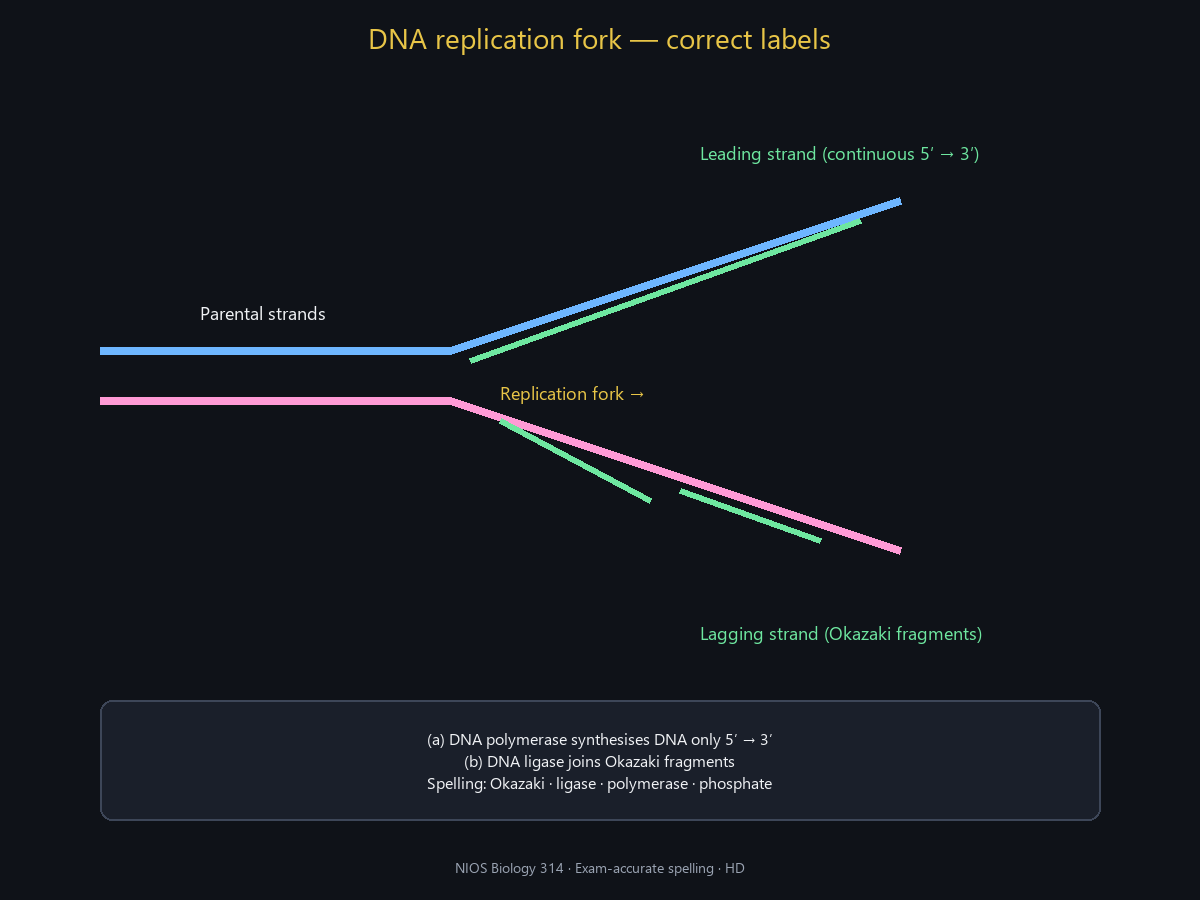
Why it clicks: Always 5′→3′; lagging strand needs ligase glue.
Q5. (I) Observe the Lac operon diagram given below and answer the questions that follows. (a) Which substance acts as inducer in this operon? (b) Where does RNA polymerase bind to initiate transcription? (c) What are the genes z, y, a called as?
This question needs a diagram — open the answer to view the HD model figure.
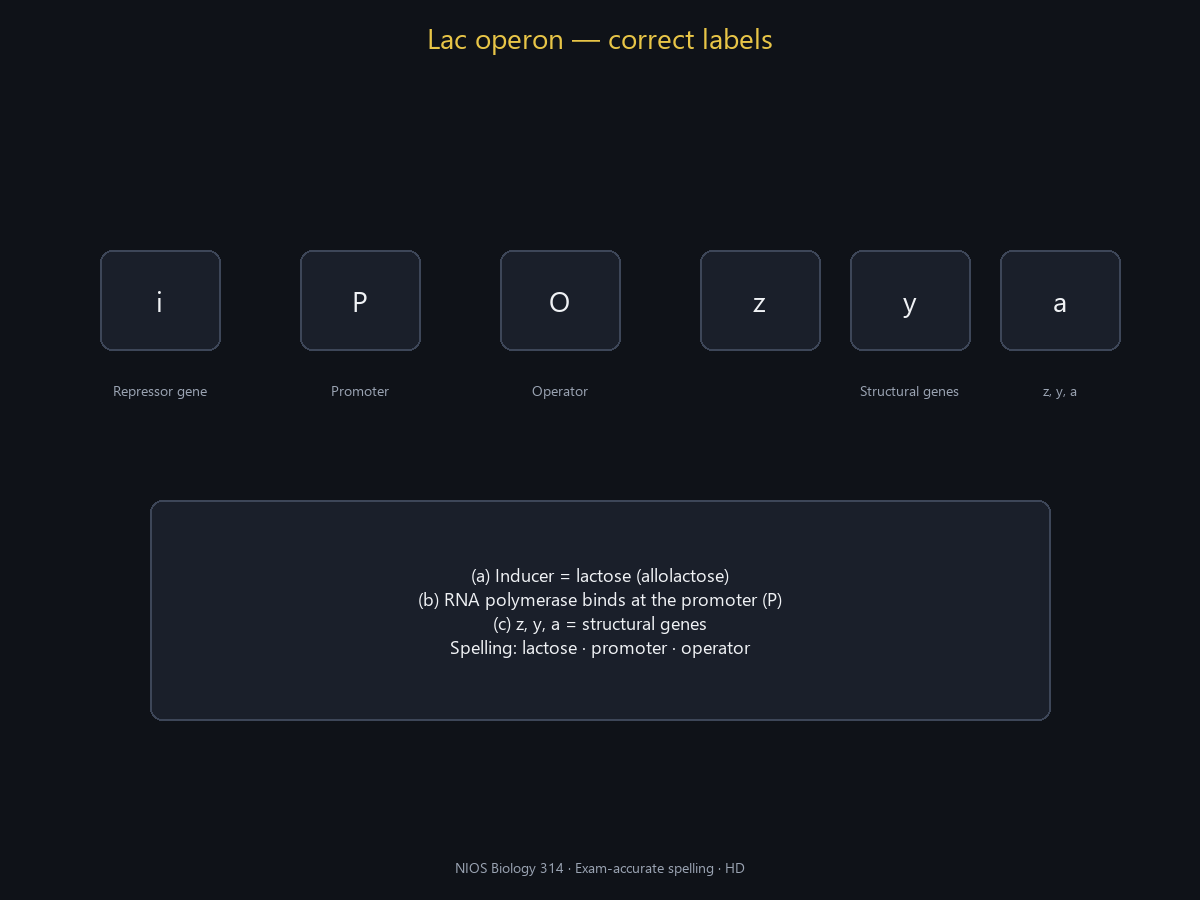
Why it clicks: Lac operon: lactose turns on structural genes via operator control.
Q6. (a) Correct the diagram of Central dogma given below DNA Transcription RNA Replication Protein (ii)Where in a eukaryotic cell, Transcription, Replication and translation occur?
This question needs a diagram — open the answer to view the HD model figure.
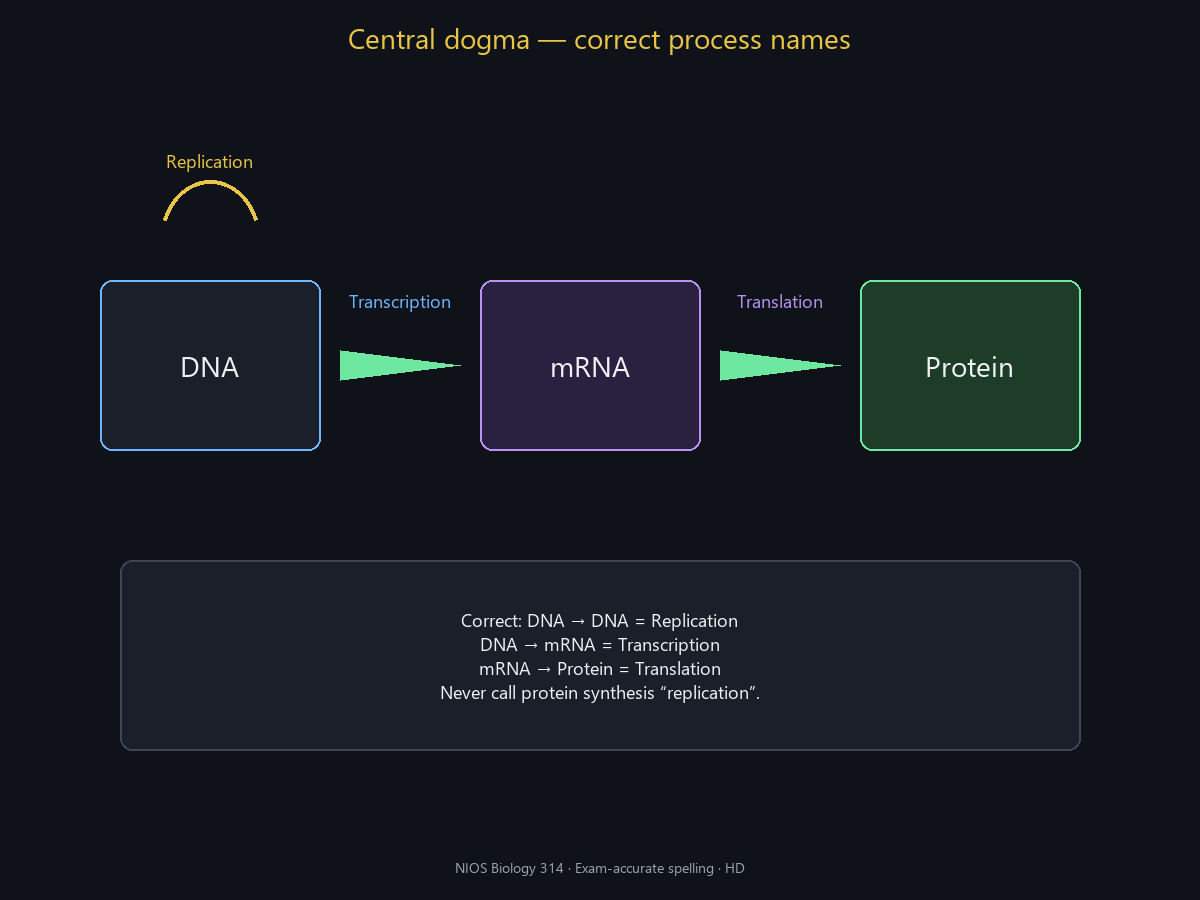
Why it clicks: Do not write RNA → protein as replication.
Q7. Desire for male offspring a) DNA Transcription mRNA Translation Protein Transcription and replication inside the nucleus, translation in the ribosome in the cytoplasm
Why it clicks: Use the corrected dogma lines as the answer.
Problem Solving — L23 Molecular Inheritance and Gene Expression
Six problems spanning this chapter’s NIOS Biology (314) syllabus. Every question is built from the notes and formula sheet: solve with definitions and equations first, then read the formal textbook-style write-up, the easy explanation, and the topic in depth (key relations, meaning, exam tips). If the question says draw, a labelled pencil sketch is provided. Explanations open by default.
State Chargaff’s base-pairing rules and name the backbone of DNA. Sketch a simple double helix idea.
Pencil sketch (labelled)
Solution — step by step
- A pairs with T; G pairs with C (hydrogen bonds).
- Backbone: sugar–phosphate.
- Sketch two twisted strands with cross rungs.
Final answer: A–T, G–C; sugar–phosphate backbone
Key relations / definitions
Textbook formal language
Watson–Crick model explains replication and information storage.
Key relations: Double helix; A–T, G–C; Antiparallel strands; sugar–phosphate backbone. State the definition or law first (NIOS style), use correct biological terms, and end with a clear boxed conclusion.
Easy language (same idea, plain words)
Letters pair A with T, G with C; sides are sugar-phosphate rails.
Read the question once for the idea, once for the details. Write the definition or equation, then apply it. Check labels and units if any numbers appear.
Topic in depth — DNA structure
Base pairs hold the two strands with hydrogen bonds.
Linked to chapter notes (L23). Remember: Double helix; A–T, G–C; Antiparallel strands; sugar–phosphate backbone. Most exam errors mix up similar terms, reverse cause and effect, or skip labelled diagrams.
Exam tip
Open with a one-line definition, then use: Double helix; A–T, G–C; Antiparallel strands; sugar–phosphate backbone. For diagram questions, label every part asked and keep lines neat.
Common mistakes
- Confusing prokaryote with eukaryote (or plant with animal tissues).
- Mixing up similar pathways (e.g. photosynthesis vs respiration; mitosis vs meiosis).
- Writing vague answers without key technical terms from NIOS notes.
- Forgetting to label diagrams or state units where numbers are used.
What does semi-conservative replication mean?
Solution — step by step
- Each daughter duplex keeps one parental strand and one newly synthesised strand.
Final answer: One old strand + one new strand per daughter DNA
Key relations / definitions
Textbook formal language
Meselson–Stahl experiment supported semi-conservative mode.
Key relations: Each new DNA: one old + one new strand. State the definition or law first (NIOS style), use correct biological terms, and end with a clear boxed conclusion.
Easy language (same idea, plain words)
DNA copies by unzipping; each half builds a new partner—so each child DNA is half-original.
Read the question once for the idea, once for the details. Write the definition or equation, then apply it. Check labels and units if any numbers appear.
Topic in depth — Semi-conservative replication
Not conservative (whole old kept intact as one molecule only).
Linked to chapter notes (L23). Remember: Each new DNA: one old + one new strand. Most exam errors mix up similar terms, reverse cause and effect, or skip labelled diagrams.
Exam tip
Open with a one-line definition, then use: Each new DNA: one old + one new strand. For diagram questions, label every part asked and keep lines neat.
Common mistakes
- Confusing prokaryote with eukaryote (or plant with animal tissues).
- Mixing up similar pathways (e.g. photosynthesis vs respiration; mitosis vs meiosis).
- Writing vague answers without key technical terms from NIOS notes.
- Forgetting to label diagrams or state units where numbers are used.
State the central dogma of molecular biology (classic form).
Pencil sketch (labelled)
Solution — step by step
- Genetic information flows DNA → RNA (transcription) → protein (translation).
Final answer: DNA → RNA → protein
Key relations / definitions
Textbook formal language
Exceptions exist (reverse transcriptase) but NIOS expects classic dogma.
Key relations: DNA → RNA → protein (central dogma). State the definition or law first (NIOS style), use correct biological terms, and end with a clear boxed conclusion.
Easy language (same idea, plain words)
DNA recipe is copied to RNA, then used to build protein.
Read the question once for the idea, once for the details. Write the definition or equation, then apply it. Check labels and units if any numbers appear.
Topic in depth — Gene expression flow
Replication is DNA→DNA, not part of dogma path to protein.
Linked to chapter notes (L23). Remember: DNA → RNA → protein (central dogma). Most exam errors mix up similar terms, reverse cause and effect, or skip labelled diagrams.
Exam tip
Open with a one-line definition, then use: DNA → RNA → protein (central dogma). For diagram questions, label every part asked and keep lines neat.
Common mistakes
- Confusing prokaryote with eukaryote (or plant with animal tissues).
- Mixing up similar pathways (e.g. photosynthesis vs respiration; mitosis vs meiosis).
- Writing vague answers without key technical terms from NIOS notes.
- Forgetting to label diagrams or state units where numbers are used.
Where does transcription occur in a eukaryotic cell? What enzyme synthesises mRNA?
Solution — step by step
- Nucleus.
- RNA polymerase.
Final answer: Nucleus; RNA polymerase
Key relations / definitions
Textbook formal language
Transcription produces complementary RNA from DNA template.
Key relations: Template strand read 3'→5'; mRNA 5'→3'; nucleus in eukaryotes. State the definition or law first (NIOS style), use correct biological terms, and end with a clear boxed conclusion.
Easy language (same idea, plain words)
In nucleus, RNA polymerase writes RNA from DNA.
Read the question once for the idea, once for the details. Write the definition or equation, then apply it. Check labels and units if any numbers appear.
Topic in depth — mRNA synthesis
Translation is on ribosomes in cytoplasm.
Linked to chapter notes (L23). Remember: Template strand read 3'→5'; mRNA 5'→3'; nucleus in eukaryotes. Most exam errors mix up similar terms, reverse cause and effect, or skip labelled diagrams.
Exam tip
Open with a one-line definition, then use: Template strand read 3'→5'; mRNA 5'→3'; nucleus in eukaryotes. For diagram questions, label every part asked and keep lines neat.
Common mistakes
- Confusing prokaryote with eukaryote (or plant with animal tissues).
- Mixing up similar pathways (e.g. photosynthesis vs respiration; mitosis vs meiosis).
- Writing vague answers without key technical terms from NIOS notes.
- Forgetting to label diagrams or state units where numbers are used.
What is a codon? Name the usual start codon.
Solution — step by step
- Triplet of mRNA bases coding for an amino acid (or stop).
- Start: AUG (methionine in eukaryotes).
Final answer: 3-base mRNA word; start AUG
Key relations / definitions
Textbook formal language
Genetic code is nearly universal, degenerate and commaless.
Key relations: Codon = 3 bases; Start AUG; stop UAA/UAG/UGA; tRNA brings amino acids. State the definition or law first (NIOS style), use correct biological terms, and end with a clear boxed conclusion.
Easy language (same idea, plain words)
Codon is a three-letter word; AUG says “start”.
Read the question once for the idea, once for the details. Write the definition or equation, then apply it. Check labels and units if any numbers appear.
Topic in depth — Genetic code basics
tRNA anticodon matches codon; ribosome is the factory.
Linked to chapter notes (L23). Remember: Codon = 3 bases; Start AUG; stop UAA/UAG/UGA; tRNA brings amino acids. Most exam errors mix up similar terms, reverse cause and effect, or skip labelled diagrams.
Exam tip
Open with a one-line definition, then use: Codon = 3 bases; Start AUG; stop UAA/UAG/UGA; tRNA brings amino acids. For diagram questions, label every part asked and keep lines neat.
Common mistakes
- Confusing prokaryote with eukaryote (or plant with animal tissues).
- Mixing up similar pathways (e.g. photosynthesis vs respiration; mitosis vs meiosis).
- Writing vague answers without key technical terms from NIOS notes.
- Forgetting to label diagrams or state units where numbers are used.
Define a gene in modern molecular terms suitable for NIOS.
Solution — step by step
- A segment of DNA that codes for a functional product (polypeptide or RNA).
Final answer: DNA segment coding functional product
Key relations / definitions
Textbook formal language
One-gene–one-enzyme idea refined to one-gene–one-polypeptide/products.
Key relations: Gene: DNA segment coding functional product (RNA/protein). State the definition or law first (NIOS style), use correct biological terms, and end with a clear boxed conclusion.
Easy language (same idea, plain words)
A gene is a DNA instruction for a useful molecule.
Read the question once for the idea, once for the details. Write the definition or equation, then apply it. Check labels and units if any numbers appear.
Topic in depth — Gene definition
Not all DNA is genes—much is non-coding.
Linked to chapter notes (L23). Remember: Gene: DNA segment coding functional product (RNA/protein). Most exam errors mix up similar terms, reverse cause and effect, or skip labelled diagrams.
Exam tip
Open with a one-line definition, then use: Gene: DNA segment coding functional product (RNA/protein). For diagram questions, label every part asked and keep lines neat.
Common mistakes
- Confusing prokaryote with eukaryote (or plant with animal tissues).
- Mixing up similar pathways (e.g. photosynthesis vs respiration; mitosis vs meiosis).
- Writing vague answers without key technical terms from NIOS notes.
- Forgetting to label diagrams or state units where numbers are used.