OneNIOS Study Hub
Biology — Class 12 — L7: Shoot System
Lesson-07.pdf). Content covers sections 7.1–7.5.Overview — The aerial plant body
The shoot system is the aerial, erect part of the plant body that grows upwards. It is usually above the soil and develops from the plumule of the embryo. It includes stem, branches, leaves, flowers, fruits and seeds. This NIOS Biology lesson (Module 2) covers morphology, modifications, anatomy and secondary growth of stem; leaf structure, phyllotaxy, modifications and internal anatomy; flower structure, placentation and inflorescence; and fruit types with edible parts.
After this lesson you should be able to list stem characters and contrast them with roots; describe shoot apex and exogenous branches; explain stem types, modifications and functions; compare dicot and monocot stem TS and secondary growth; define wood and annual rings; describe leaf morphology, venation, phyllotaxy and modifications; compare dicot and monocot leaf anatomy; define flower, placentation and major inflorescence types; and classify fruits with examples. Notes follow textbook order only.
Lesson 6 (root) and Lesson 7 (shoot) are paired: radicle vs plumule, endogenous laterals vs exogenous branches, exarch vs endarch xylem, radial vs conjoint bundles. Keep those contrasts ready for table questions.
Section 1: Stem — characters and stem vs root (7.1.1–7.1.2)
Stem characteristics: (i) prolongation of plumule; (ii) positively phototropic and negatively geotropic; (iii) divided into nodes (leaf attachment) and internodes; (iv) bears leaves, branches and flowers on nodes; (v) vegetative buds — terminal (apical) for upward growth, axillary for lateral branches; (vi) floral buds (terminal or axillary) → flowers.
Morphological stem vs root (Table 7.1): plumule vs radicle; young stem green vs non-green root; nodes/internodes present vs absent; leaves and buds present vs absent; no apical cap vs root cap; +photo/−geo vs −photo/+geo; lateral branches exogenous (outer layers) vs lateral roots endogenous (pericycle). That is why lateral roots are hard to break off but stem branches break more easily at the surface.
Section 2: Shoot apex and lateral branches (7.1.3–7.1.4)
Shoot apex is terminal, dome-shaped, with apical shoot meristem for primary permanent tissues and growth in length. Two zones (tunica–corpus theory):
- Tunica — outer 1–3 layers; cells divide only anticlinally; surface growth; gives rise to epidermis.
- Corpus — inner multilayered mass; cells divide in all planes; gives procambium (vascular tissue), ground meristem (ground tissue) and leaf primordia.
Lateral branches arise from axillary buds in the leaf axil. Each bud is a compact underdeveloped shoot with overlapping leaf primordia; internodes elongate into a branch. Development is exogenous (from outer layers).
Section 3: Types and modifications of stem (7.1.5–7.1.6)
Stems may be aerial (erect herbs, shrubs, trees), subaerial (weak creepers/climbers), or underground (buried; aerial shoots only in favourable season).
3.1 Underground modified stems
Look like roots but are stems because they have nodes and internodes, scaly non-green leaves, and buds. Functions: perennation (dormant over bad season) and food storage.
- Rhizome — thick fleshy horizontal stem near soil surface; scale leaves, buds, adventitious roots — ginger, turmeric.
- Corm — fleshy spherical stem with flattened base, grows vertically; nodes/internodes, buds — saffron, yam, gladiolus.
- Bulb — reduced discoid stem with crowded fleshy and dry scale leaves; terminal bud forms foliage; onion.
- Tuber — swollen tips of underground lateral stem branches store starch; “eyes” are nodes with buds and scale scars — potato.
Haldi = rhizome; onion = bulb — classic matching pair.
3.2 Subaerial modifications (creepers; vegetative propagation)
- Runner — long weak slender branch, long internodes, horizontal on surface, adventitious roots at nodes — grass, Oxalis.
- Stolon — grows up then arches down to soil, roots, daughter plant — mint, jasmine.
- Offset — thicker shorter runner; short distance then rosette of leaves + roots below; aquatics — water hyacinth, water lettuce.
- Sucker — underground runner that later emerges obliquely — chrysanthemum.
3.3 Aerial modifications
- Stem tendrils — coiled leafless threads for climbing — grape vine.
- Thorns — hard pointed axillary (Citrus) or terminal (Carissa) buds; defence/climbing.
- Phylloclade — green flattened/cylindrical fleshy stem with nodes; spines = modified leaves; photosynthesis + water storage — Opuntia.
- Cladode — phylloclade of limited growth (1–2 internodes) — Asparagus.
Section 4: Functions of stem (7.1.7)
Primary: support and orient leaves to light; conduct water/minerals (xylem) and food (phloem); bear flowers and fruits. Secondary: storage (potato); perennation (ginger); vegetative propagation (rose, sugarcane cuttings); photosynthesis (Opuntia); protection (thorns); climbing (tendrils).
Matching drills worth one mark each: tendril → climbing; sucker → vegetative reproduction; thorns → protection; bulb → perennation/storage; phylloclade → photosynthesis. Opuntia → photosynthesis; Duranta → protection; ginger → perennation; potato → food storage; stem (general) → conduction. Sugarcane multiplies by stem cuttings — a direct vegetative-propagation example from the book.
Section 5: Primary anatomy of stem (7.1.8)
5.1 Dicot stem (e.g. sunflower)
- Epidermis — single layer, cuticle, multicellular hairs; protective.
- Cortex — hypodermis of collenchyma (support); middle parenchyma; endodermis (starch sheath) with barrel cells.
- Stele — multilayered pericycle (parenchyma + sclerenchyma patches); vascular bundles in a ring; each VB conjoint (xylem+phloem together), collateral (same radius, phloem outer), open (cambium between); xylem endarch (protoxylem center, metaxylem periphery); medullary rays between bundles; central pith parenchyma.
5.2 Monocot stem (e.g. maize)
- Epidermis with cuticle; stem hairs absent; few outer sclerenchyma layers = hypodermis.
- Ground tissue largely undifferentiated parenchyma.
- Numerous scattered vascular bundles, each with sclerenchymatous bundle sheath; collateral closed (no cambium); endarch xylem in Y-shape; innermost protoxylem may form water cavity.
| Feature | Dicot stem | Monocot stem |
|---|---|---|
| Hypodermis | Collenchyma | Sclerenchyma |
| Ground tissue | Differentiated | Undifferentiated |
| VB arrangement | Ring | Scattered |
| VB type | Open | Closed |
| Secondary growth | Present | Mostly absent |
Stem vs root anatomy (Table 7.6): cuticle present/absent; multicellular vs unicellular hairs; conjoint collateral vs radial bundles; endarch vs exarch xylem. Conjoint = xylem and phloem in one bundle; collateral = on same radius. Study material: sunflower for dicot stem, maize for monocot stem. Medullary rays are the parenchymatous regions between two vascular bundles in a dicot stem — they later source interfascicular cambium. Radially arranged bundles with exarch xylem occur in the root, not the stem — a trap if you mix Lesson 6 and 7 tables.
Extra monocot stem detail: bundles near the periphery are often smaller; central ones larger; each is wrapped in a sclerenchymatous sheath. Dicot stem has epidermal hairs; monocot stem typically lacks them. Secondary growth present in dicot stem and mostly absent in monocot stem — that single line explains why tree trunks thicken for decades while cereal stems stay slender.
Section 6: Secondary growth and wood (7.1.9–7.1.10)
Secondary growth (girth) occurs in dicot stem away from the apex via two lateral meristems. Tall trees stand wind and rain because of secondary tissues; grasses and rice stay thin and weak without it.
Vascular cambium: fascicular cambium (strip in each open VB) + interfascicular cambium (from medullary ray cells) join into a continuous cambium ring. Division adds secondary xylem toward pith (more) and secondary phloem toward periphery (less).
Cork cambium (phellogen) develops in cortex; outer cells → cork (phellem, suberized, dead); inner → secondary cortex (phelloderm). Periderm = phellem + phellogen + phelloderm (protective; replaces epidermis). Lenticels — loose non-suberized complementary cells for gaseous exchange in woody stems. Bark = all dead tissues outside active phellogen. Commercial cork from Quercus suber; Betula bark peels like paper.
Wood = secondary xylem from vascular cambium. In temperate climates, spring (early) wood = wide vessels, active cambium; summer (late) wood = narrow vessels; together one annual ring. Counting rings = dendrochronology (age of tree). When cambium is less active it produces late/summer wood — a frequent one-line answer. Sapwood — outer light functional wood with living cells, open vessels conducting water and minerals. Heartwood — central dark non-functional wood with gums, resins, oils, tannins; vessels plugged with tyloses; heavier, more durable, pathogen-resistant, commercially more valuable. Tall trees stand erect in strong wind because of abundant mechanical tissue: sclerenchyma in hypodermis and pericycle, lignified vessels, tracheids and fibres in secondary xylem, and sclereids in pith.
Bark definition (intext): all tissues outside the functional cork cambium. Lenticels remain non-suberized so woody trunks can exchange gases. Periderm layers: phellem, phellogen, phelloderm — protection after epidermis is replaced.
Section 7: Leaf — morphology (7.2.1–7.2.5)
Leaf = flattened lateral appendage from stem/branch node; from leaf primordium; axillary bud in axil. Parts: leaf base (sheath in monocots; stipules in many dicots); petiole (petiolate vs sessile); lamina with midrib, veins and veinlets (support + conduction).
Venation: arrangement of veins. Reticulate network — dicots (peepal); parallel — monocots (palm, canna). Each may be unicostate (one midrib, pinnate) or multicostate (many strong veins from a point, palmate).
Simple vs compound: simple = single undivided lamina (or incisions not to midrib); compound = lamina cut into leaflets; bud in axil of whole leaf but not in axil of leaflets. Pinnate = leaflets on rachis; palmate = leaflets from petiole end (bi/tri/quadri/multifoliate). Pinnate may be uni/bi/tripinnate or decompound.
Phyllotaxy (leaf arrangement for light): alternate (one leaf/node — mango, China rose); opposite decussate (pairs at right angles — tulsi, Calotropis); opposite superposed (same plane — guava); whorled (more than two leaves/node — Nerium).
Leaf modifications: tendril (pea, glory lily — climb); spines (Argemone, Opuntia, Aloe — protection, less transpiration); phyllode (flattened petiole — Australian acacia — photosynthesis); insectivorous pitcher (Nepenthes) or bladder (Utricularia). Heterophylly = more than one leaf type on same plant (water chestnut, Limnophila).
Section 8: Leaf functions and internal structure (7.2.6)
Functions: photosynthesis; gas exchange via stomata; transpiration (vapour; cools, helps ascent of sap); guttation (liquid with salts from margins in humid climates); special roles via modifications.
Dicot leaves usually dorsiventral; monocot often isobilateral. VS shows epidermis, mesophyll, vascular system.
- Epidermis both sides; stomata (guard cells) for gas exchange and transpiration. Monocot upper epidermis may have bulliform cells that lose water so leaf rolls and cuts transpiration on hot days (maize, bajra, jowar).
- Mesophyll — chlorenchyma for photosynthesis. Dicot: palisade (compact, many chloroplasts under upper epidermis) + spongy (loose, fewer chloroplasts, gas spaces). Monocot: only spongy-type mesophyll (no palisade).
- Vascular bundles — conjoint, collateral, closed; xylem upper (ventral), phloem lower (dorsal); often with bundle sheath.
Stomata: dicot reniform/semicircular guard cells, often more on lower surface; monocot dumbbell-shaped, both surfaces. Xerophytes: fewer/sunken/lower only. Floating hydrophytes: upper only; submerged: stomata absent. Hydathodes (water stomata) at vein ends near margins — always open; guttation (liquid); humid climates. Stomata smaller, open/close with light, vapour loss = transpiration.
| Dicot leaf | Monocot leaf | |
|---|---|---|
| Mesophyll | Palisade + spongy | Only spongy type |
| Stomata | Mostly lower | Both surfaces |
| Bulliform | Absent | Present (upper) |
Section 9: Flower (7.3)
Flowers are seats of sexual reproduction; produce fruits and seeds. A flower is a modified shoot: nodes very close; floral leaves in successive whorls on swollen tip of pedicel = thalamus/receptacle.
Accessory whorls: calyx (sepals — protection); corolla (petals — attract pollinators). Reproductive: androecium (stamens = filament + bilobed anther + connective; pollen); gynoecium (carpels → pistil: ovary with ovules, style, stigma).
Variations: complete (all 4 whorls) vs incomplete; bisexual vs unisexual (staminate/pistillate); monoecious (both sexes same plant — cucumber) vs dioecious (papaya); neuter (no sex organs); actinomorphic (radial — mustard), zygomorphic (bilateral — pea), asymmetrical (Canna). Sepals/petals free (poly) or fused (gamo); perianth when not distinguishable (onion). Stamen cohesion: monadelphous (China rose), diadelphous (pea), polyadelphous (lemon), syngenecious (sunflower), synandrous; epipetalous; didynamous; tetradynamous (mustard). Carpels: monocarpellary vs polycarpellary; syncarpous vs apocarpous.
Ovary position: hypogynous — ovary superior, other whorls below (China rose, mustard); perigynous — half-inferior, whorls on rim (peach, plum); epigynous — ovary inferior, whorls above (sunflower, cucumber).
9.1 Placentation (7.3.2)
Manner of distribution of placentae (ovule attachment) in ovary:
- Marginal — one chamber, monocarpellary, ovules on fused margins — pea, gram.
- Axile — many chambers, ovules on central axis — China rose, tomato, bhindi.
- Parietal — one chamber, ovules on walls where carpels meet — mustard, cucumber.
- Basal — single ovule at base — sunflower.
- Free central — unilocular, central placenta, many ovules — Dianthus, Primula.
- Superficial — multilocular, ovules all over inner walls — water lily.
Section 10: Inflorescence (7.4)
Inflorescence = arrangement of flowers on floral axis (peduncle); terminal or axillary.
Racemose: main axis unlimited growth, does not end in a flower; flowers acropetal (oldest below). Types: raceme (mustard — stalked); spike (Achyranthes — sessile); spikelet (wheat); catkin (mulberry — pendulous unisexual); spadix (banana — fleshy axis + spathe); corymb (equal height by unequal stalks); umbel (equal stalks from one point — coriander); head/capitulum (sunflower — flat receptacle, sessile florets, involucre).
Cymose: main axis ends in a flower; limited growth; basipetal (terminal flower older). Monochasial, dichasial, multichasial types.
Special: hypanthodium (fig, peepal — cup with apical opening, flowers inside); cyathium (Euphorbia — cup involucre, one female + many male); verticillaster (tulsi, Salvia — condensed dichasial clusters at nodes).
Section 11: Fruit (7.5)
True fruit = ripened ovary after fertilisation; ovules → seeds; ovary wall → pericarp. Fleshy fruits: epicarp (skin), mesocarp (pulp), endocarp (hard/stony or membranous). Dry fruits: thin papery or woody pericarp, not three-layered. False fruit — other parts (thalamus, receptacle, calyx) join ovary — apple, pear (thalamus), fig (receptacle). Parthenocarpic fruit develops without fertilisation; seedless or non-viable seeds — banana, some grapes.
Three basic kinds: simple (one syncarpous ovary — pea, tomato); aggregate (etaerio of free carpels — raspberry, strawberry); composite/multiple from whole inflorescence — sorosis (pineapple, mulberry), syconus (fig).
Simple dry: dehiscent (legume, siliqua, follicle, capsule) vs indehiscent (caryopsis wheat/rice, nut, cypsella sunflower, samara). Simple fleshy: drupe (mango, coconut), berry (tomato, banana), pepo (cucumber), hesperidium (orange), pome (apple — often false).
Edible parts to memorise: mango — mesocarp; apple/pear — fleshy thalamus; coconut — endosperm; orange — juicy hairs from endocarp; banana — meso+endocarp; tomato — pericarp + placentae; pineapple — outer receptacle + bracts + perianth; fig — fleshy receptacle; wheat — starchy endosperm; cashew — peduncle + cotyledons; date — pericarp; strawberry — succulent thalamus; litchi — juicy aril; custard apple — pericarp of etaerio of berries.
Fruit classification snapshot: legume (pea, bean, groundnut); siliqua (mustard); follicle (Calotropis); capsule (cotton, poppy, bhindi); caryopsis (wheat, rice); nut (almond, cashew); cypsella (sunflower); drupe (mango, coconut); berry (tomato, banana); pepo (cucumber, watermelon); hesperidium (lemon, orange); pome (apple, pear). Aggregate etaerio types: drupes (raspberry), achenes (strawberry, rose), berries (custard apple), follicles (periwinkle). Composite: sorosis (pineapple, mulberry, jackfruit); syconus (fig, peepal).
Section 12: Exam map and closed-book checklist
Stem vs root table + exogenous vs endogenous. Shoot apex: tunica anticlinal; corpus all planes; branch from axillary bud. Mods: potato tuber eyes = nodes; rhizome/corm/bulb; runner/stolon/offset/sucker; tendril/thorn/phylloclade/cladode. Anatomy: dicot ring open endarch; monocot scattered closed Y-xylem; stem endarch / root exarch. Secondary growth: fascicular + interfascicular; wood = 2° xylem; annual rings; sap vs heart wood; periderm and bark; lenticels. Leaf: midrib, venation, simple vs compound (axillary bud test), phyllotaxy, mods, dicot vs monocot TS, bulliform, hydathode vs stoma. Flower: four whorls, ovary position, placentation (especially axile/marginal/parietal), stamen fusion names. Inflorescence: racemose vs cymose; capitulum and hypanthodium. Fruit: true/false/parthenocarpic; edible parts list.
Terminal-style: differentiate dicot/monocot stem and leaf; root vs stem; racemose vs cymose; stoma vs hydathode; true vs false fruit; underground stem mods; secondary growth outline; define flower, phyllotaxy, venation, hypogynous, parthenocarpic; edible parts of mango, orange, apple, banana, coconut, cashew; scattered closed Y-bundles = monocot stem; less active cambium → late/summer wood; region outside phellogen → bark.
Use the Formula Sheet tab for lockable summaries; drill the ten MCQs and twenty flashcards until tables come without the book. This chapter is large — prioritise comparison tables and named examples over memorising every figure detail.
Section 13: One-line answers (intext key)
Part bearing nodes, leaves, flowers → stem. Lateral branch from → axillary bud. Hard to break laterals of root because → endogenous (pericycle). Stem growth pattern → +phototropic, −geotropic. Cells dividing in all planes at apex → corpus. Vascular tissue from → procambium. Lateral branch origin type → exogenous. Structure covering root apex but absent in stem → root cap. Weak trailing stems → creepers. Runner/stolon/offset/sucker category → subaerial. Phylloclade with 1–2 internodes → cladode. Haldi and onion → rhizome and bulb. Primary stem function example → conduction / support / bear flowers. Mesophyll difference dicot vs monocot → palisade+spongy vs only spongy type; function photosynthesis. Stomata on grass leaf → both surfaces. Liquid water loss structures → hydathodes. Collection of sepals / petals → calyx / corolla. Placentation with many chambers and central ovules → axile. Cymose definition → axis ends in flower, growth limited. Raceme vs spike → stalked vs sessile flowers. Inflorescence definition → arrangement of flowers on floral axis. Sunflower / fig → capitulum / hypanthodium. Fruit definition → ripened ovary after fertilisation. False fruits → apple, pear. Fruit wall → pericarp. Three pericarp layers → epicarp, mesocarp, endocarp.
Connect forward: reproduction lessons use flower and fruit vocabulary from here; physiology of photosynthesis and translocation assumes leaf and stem anatomy. Review Lesson 6 root tables beside Lesson 7 stem tables in one sitting so “radial/exarch/endogenous” never confuses with “conjoint/endarch/exogenous.”
MCQ Quiz — L7 Shoot System
Flashcards — L7
Golden Rules — L7 Shoot System
Most exam-important points from this chapter:
Stem identity & mods
Nodes, internodes, buds, leaves. Underground organs with eyes/scales are stems (potato, ginger, onion). Exogenous branches from axillary buds; roots are endogenous.
Anatomy contrasts
Stem: conjoint collateral, endarch. Root: radial, exarch. Dicot stem: ring open + secondary growth. Monocot stem: scattered closed, no typical secondary growth.
Secondary growth & wood
Cambium ring → more 2° xylem than phloem. Wood = 2° xylem. Annual rings age trees. Sapwood conducts; heartwood durable. Periderm protects; bark is outside active cork cambium.
Leaf essentials
Photosynthesis organ. Reticulate vs parallel; simple vs compound (bud test). Dicot: palisade+spongy. Monocot: bulliform, stomata both sides. Hydathode ≠ stoma.
Flower · inflorescence · fruit
Four whorls on thalamus; ovary hypo/peri/epi. Placentation types (axile, marginal, parietal…). Racemose unlimited; cymose limited. Fruit = ripened ovary; know true/false and edible parts.
Past Year Questions — L7 Shoot System
PE-only questions for this chapter only. 2 item(s). No overlap with other lessons. Tap Show answer after you try each question.
Q1. Observe the diagrams given below and assign the correct name from the li st supplied. (Attempt any two parts from A-D) (Rhizome, Tuber, Corm, Bulb) 10 ]
This question needs a diagram — open the answer to view the HD model figure.
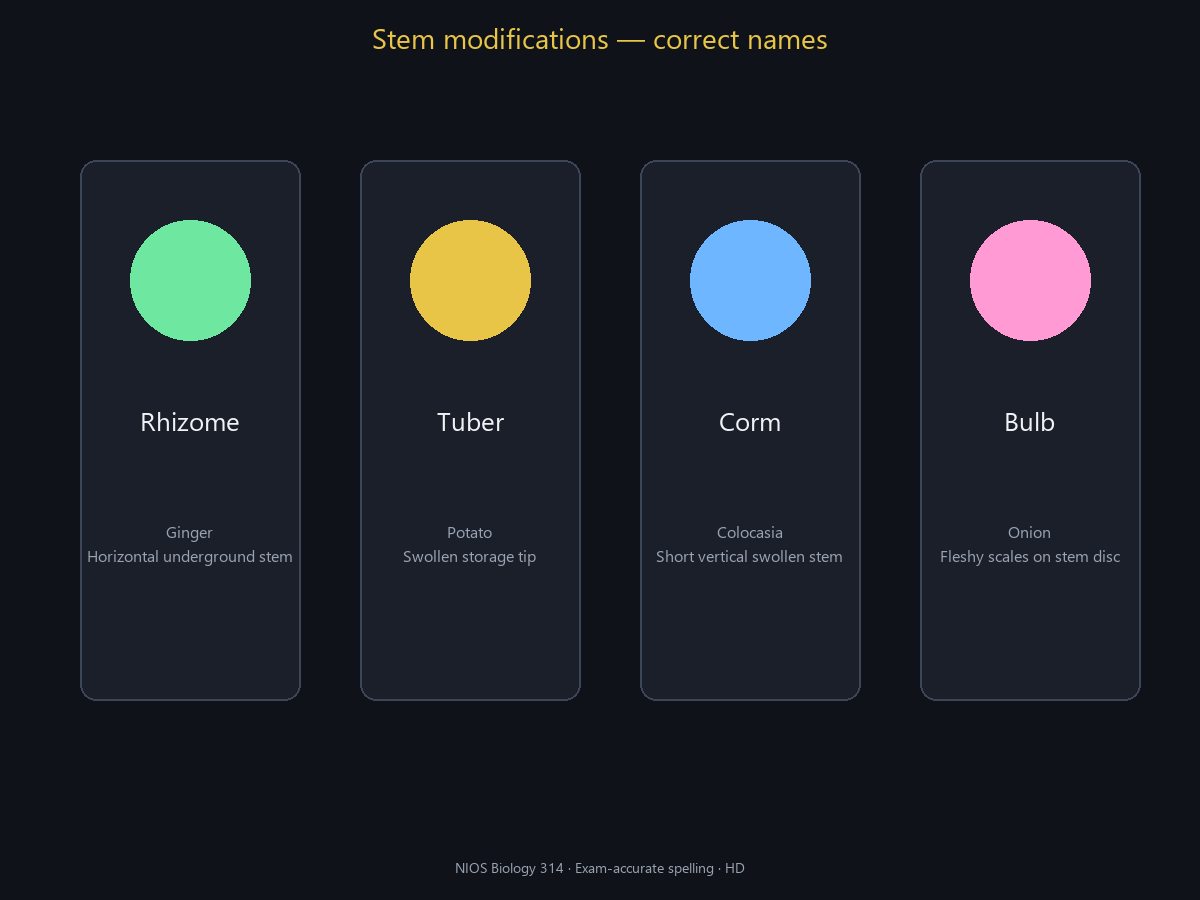
Why it clicks: All four are stem modifications for storage/perennation—not roots.
Q2. The leaf of a plant is an example of A. a particular type of tissue B. an organ C. can organ system D. cell level of organization
Why it clicks: Leaf = organ (several tissues: epidermis, mesophyll, vascular). Not a single tissue or whole organ system.
Problem Solving — L7 Shoot System
Six problems spanning this chapter’s NIOS Biology (314) syllabus. Every question is built from the notes and formula sheet: solve with definitions and equations first, then read the formal textbook-style write-up, the easy explanation, and the topic in depth (key relations, meaning, exam tips). If the question says draw, a labelled pencil sketch is provided. Explanations open by default.
State three functions of the stem.
Solution — step by step
- Supports leaves, flowers and fruits in light/air.
- Conducts water (xylem) and food (phloem).
- May store food or propagate vegetatively (e.g. potato tuber).
Final answer: Support, conduction, storage/propagation
Key relations / definitions
Textbook formal language
Shoot system = stem + leaves + buds + flowers/fruits.
Key relations: Support leaves/flowers; conduction; storage; vegetative propagation. State the definition or law first (NIOS style), use correct biological terms, and end with a clear boxed conclusion.
Easy language (same idea, plain words)
Stem is the scaffold and pipe network of the shoot.
Read the question once for the idea, once for the details. Write the definition or equation, then apply it. Check labels and units if any numbers appear.
Topic in depth — Stem functions
Stem vs root: stem has nodes/internodes and buds.
Linked to chapter notes (L7). Remember: Support leaves/flowers; conduction; storage; vegetative propagation. Most exam errors mix up similar terms, reverse cause and effect, or skip labelled diagrams.
Exam tip
Open with a one-line definition, then use: Support leaves/flowers; conduction; storage; vegetative propagation. For diagram questions, label every part asked and keep lines neat.
Common mistakes
- Confusing prokaryote with eukaryote (or plant with animal tissues).
- Mixing up similar pathways (e.g. photosynthesis vs respiration; mitosis vs meiosis).
- Writing vague answers without key technical terms from NIOS notes.
- Forgetting to label diagrams or state units where numbers are used.
What is apical dominance? How does removing the tip affect branching?
Solution — step by step
- Apical bud suppresses growth of nearby axillary buds (auxin-related).
- Removing tip reduces dominance → more lateral branching.
Final answer: Tip suppresses sides; decapitation → more branches
Key relations / definitions
Textbook formal language
Hormonal control of architecture uses apical dominance.
Key relations: Apical bud: tip growth; Axillary bud: branch/flower. State the definition or law first (NIOS style), use correct biological terms, and end with a clear boxed conclusion.
Easy language (same idea, plain words)
The top bud bosses side buds; cut the top and side buds wake up.
Read the question once for the idea, once for the details. Write the definition or equation, then apply it. Check labels and units if any numbers appear.
Topic in depth — Axillary and apical buds
Gardeners prune tips to make bushier plants.
Linked to chapter notes (L7). Remember: Apical bud: tip growth; Axillary bud: branch/flower. Most exam errors mix up similar terms, reverse cause and effect, or skip labelled diagrams.
Exam tip
Open with a one-line definition, then use: Apical bud: tip growth; Axillary bud: branch/flower. For diagram questions, label every part asked and keep lines neat.
Common mistakes
- Confusing prokaryote with eukaryote (or plant with animal tissues).
- Mixing up similar pathways (e.g. photosynthesis vs respiration; mitosis vs meiosis).
- Writing vague answers without key technical terms from NIOS notes.
- Forgetting to label diagrams or state units where numbers are used.
Name three parts of a typical leaf. How does venation differ in dicot and monocot leaves?
Pencil sketch (labelled)
Solution — step by step
- Leaf base, petiole, lamina (blade).
- Dicot: usually reticulate venation; monocot: parallel venation.
Final answer: Base–petiole–lamina; dicot net, monocot parallel
Key relations / definitions
Textbook formal language
Leaf is the main photosynthetic organ; venation is a taxonomic clue.
Key relations: Lamina, petiole, leaf base; venation reticulate vs parallel. State the definition or law first (NIOS style), use correct biological terms, and end with a clear boxed conclusion.
Easy language (same idea, plain words)
Blade + stalk + base; net veins in dicots, parallel in grasses.
Read the question once for the idea, once for the details. Write the definition or equation, then apply it. Check labels and units if any numbers appear.
Topic in depth — Leaf parts
Some monocots show exceptions—exam uses general rule.
Linked to chapter notes (L7). Remember: Lamina, petiole, leaf base; venation reticulate vs parallel. Most exam errors mix up similar terms, reverse cause and effect, or skip labelled diagrams.
Exam tip
Open with a one-line definition, then use: Lamina, petiole, leaf base; venation reticulate vs parallel. For diagram questions, label every part asked and keep lines neat.
Common mistakes
- Confusing prokaryote with eukaryote (or plant with animal tissues).
- Mixing up similar pathways (e.g. photosynthesis vs respiration; mitosis vs meiosis).
- Writing vague answers without key technical terms from NIOS notes.
- Forgetting to label diagrams or state units where numbers are used.
Identify: underground stem swollen with buds (eyes) used as food. Is it root or stem? Why?
Solution — step by step
- Potato tuber — stem modification.
- Has nodes/buds (eyes); scale leaves; not a root (roots lack nodes/buds).
Final answer: Potato tuber = stem (nodes/eyes)
Key relations / definitions
Textbook formal language
Morphology of nodes, buds and scale leaves diagnoses stem vs root.
Key relations: Tuber potato; rhizome ginger; bulb onion; cladode/phylloclade drought forms. State the definition or law first (NIOS style), use correct biological terms, and end with a clear boxed conclusion.
Easy language (same idea, plain words)
Potato has “eyes” that sprout—stems have buds; roots don’t.
Read the question once for the idea, once for the details. Write the definition or equation, then apply it. Check labels and units if any numbers appear.
Topic in depth — Stem modifications
Sweet potato is root; potato is stem—memorise this pair.
Linked to chapter notes (L7). Remember: Tuber potato; rhizome ginger; bulb onion; cladode/phylloclade drought forms. Most exam errors mix up similar terms, reverse cause and effect, or skip labelled diagrams.
Exam tip
Open with a one-line definition, then use: Tuber potato; rhizome ginger; bulb onion; cladode/phylloclade drought forms. For diagram questions, label every part asked and keep lines neat.
Common mistakes
- Confusing prokaryote with eukaryote (or plant with animal tissues).
- Mixing up similar pathways (e.g. photosynthesis vs respiration; mitosis vs meiosis).
- Writing vague answers without key technical terms from NIOS notes.
- Forgetting to label diagrams or state units where numbers are used.
Differentiate racemose and cymose inflorescence in one sentence each.
Solution — step by step
- Racemose: growth of main axis continues; flowers acropetal on sides.
- Cymose: main axis terminates in a flower; further growth by laterals.
Final answer: Racemose unlimited axis; cymose terminal flower
Key relations / definitions
Textbook formal language
Inflorescence is the flowering shoot arrangement.
Key relations: Racemose: main axis unlimited, flowers lateral; Cymose: main axis ends in flower. State the definition or law first (NIOS style), use correct biological terms, and end with a clear boxed conclusion.
Easy language (same idea, plain words)
Raceme keeps growing at tip; cyme tip becomes a flower and stops.
Read the question once for the idea, once for the details. Write the definition or equation, then apply it. Check labels and units if any numbers appear.
Topic in depth — Racemose vs cymose
Examples help: mustard raceme; jasmine cymose types.
Linked to chapter notes (L7). Remember: Racemose: main axis unlimited, flowers lateral; Cymose: main axis ends in flower. Most exam errors mix up similar terms, reverse cause and effect, or skip labelled diagrams.
Exam tip
Open with a one-line definition, then use: Racemose: main axis unlimited, flowers lateral; Cymose: main axis ends in flower. For diagram questions, label every part asked and keep lines neat.
Common mistakes
- Confusing prokaryote with eukaryote (or plant with animal tissues).
- Mixing up similar pathways (e.g. photosynthesis vs respiration; mitosis vs meiosis).
- Writing vague answers without key technical terms from NIOS notes.
- Forgetting to label diagrams or state units where numbers are used.
Which meristem adds wood (secondary xylem) in a dicot stem?
Pencil sketch (labelled)
Solution — step by step
- Vascular cambium.
- Forms secondary xylem inward and secondary phloem outward.
Final answer: Vascular cambium
Key relations / definitions
Textbook formal language
Secondary growth increases girth in gymnosperms and many dicots.
Key relations: Vascular cambium → secondary xylem/phloem; Cork cambium → periderm. State the definition or law first (NIOS style), use correct biological terms, and end with a clear boxed conclusion.
Easy language (same idea, plain words)
Cambium ring makes wood inside the stem.
Read the question once for the idea, once for the details. Write the definition or equation, then apply it. Check labels and units if any numbers appear.
Topic in depth — Cambium
Monocots generally lack typical secondary growth.
Linked to chapter notes (L7). Remember: Vascular cambium → secondary xylem/phloem; Cork cambium → periderm. Most exam errors mix up similar terms, reverse cause and effect, or skip labelled diagrams.
Exam tip
Open with a one-line definition, then use: Vascular cambium → secondary xylem/phloem; Cork cambium → periderm. For diagram questions, label every part asked and keep lines neat.
Common mistakes
- Confusing prokaryote with eukaryote (or plant with animal tissues).
- Mixing up similar pathways (e.g. photosynthesis vs respiration; mitosis vs meiosis).
- Writing vague answers without key technical terms from NIOS notes.
- Forgetting to label diagrams or state units where numbers are used.