OneNIOS Study Hub
Biology — Class 12 — L31: Immunobiology: An Introduction
Lesson-31.pdf). Content covers sections 31.1–31.7.Overview — How the body knows “not me”
We all meet infections, yet some people fall ill more often. That difference tracks the immune system: when it works, pathogens are blocked or cleared; when it fails, disease finds a gap. The immune system also watches for mutant cells and clears damaged ones. This NIOS Module 5 lesson defines immunity and immunobiology, self versus non-self, defence roles, lymphoid organs and cells, antigens and antibodies, cellular versus humoral responses, innate versus acquired immunity, and vaccination types including BCG, DPT and MMR.
Section 1: Immunity and Jenner (31.1)
Immunity is the capacity of the body to recognize materials as foreign to itself and to neutralize, eliminate or metabolize them, with or without injury to its own tissues. Immunobiology is the study of organization and functioning of the immune system, which provides immunity (protection against disease).
Edward Jenner (1749–1823) is the father of modern immunobiology. He saw that milkmaids who had cowpox did not get smallpox, and showed that inoculating cowpox crusts protected people against smallpox. The word vaccination comes from Latin vacca (cow). Jenner did not know the virus or the molecular mechanism, but he demonstrated protective immunity.
1.1 Self and non-self
Protection depends on distinguishing self (one’s own tissues) from non-self (outsiders such as viruses, bacteria, fungi, parasites and other foreign molecules). An individual mounts a physiological immune response against substances different from self components. Pathogens attacking the host are classic non-self triggers.
Section 2: Defence mechanisms in the body (31.2)
Four body defence mechanisms: (1) immunity against infections; (2) metabolic defence to detoxify foreign chemicals; (3) haemostasis to stop bleeding and prevent blood loss; (4) resistance to stress mainly via hormones. Immunological defence is the most important against infective agents and also against tumour development.
Three main functions of immunological defence: (1) defence against microorganisms; (2) surveillance — recognition and destruction of mutant cells; (3) homeostasis — removal of damaged or non-functional cells to keep a normal state.
Section 3: Immune system — organs and cells (31.3)
Immunity rests on a network of cells, tissues and soluble factors — the immune system. Participating cells are organized into discrete lymphoid tissues and organs.
3.1 Primary and secondary lymphoid organs
Central (primary) lymphoid organs: thymus and bone marrow — sites where lymphocytes develop and mature. Peripheral (secondary) lymphoid organs: spleen, Peyer’s patches, tonsils, lymph nodes, and mucosa-associated lymphoid tissue (MALT) of respiratory, urogenital and alimentary tracts — sites of immune responses to antigen.
3.2 Cells: lymphocytes and macrophages
All lymphocytes begin from haemopoietic stem cells in bone marrow — undifferentiated cells that divide unlimitedly and give several blood lineages (erythrocytes, thrombocytes, granulocytes, monocytes, lymphocytes). Macrophages arise from monocytes. Humans have on the order of 10¹² lymphocytes in the mature system. Functionally lymphocytes split into B-cells and T-cells, morphologically similar but distinct by surface markers.
3.3 B-cells (B-lymphocytes)
Main functions: initiate antibody-mediated immunity; transform into plasma cells that secrete antibodies. “B” comes from birds’ bursa of Fabricius, the hind-gut organ where antibody-producing cells were first mapped. In mammals, B-cells mature in bone marrow and travel via blood to peripheral lymphoid organs. Lineage begins in foetal liver from about week 8 of gestation; foetal liver dominates until mid-second trimester, then bone marrow produces B-cells lifelong.
Characteristics: membrane immunoglobulin as antigen receptor; activated B-cells become plasma cells producing thousands of antibody molecules per second before dying within about a day; some progeny become memory cells that respond faster if the same antigen returns.
3.4 T-cells (T-lymphocytes)
Immature cells leave bone marrow early in life, mature in the thymus (“T” for thymus), then seed peripheral organs. Production of new T-cells finishes early, but they divide in periphery with identical daughters. Functions: regulate immune responses; mediate cell-mediated immunity (CMI); help B-cells make antibody.
Three functional categories: Helper T-cells (TH) promote B-cell responses and activate other T-cells; Cytotoxic T-cells (TC) kill virus-infected and tumour cells; Suppressor T-cells (TS) limit helper (and sometimes B) activity. T-cells thus have effector and regulatory roles. B and T cells cooperate; surface receptors distinguish subsets.
Section 4: Antigen and antibody (31.4)
An antigen is any foreign molecule that can trigger a specific immune response. Most antigens are proteins or very large polysaccharides. Immunogen stresses the molecule that provokes a response; antigen stresses reaction with the antibody produced. The antibody contact site is the paratope; the antigen contact site is the epitope. Clusters of epitopes form an antigenic determinant.
Requirements to act as antigen: foreign to the host; molecular weight about 10,000 daltons or more; chemical complexity.
An antibody is a protein made in response to an antigen; antibodies are immunoglobulins. Structure: four polypeptide chains — two long heavy chains and two short light chains. The stem is the Fc portion (lower heavy chains); the prongs carry variable amino-acid sequences that bind antigen. Fc sequences are constant within a class; binding sites vary between specific antibodies.
4.1 Immunoglobulin classes
Five major classes by heavy-chain sequences: IgG, IgA, IgM, IgD, IgE (textbook also lists Ig). They differ in molecular weight and function. IgG is highest (~75% of human immunoglobulins). Each B-cell clone makes antibody for a particular epitope. Secreted antibodies travel in blood, bind matching antigens, and direct phagocytes to clear antigen or antigen-bearing cells.
Section 5: Types of immune responses (31.5)
Non-specific responses protect without identifying exact identity — e.g. phagocytosis by macrophages and killing via complement proteins. Specific (adaptive) responses require immunological recognition of the target.
Specific responses split into: (a) Cell-mediated (CMI) — cytotoxic T-cells and natural killer cells; major defence against intracellular viruses and cancer cells; also graft rejection and delayed hypersensitivity. (b) Antibody-mediated (humoral) — antibodies from plasma cells of activated B-cells; major protection against many bacteria and viruses; binding can clump particles, neutralize toxins, opsonize for phagocytosis, or help lyse cellular antigens.
Helper T-cells facilitate both paths; suppressor T-cells inhibit. Table contrast for exams: CMI kills intracellular organisms, destroys tumours, rejects grafts, delayed hypersensitivity; humoral antibody combines with antigen for clumping, neutralization, phagocyte uptake, lysis of RBCs or bacteria.
Section 6: Types of immunity (31.6)
Two main types: natural/innate (genetic, from birth) and acquired (developed during life).
6.1 Innate immunity
Three components: physical barriers; phagocytic cells; soluble complement.
Physical barriers (first line): skin keratin almost impermeable; sebaceous lactic acid creates an acidic surface hostile to many pathogens. Epithelial linings of respiratory, gut and urogenital tracts under protective mucus; respiratory cilia beat toward nasopharynx to expel particles; continuous epithelial renewal sheds lodged pathogens. Secretions (sweat, tears) and bactericidal molecules (spermine in seminal fluid, HCl in gastric juice) help.
Phagocytic cells: rapidly engulf microbes or particles in tissue fluid or blood — circulating or fixed. Phagocytosis literally means cell-eating. Microphages (certain WBCs) and macrophages (e.g. liver and spleen) digest engulfed material with enzymes. Features: rapid engulfment; digestive enzymes; bridge between innate and acquired immunity.
Complement: complex set of at least ~20 proteins that can kill microbes without prior phagocytosis. Components labelled C plus a number; C3 is pivotal and abundant. Some act as opsonins (e.g. C3b path in textbook wording) so coating antigen on virus or bacterium eases phagocyte ingestion; can also make membranes leaky and destroy microbes directly.
6.2 Acquired immunity
Mediated by lymphocytes; antigen-specific with memory. Actively acquired: by infection or deliberate artificial immunization so the person makes their own antibodies and memory. Some infections (diphtheria, whooping cough, smallpox, mumps) often give lifelong immunity; others (common cold, influenza, bacillary dysentery, pneumococcal pneumonia) give short protection of weeks. Passively acquired: ready-made antibodies transferred — maternal IgG across placenta; antibodies in breast milk; pooled human immunoglobulin for measles or infectious hepatitis; immunoglobulin for patients who cannot make antibody globulin.
Section 7: Active immunization — vaccination (31.7)
Recovery from disease sometimes gave lifelong protection — the root idea of immunization. Jenner’s 1796 cowpox method is the classic start. Vaccination introduces attenuated (or otherwise safe) antigen so the body generates memory cells that expand quickly on re-exposure and produce more antibody.
7.1 Three main vaccine types
- Killed organisms: typhoid, cholera, pertussis (whooping cough), rabies, poliomyelitis.
- Live attenuated (weakened) organisms: BCG, rubella, measles, polio. Attenuation mimics natural behaviour without disease; multiplying organisms give a sustained antigen supply.
- Toxoid vaccines: diphtheria and tetanus. A toxoid is a chemically or physically modified toxin that is no longer harmful but still immunogenic.
Named combinations: BCG = Bacillus Calmette–Guérin (TB vaccine developers Calmette and Guérin). DPT = triple antigen for diphtheria and tetanus toxoids plus pertussis (Bordetella pertussis). MMR = attenuated measles, mumps and rubella. Polysaccharide vaccines use immunogenic parts of organisms (influenza, meningitis, pneumonia). Future targets listed in the text include malaria, leprosy, anthrax and AIDS.
Section 8: Closed-book terminal checklist
Define immunity and immunobiology. Name Jenner and vacca origin. Self vs non-self. Four body defences; three immunological functions. Primary vs secondary lymphoid organs. Stem cells; B vs T origin and functions; TH/TC/TS; plasma and memory cells; bursa of Fabricius. Antigen requirements; epitope vs paratope; antibody structure; five Ig classes and IgG dominance. Non-specific vs specific; CMI vs humoral table points. Innate barriers, phagocytes, complement/opsonin. Active vs passive acquired examples. Vaccination memory idea; three vaccine types with examples; BCG, DPT, MMR expansions.
Section 9: Extra depth for board answers
Write immunity as recognition plus neutralization/elimination/metabolism of non-self — not merely “not getting sick.” Immunobiology is organization and function of the whole network, not only antibodies. Jenner’s observation is natural experiment: cross-protection without knowing viruses. Self/non-self explains both infection defence and transplant rejection themes later in life science courses.
Haemostasis and metabolic detox are defences but not adaptive immunity — exam questions may list four mechanisms; pick immunological for infection. Surveillance (cancer cells) and homeostasis (clear debris) elevate immunity beyond germs alone. Primary organs educate lymphocytes; secondary organs stage the fight. MALT matters for mucosal pathogens of gut and airway.
B-cell story: foetal liver then marrow; surface Ig as receptor; plasma factory; memory for booster speed. T-cell story: thymus school; help, kill, suppress. Cooperation is essential — pure B or pure T failure both cause severe disease (link SCID ideas from biotech lesson if asked comparatively). Macrophages link innate eating to antigen presentation themes in higher texts; NIOS stresses engulfment and enzyme digestion.
Antigen criteria: foreign, large, complex — small simple molecules may need carrier (beyond this text but explains hapten idea if mentioned elsewhere). Antibody Y-shape: constant Fc for effector recruitment, variable prongs for specificity. IgG dominance and five classes are pure recall marks. Epitope–paratope pairing is the lock-and-key language of the chapter.
CMI vs humoral: intracellular/virus/tumour/graft vs extracellular bacteria and circulating toxin neutralization. Helper facilitation and suppressor braking prevent runaway responses. Innate first line fails → phagocytes and complement; still not enough → adaptive with memory. Active immunity is slower first time but durable; passive is instant but temporary (mother’s IgG, pooled Ig).
Vaccination is deliberate active immunization. Attenuation is weakening without losing immunogenicity. Toxoid is toxin made safe but still antigenic. Memorize killed/live/toxoid lists and the three letter expansions BCG, DPT, MMR — frequent short-answer and MCQ targets.
Section 10: Comparison tables for revision
Self versus non-self: own tissues versus foreign pathogens/molecules. Primary versus secondary lymphoid: development/maturation versus response sites. B versus T: antibody lineage versus thymus-matured CMI/regulation. Plasma versus memory B: immediate antibody flood versus long-term rapid recall. Helper versus cytotoxic versus suppressor T: activate versus kill infected/tumour versus limit response. Antigen versus antibody: trigger molecule versus immunoglobulin product. Epitope versus paratope: site on antigen versus site on antibody. Immunogen versus antigen (text nuance): provokes response versus reacts with antibody. Non-specific versus specific immunity: no identity learning versus recognition and memory. CMI versus humoral: T/NK effectors versus antibody effectors. Innate versus acquired: barriers/phagocytes/complement from birth versus lymphocyte-driven specificity. Active versus passive acquired: host makes response versus receives ready antibody. Killed versus live attenuated versus toxoid vaccines: dead whole organism versus weakened live versus modified toxin.
Lifetime immunity examples (diphtheria, mumps, smallpox, whooping cough) versus short immunity (cold, flu, some pneumonias). Physical barrier skin versus mucosal cilia/mucus. Microphage versus macrophage (circulating WBC types versus fixed tissue eaters in liver/spleen). Opsonin-assisted phagocytosis versus direct complement membrane attack. Maternal placental IgG versus milk antibodies — both passive for the infant.
Section 11: Formula strip and memory anchors
Quick strip: immunity = foreign recognition + clearance; Jenner vacca; self/non-self; defence three immunological jobs; primary marrow+thymus; secondary nodes/spleen/MALT; B plasma+memory; T help/kill/suppress; antigen large foreign complex; epitope–paratope; IgG tops five classes; CMI vs humoral; innate barrier–phagocyte–complement; active/passive acquired; vaccines killed/live/toxoid; BCG DPT MMR.
Say aloud: milkmaid cowpox story; bursa names B-cells; thymus names T-cells; plasma factories; skin lactic acid; C3 complement pivot; toxoid not toxin; DPT triple antigen. You are exam-ready when self/non-self, B/T maps, CMI/humoral, innate/acquired and vaccine types come without notes on the NIOS Module 5 immunobiology paper.
Section 12: Expanded review for full coverage
Immunobiology introduces how organization of organs and cells creates protection. Start every long answer with the formal immunity definition, then self versus non-self, then Jenner’s vaccination origin. Expand defence into four body mechanisms but stress the three immunological functions against microbes, mutants and damaged cells.
Describe the immune system as coordinated cells, tissues and soluble factors. Map primary organs for lymphocyte education and secondary organs for antigen encounter. Trace B-cells from foetal liver and bone marrow to plasma and memory; trace T-cells through thymus to helper, cytotoxic and suppressor roles. Mention macrophages from monocytes as innate effectors that also connect to later adaptive steps.
Define antigen and antibody with structure and class list. Use epitope and paratope correctly. Contrast non-specific phagocytosis and complement with specific CMI and humoral arms, including helper and suppressor regulation. Split innate physical, cellular and complement layers from acquired active and passive routes with concrete disease and maternal examples.
Close with vaccination purpose (memory cells), three vaccine platforms, and high-yield products BCG, DPT and MMR plus polysaccharide vaccines. Future vaccine targets show the field is open. Completing this arc covers Lesson 31 terminals for Module 5 Emerging Areas in Biology.
Sample story chain: a bacterium breaches skin → phagocytes and complement act → remaining antigen activates B and T in lymph nodes → plasma cells pour IgG → memory remains → later vaccine or reinfection boosts faster clearance. A virus inside cells meets cytotoxic T-cells more than free antibody alone. A newborn borrows mother’s IgG then builds active memory after vaccines. You are exam-ready when these stories, the cell map and the vaccine tables all come without notes on the public examination paper for this Module 5 immunobiology introduction this year for every serious board candidate.
Section 13: Worked short-answer banks
Define immunity in one sentence using the textbook words: capacity to recognize materials as foreign and to neutralize, eliminate or metabolize them with or without self-injury. Define immunobiology as the study of organization and functioning of the immune system. Name Edward Jenner as father of modern immunobiology and link cowpox inoculation to smallpox protection and the Latin root vacca. Explain self versus non-self with pathogen examples: bacteria, viruses, fungi and parasites that are not host tissue.
List four defence mechanisms: immunity, metabolic detoxification of foreign chemicals, haemostasis against blood loss, and hormonal resistance to stress. Then list three immunological functions only: defence against microorganisms, surveillance of mutant cells, and homeostatic removal of damaged cells. Students often mix the four and the three — keep them separate in answers.
Justify “immune system is a complex network” by naming primary organs (thymus, bone marrow), secondary organs (spleen, lymph nodes, tonsils, Peyer’s patches, MALT), cell types (B, T, macrophages from monocytes), and soluble factors (antibodies, complement). Stem cells of bone marrow are multipotent blood-cell sources; lymphocytes are the main adaptive players at roughly 10¹² cells in the mature human system.
Describe antibody production path: antigen binds surface Ig on a matching B-cell → activation with T-helper help → differentiation to plasma cells → massive Ig secretion → some clones become memory B-cells. Draw or describe antibody structure: two heavy and two light chains, Fc stem constant within class, variable antigen-binding prongs, five classes with IgG majority. State epitope on antigen and paratope on antibody as contact partners.
List T-cell functions: regulate responses, mediate CMI, induce B-cells to produce antibody. Expand TH, TC, TS roles. Physical barriers: keratinized skin, sebaceous acidity, mucus and cilia, renewing epithelium, sweat, tears, gastric HCl, spermine. Phagocyte features: rapid engulfment, digestive enzymes, link to acquired immunity. Complement: multi-protein cascade, C3 central, opsonization and membrane damage.
Active versus passive: infection or vaccine makes host antibodies and memory; transfer of ready Ig from mother or pooled serum gives temporary cover. Attenuation means weakened live organisms that still immunize. Name two toxoids (diphtheria, tetanus). Expand BCG, DPT, MMR fully. Give two examples each for killed, live attenuated and toxoid platforms. Mention polysaccharide vaccines for influenza, meningitis and pneumonia as subunit-style products in the text.
Section 14: Integrated Module 5 wrap for immunobiology
This lesson pairs with biotechnology: vaccines appear in both industrial production and immune memory. Here the focus is how the host body recognizes antigen and builds protection, not how a factory grows antigen protein. Use CMI language when the pathogen is intracellular; use humoral language for many extracellular bacteria and free toxins. Use innate language for first minutes and hours; use acquired language for days, boosters and lifelong patterns after certain diseases.
Clinical flavour without leaving the syllabus: allergy and autoimmunity are malfunctions of recognition, though the PDF centres on infection defence. Graft rejection sits under CMI table points. Delayed hypersensitivity is listed under cell-mediated responses. Maternal passive immunity explains why some infections are delayed until after breastfeeding ends and why infant immunization schedules matter.
Revision order that scores: (1) definitions and Jenner; (2) organs and B/T map; (3) antigen–antibody structure and classes; (4) CMI versus humoral table; (5) innate three layers; (6) active versus passive; (7) vaccine three types and letter expansions. If time remains, add phagocyte features and complement opsonin. If still remaining, add lifelong versus short post-infection immunity examples from the textbook list.
Memory palace: skin door locks (barriers) → janitors (phagocytes) → chemical spray (complement) → specialists with ID cards (B and T) → factories (plasma) → archives (memory) → training drill (vaccine). Cytotoxic T is the indoor security for virus-infected rooms; antibody is the outdoor patrol for free germs. Helper T is the supervisor who calls both teams; suppressor T is the brake.
Final closed-book sprint: write immunity definition; sketch primary and secondary organs; table B versus T; table CMI versus humoral; table innate versus acquired; list vaccine examples under three headings; expand BCG DPT MMR. That sprint alone hits almost every terminal exercise in Lesson 31. You are exam-ready when the sprint finishes under ten minutes without looking at notes on this Module 5 immunobiology introduction for board and public examination practice this year.
MCQ Quiz — L31 Immunobiology: An Introduction
Flashcards — L31
Golden Rules — L31 Immunobiology: An Introduction
Most exam-important points from this chapter:
Immunity & self/non-self
Immunity recognizes non-self and clears it. Jenner’s cowpox story names vaccination. Immunological defence: microbes, mutant surveillance, cell homeostasis.
Organs & cells
Primary: marrow + thymus. Secondary: nodes, spleen, MALT…. B → plasma antibodies + memory. T: help, cytotoxic kill, suppress. Macrophages phagocytose.
Antigen–antibody
Antigen: foreign, large, complex. Epitope meets paratope. Ig = 2H+2L; five classes; IgG highest. Antibodies neutralize, opsonize, help clear.
Response types
Non-specific: phagocytosis + complement. Specific: CMI (intracellular/tumour) vs humoral (Ab). Innate barriers/phagocytes/complement; acquired active or passive.
Vaccination
Active immunization builds memory. Killed, live attenuated, toxoid. Know BCG, DPT, MMR and example lists for each vaccine type.
Past Year Questions — L31 Immunobiology: An Introduction
PE-only questions for this chapter only. 8 item(s). No overlap with other lessons. Tap Show answer after you try each question.
Q1. The largest lymphoid organ in the human body is
Why it clicks: Spleen is the largest lymphoid organ.
Q2. Write the main functions of B-cells and T-cells in the immune system
Why it clicks: B = antibodies; T = help/kill/regulate.
Q3. Draw a diagrammatic structure of an antibody, and label the specific antigen-binding site
This question needs a diagram — open the answer to view the HD model figure.
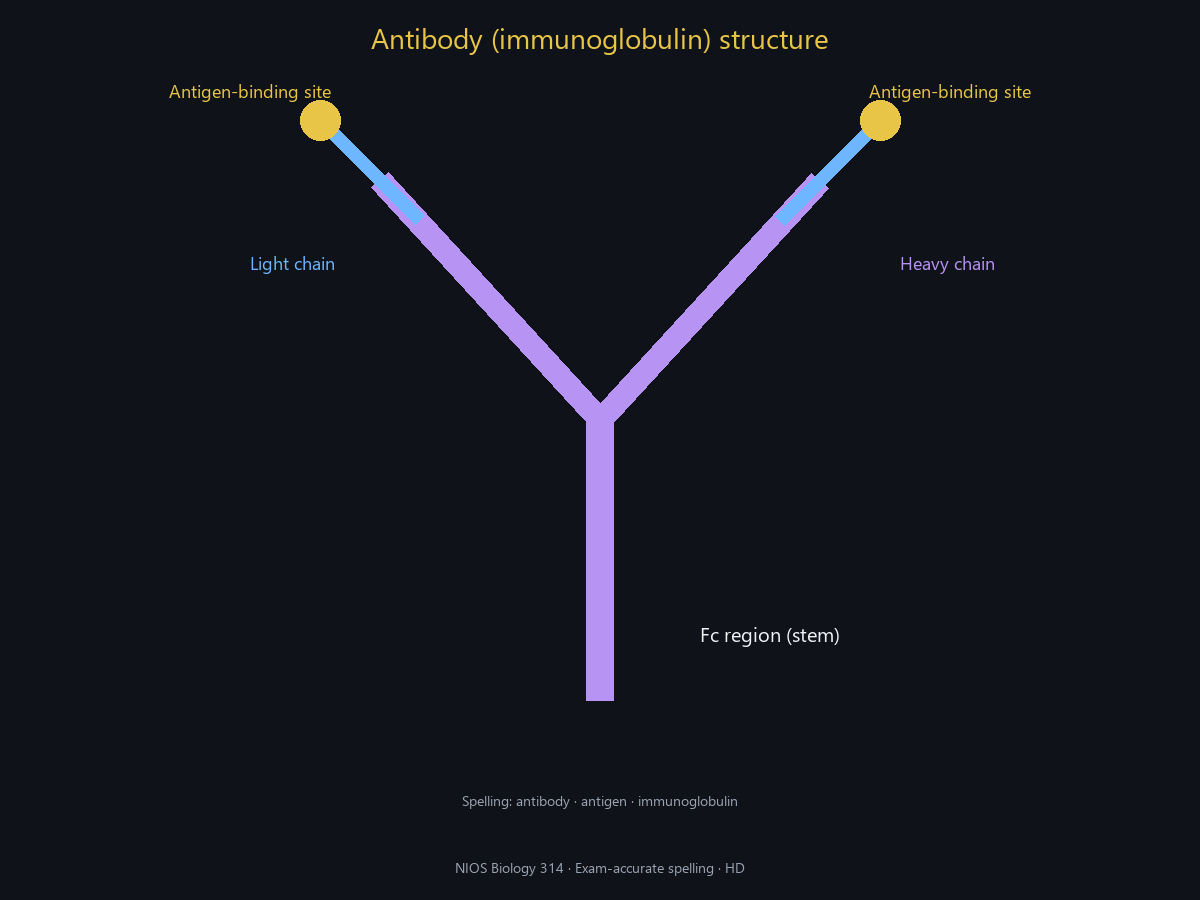
Why it clicks: Two sticky hands (bind antigen) + one handle (Fc).
Q4. (a) Write the names of any two immunodeficiency disorders and give the cause of the disease. (b) Name the two major types of lymphocytes. State where they develop and mature. (H)
Why it clicks: Primary genetic vs acquired viral immunodeficiency.
Q5. Name the cells that are seen in the lymph nodes and attack bacteria
Why it clicks: Lymph nodes are packed with lymphocytes (B and T cells) that target pathogens (L15/L31). Erythrocytes carry O₂; they do not attack bacteria.
Q6. Identify the immunoglobulin found in highest concentration in our body
Why it clicks: IgG is most abundant antibody class.
Q7. Fill in the spaces A and B in the sentences given below: 2 (a) Cell mediated immune response is mediated by (b) Humoral immune responses is mediated by B
Why it clicks: T cells cell-mediated; B cells antibodies.
Q8. (a) What are the two specific immune responses we develop in our body when we are infected?
Why it clicks: Two arms of adaptive immunity.
Problem Solving — L31 Immunobiology
Six problems spanning this chapter’s NIOS Biology (314) syllabus. Every question is built from the notes and formula sheet: solve with definitions and equations first, then read the formal textbook-style write-up, the easy explanation, and the topic in depth (key relations, meaning, exam tips). If the question says draw, a labelled pencil sketch is provided. Explanations open by default.
Differentiate innate and adaptive immunity with one example each.
Solution — step by step
- Innate: barriers, phagocytes, inflammation — rapid, non-specific (e.g. skin, macrophages).
- Adaptive: B/T lymphocytes — specific antibodies/cell-mediated + memory (e.g. vaccine response).
Final answer: Innate fast nonspecific; adaptive specific with memory
Key relations / definitions
Textbook formal language
Both arms cooperate to eliminate pathogens.
Key relations: Innate: nonspecific, immediate; Adaptive: specific, memory. State the definition or law first (NIOS style), use correct biological terms, and end with a clear boxed conclusion.
Easy language (same idea, plain words)
First wall is general guards; later elite units remember the enemy.
Read the question once for the idea, once for the details. Write the definition or equation, then apply it. Check labels and units if any numbers appear.
Topic in depth — Innate vs adaptive
Vaccines train adaptive memory.
Linked to chapter notes (L31). Remember: Innate: nonspecific, immediate; Adaptive: specific, memory. Most exam errors mix up similar terms, reverse cause and effect, or skip labelled diagrams.
Exam tip
Open with a one-line definition, then use: Innate: nonspecific, immediate; Adaptive: specific, memory. For diagram questions, label every part asked and keep lines neat.
Common mistakes
- Confusing prokaryote with eukaryote (or plant with animal tissues).
- Mixing up similar pathways (e.g. photosynthesis vs respiration; mitosis vs meiosis).
- Writing vague answers without key technical terms from NIOS notes.
- Forgetting to label diagrams or state units where numbers are used.
Define antigen and antibody.
Solution — step by step
- Antigen: substance that can trigger an immune response (often foreign).
- Antibody: protein (Ig) produced by B cells that specifically binds antigen.
Final answer: Antigen triggers; antibody binds specifically
Key relations / definitions
Textbook formal language
Epitope is the part of antigen recognised by antibody/TCR.
Key relations: Antigen: foreign molecule eliciting response; Antibody: immunoglobulin binds antigen. State the definition or law first (NIOS style), use correct biological terms, and end with a clear boxed conclusion.
Easy language (same idea, plain words)
Antigen is the invader flag; antibody is the custom lock-on protein.
Read the question once for the idea, once for the details. Write the definition or equation, then apply it. Check labels and units if any numbers appear.
Topic in depth — Antigen and antibody
Not all foreign molecules are strong antigens.
Linked to chapter notes (L31). Remember: Antigen: foreign molecule eliciting response; Antibody: immunoglobulin binds antigen. Most exam errors mix up similar terms, reverse cause and effect, or skip labelled diagrams.
Exam tip
Open with a one-line definition, then use: Antigen: foreign molecule eliciting response; Antibody: immunoglobulin binds antigen. For diagram questions, label every part asked and keep lines neat.
Common mistakes
- Confusing prokaryote with eukaryote (or plant with animal tissues).
- Mixing up similar pathways (e.g. photosynthesis vs respiration; mitosis vs meiosis).
- Writing vague answers without key technical terms from NIOS notes.
- Forgetting to label diagrams or state units where numbers are used.
What do B lymphocytes differentiate into to secrete antibodies? Role of helper T cells?
Solution — step by step
- Plasma cells secrete antibodies.
- Helper T cells help activate B cells and other immune cells via cytokines.
Final answer: Plasma cells; helpers coordinate response
Key relations / definitions
Textbook formal language
Adaptive cellular players have specialised roles.
Key relations: B cells → plasma cells → antibodies; T cells: helper/cytotoxic. State the definition or law first (NIOS style), use correct biological terms, and end with a clear boxed conclusion.
Easy language (same idea, plain words)
B cells become antibody factories; helper T cells are the coaches.
Read the question once for the idea, once for the details. Write the definition or equation, then apply it. Check labels and units if any numbers appear.
Topic in depth — Lymphocytes
HIV targets helper T cells—why AIDS cripples immunity.
Linked to chapter notes (L31). Remember: B cells → plasma cells → antibodies; T cells: helper/cytotoxic. Most exam errors mix up similar terms, reverse cause and effect, or skip labelled diagrams.
Exam tip
Open with a one-line definition, then use: B cells → plasma cells → antibodies; T cells: helper/cytotoxic. For diagram questions, label every part asked and keep lines neat.
Common mistakes
- Confusing prokaryote with eukaryote (or plant with animal tissues).
- Mixing up similar pathways (e.g. photosynthesis vs respiration; mitosis vs meiosis).
- Writing vague answers without key technical terms from NIOS notes.
- Forgetting to label diagrams or state units where numbers are used.
How does a vaccine protect without causing the full disease (ideal case)?
Solution — step by step
- Presents antigen safely (killed/attenuated/subunit/mRNA etc.).
- Triggers primary response and memory; later real infection meets secondary rapid response.
Final answer: Safe antigen → memory; faster later defence
Key relations / definitions
Textbook formal language
Herd immunity reduces transmission when coverage is high.
Key relations: Stimulate memory without disease; Active artificial immunity. State the definition or law first (NIOS style), use correct biological terms, and end with a clear boxed conclusion.
Easy language (same idea, plain words)
Vaccine is a practice drill so real germs meet prepared memory cells.
Read the question once for the idea, once for the details. Write the definition or equation, then apply it. Check labels and units if any numbers appear.
Topic in depth — Vaccination principle
Passive immunity (antibodies given) is temporary—different from vaccine.
Linked to chapter notes (L31). Remember: Stimulate memory without disease; Active artificial immunity. Most exam errors mix up similar terms, reverse cause and effect, or skip labelled diagrams.
Exam tip
Open with a one-line definition, then use: Stimulate memory without disease; Active artificial immunity. For diagram questions, label every part asked and keep lines neat.
Common mistakes
- Confusing prokaryote with eukaryote (or plant with animal tissues).
- Mixing up similar pathways (e.g. photosynthesis vs respiration; mitosis vs meiosis).
- Writing vague answers without key technical terms from NIOS notes.
- Forgetting to label diagrams or state units where numbers are used.
Classify: (i) recovery from measles (ii) antiserum for snake bite — active or passive?
Solution — step by step
- (i) Active natural.
- (ii) Passive artificial (ready antibodies).
Final answer: Active natural; passive artificial
Key relations / definitions
Textbook formal language
Duration and memory differ: active long; passive short.
Key relations: Active: host makes response/memory; Passive: ready antibodies given. State the definition or law first (NIOS style), use correct biological terms, and end with a clear boxed conclusion.
Easy language (same idea, plain words)
Your own fight builds lasting memory; borrowed antibodies fade fast.
Read the question once for the idea, once for the details. Write the definition or equation, then apply it. Check labels and units if any numbers appear.
Topic in depth — Active vs passive immunity
Maternal antibodies to infant are passive natural.
Linked to chapter notes (L31). Remember: Active: host makes response/memory; Passive: ready antibodies given. Most exam errors mix up similar terms, reverse cause and effect, or skip labelled diagrams.
Exam tip
Open with a one-line definition, then use: Active: host makes response/memory; Passive: ready antibodies given. For diagram questions, label every part asked and keep lines neat.
Common mistakes
- Confusing prokaryote with eukaryote (or plant with animal tissues).
- Mixing up similar pathways (e.g. photosynthesis vs respiration; mitosis vs meiosis).
- Writing vague answers without key technical terms from NIOS notes.
- Forgetting to label diagrams or state units where numbers are used.
Why are AIDS patients prone to opportunistic infections?
Solution — step by step
- HIV depletes helper T lymphocytes.
- Impaired adaptive immunity fails to control normally weak pathogens.
Final answer: Helper T loss → weak adaptive immunity
Key relations / definitions
Textbook formal language
Immunodeficiency can be primary or acquired (AIDS).
Key relations: Allergy: hypersensitive IgE; AIDS: HIV destroys helper T cells. State the definition or law first (NIOS style), use correct biological terms, and end with a clear boxed conclusion.
Easy language (same idea, plain words)
Without helper T coaches, the immune army collapses; weak germs invade.
Read the question once for the idea, once for the details. Write the definition or equation, then apply it. Check labels and units if any numbers appear.
Topic in depth — Allergy & AIDS
Allergy is over-reaction; AIDS is under-reaction—don’t confuse.
Linked to chapter notes (L31). Remember: Allergy: hypersensitive IgE; AIDS: HIV destroys helper T cells. Most exam errors mix up similar terms, reverse cause and effect, or skip labelled diagrams.
Exam tip
Open with a one-line definition, then use: Allergy: hypersensitive IgE; AIDS: HIV destroys helper T cells. For diagram questions, label every part asked and keep lines neat.
Common mistakes
- Confusing prokaryote with eukaryote (or plant with animal tissues).
- Mixing up similar pathways (e.g. photosynthesis vs respiration; mitosis vs meiosis).
- Writing vague answers without key technical terms from NIOS notes.
- Forgetting to label diagrams or state units where numbers are used.